Posts tagged as:

Sherwin Siy, Vice President of Legal Affairs at Public Knowledge, discusses emerging issues in digital copyright policy. He addresses the Department of Commerce’s recent green paper on digital copyright, including the need to reform copyright laws in light of new technologies. This podcast also covers the DMCA, online streaming, piracy, cell phone unlocking, fair use recognition, digital ownership, and what we’ve learned about copyright policy from the SOPA debate.

Download

Related Links

In the ongoing copyright debates, areas of common ground are seemingly few and far between. It’s easy to forget that not all approaches to combating copyright infringement are mired in controversy. One belief that unites many stakeholders across the spectrum is that more efforts are needed to educate Internet users about copyright. The Internet has spawned legions of amateur content creators, but not all of the content that’s being created is original. Indeed, a great deal of online copyright infringement owes to widespread ignorance of copyright law and its penalties.

For its part, Google yesterday unveiled “Copyright School” for YouTube users. As Justin Green explains on the official YouTube blog, users whose accounts have been suspended for allegedly uploading infringing content will be required to watch this video and then correctly answer questions about it before their account will be reinstated:

http://www.youtube.com/v/InzDjH1-9Ns?version=3

Of course, boiling down the basics of copyright into a four and a half minute video is not an easy task, to put it mildly. (The authoritative treatment of copyright law, Nimmer on Copyright, fills an 11-volume treatise.) Copyright geeks and fans of “remix culture” will appreciate that Google’s video touches on fair use and includes links to in-depth resources for users to learn more about copyright. It will be interesting to see how Google’s effort influences the behavior of YouTube users and the incidence of repeat infringement.

Continue reading →

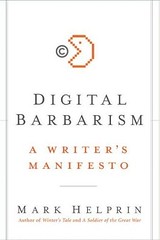
Last month, Digital Barbarism book cover National Review magazine published a review that I penned of Mark Helprin’s new book, Digital Barbarism: A Writer’s Manifesto.  Helprin’s book is both a passionate defense of copyright law as well as a mini-autobiography.  Helprin is one of the great novelists and essayists of the past half-century, and his book A Soldier of a Great War is one of my all-time favorite novels.  I cannot in strong enough words encourage you to read that book; it is profoundly moving. (I almost named my son after the lead character in the book!)

Thus, I was quite excited when I learned that Helprin had penned a defense of copyright and I jumped at the chance to review it when the folks at National Review asked me to do so.  Alas, as you will see in my review, I was terribly disappointed.  I wish Helprin would have stuck with the very reasonable tone he adopted in this excellent podcast interview he did recently with John J. Miller of National Review Online. Unfortunately, he went a different direction in the book, as I make clear in my review:


National Review July 20, 2009

“Man, Machine, and Copyright” a review of Digital Barbarism: A Writer’s Manifesto, by Mark Helprin by Adam Thierer

It would be difficult to think of anyone more ideally suited to pen a passionate defense of copyright law than novelist Mark Helprin.  Helprin has written several of the finest works of modern literature, including his masterpiece, A Soldier of the Great War, a narrative of transcendent beauty. In Digital Barbarism, Helprin sets out to use his formidable gift for the written word to repel the “cyber mob” that has attacked copyright law and called for its curtailment, or even abolition.

Unfortunately, while Helprin occasionally rises to great heights in his defense of copyright, he too often sinks to lamentable lows — by resorting to the same unbecoming rhetorical tactics used by the mob he seeks to condemn. Indeed, his book is filled with gratuitous vitriol and neo-Luddite ramblings about the Internet and Information Age that severely detract from his defense of copyright. This is a shame, because, in places, Digital Barbarism makes a fine case against those critics who wrongly view copyright as an impediment to the creation and diffusion of content. “The availability of information is not and will not be restrained by the copyright system any more than it is or will be restrained by the delivery systems that make it possible,” Helprin argues. Why, he asks, “must ‘content’ be free” when everything else — access to the Internet, digital devices, etc. — costs good money? He notes that the movement that advocates “free,” universal access to all copyrighted material in the name of “openness” and “the public good” would, ironically, “destroy the dream it advocates”: Continue reading →

A U.S. district judge got it right yesterday when he refused to dismiss a lawsuit against Universal, ruling that copyright holders should take into account fair use prior to issuing DMCA takedown notices. The dispute arose last year when a woman received a takedown notice over a YouTube video featuring a kid dancing to a Prince song owned by Universal.

Over at Ars, fellow TLFer Tim Lee has a good overview of the issue in which he explains how the various legal arguments played out. EFF, which represents the plaintiff in the case, offered several compelling reasons why ignoring fair use in a takedown notice might actually constitute “bad faith” under the DMCA.

As Cord discussed a few months ago, my employer, the Competitive Enterprise Institute, recently received a meritless takedown notice for a global warming ad we posted on YouTube which featured about seven seconds from a copyrighted video clip. Our use of a trivial portion of a copyrighted video was clearly both transformative and non-commercial, yet the content owner still deemed it worthwhile to try to get the video removed.

Continue reading →

There’s been a lot of FUD floating around about the MPAA’s plan to offer new release films for cable subscribers to watch at home on pay-per-view channels. Currently, movies come out on DVD about four months after their theatrical release, and are typically available on pay-per-view a month or two thereafter. As box office receipts have waned, Hollywood has warmed to the idea of letting consumers watch movies at home just a few weeks after being released in theaters.

Due to piracy concerns, new movies would be subject to an extra layer of copy protection. The movie studios want to use a technology called Selectable Output Control (SOC) to prevent new release films from being viewed on analog outputs. SOC makes it possible to seal the “analog hole” by disabling all unprotected paths.

Consumers are willing to pay to watch new movies at home, and content producers are willing to transmit them, but government is standing in the way. FCC regulations forbid multi-channel video programming distributors from activating SOC, but firms may apply for a waiver from these rules if they can demonstrate that consumers stand to benefit. The MPAA has applied for a waiver, arguing that “These new Services are exactly the type of ‘new business models’ that the Commission contemplated when it adopted the encoding rules.”

Under Section 304 of the Telecommunications Act of 1996, the FCC is tasked with “assuring commercial consumer availability of equipment used to access services provided by multichannel video programming distributors.” FCC regulations, therefore, mandate that all video transmitted on cable TV must be viewable on all outputs, including legacy analog connectors like RCA and S-Video. In a 2003 Notice of Proposed Rulemaking, the FCC stated that, “we are concerned that selectable output control would harm those ‘early adopters’ whose DTV equipment only has component analog inputs for high definition display, placing these consumers at risk of being completely shut off from the high-definition content they expect to receive.”

But it’s expected that early adopters will sometimes encounter technical hurdles. Why should Selective Output Control be any different? Just as HD-DVD players are effectively obsolete, and K56flex modems are no longer supported by most dial-up ISPs, people who bought HDTVs several years ago prior to the adoption of HDCP might have to live without the ability to watch new release movies at home.

Continue reading →