Is code speech? That is one of the timeless questions that comes up again and again in the field of Internet law and policy. Many books and countless papers and essays have touched on this topic. Personally, I’ve always thought it was a bit silly that this is even a serious question. After all, if code isn’t speech, what the heck is it?
We humans express ourselves in many creative ways. We speak and write. We sing and dance. We paint and sculpt. And now we code. All these things are forms of human expression. Under American First Amendment jurisprudence, expression is basically synonymous with speech. We very tightly limit restrictions on speech and expression because it is a matter of personal autonomy and also because we believe that there is a profound danger of the proverbial slippery slope kicking in once we allow government officials to start censoring what they regard as offensive speech or dangerous expression.
Thus, we when creative people come up with creative thoughts and use computers and software to express them in code, that is speech. It is fundamentally no different than using a pencil and pad of paper to write a manifesto, or using a guitar and microphone to sing a protest song. The authorities might not like the resulting manifesto or protest song–in fact, they might feel quite threatened by it–but that fact also makes it clear why, in both cases, that expression
is speech and that speech is worth defending. Moreover, the methods or mediums of speech production and dissemination–pencils, paper, guitars, microphones, etc.–are what Ithiel de Sola Pool referred to as “Technologies of Freedom.” They help people extend their voices and to communicate with the world, while also learning more about it.
Which brings us to the 3D printers and the code behind the open source blueprints that many people share to fabricate things with 3D printers. Continue reading →
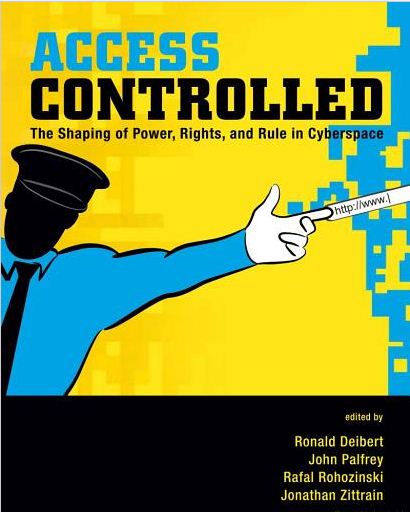
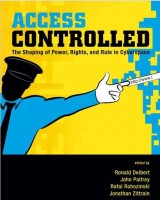 Faithful readers know of my geeky love for tech policy books. I read lots of ’em. There’s a steady stream of Amazon.com boxes that piles up on my doorstop some days because my mailman can’t fit them all in my mailbox. But I go pretty hard on all the books I review. It’s rare for me pen a glowing review. Occasionally, however, a book will come along that I think is both worthy of your time and which demands a place on your bookshelf because it is such an indispensable resource. Access Controlled: The Shaping of Power, Rights, and Rule in Cyberspace is one of those books.
Smartly organized and edited by Ronald J. Deibert, John G. Palfrey, Rafal Rohozinski, and Jonathan Zittrain, Access Controlled is essential reading for anyone studying the methods governments are using globally to stifle online expression and dissent. As I noted of their previous edition, Access Denied: The Practice and Policy of Global Internet Filtering, there is simply no other resource out there like this; it should be required reading in every cyberlaw or information policy program.
The book, which is a project of the OpenNet Initiative (ONI), is divided into two parts. Part 1 of the book includes six chapters on “Theory and Analysis.” They are terrifically informative essays, and the editors have made them all available online here (I’ve listed them down below with links embedded). The beefy second part of the book provides a whopping 480 pages(!) of detailed regional and country-by-country overviews of the global state of online speech controls and discuss the long-term ramifications of increasing government meddling with online networks.
In their interesting chapter on “Control and Subversion in Russian Cyberspace,” Deibert and Rohozinski create a useful taxonomy to illustrate the three general types of speech and information controls that states are deploying today. What I find most interesting is how, throughout the book, various authors document the increasing movement away from “first generation controls,” which are epitomized by “Great Firewall of China”-like filtering methods, and toward second- and third-generation controls, which are more refined and difficult to monitor. Here’s how Deibert and Rohozinski define those three classes (or “generations”) of controls: Continue reading →
 This morning at the Newseum in Washington, DC, U.S. Secretary of State Hillary Rodham Clinton delivered remarks on Internet freedom and the future of global free speech and expression. [Transcript is here + video.] It will go down as a historic speech in the field of Internet policy since she drew a bold line in the cyber-sand regarding exactly where the United States stands on global online freedom. Clinton’s answer was unequivocal: “Both the American people and nations that censor the Internet should understand that our government is committed to helping promote Internet freedom.” “The Internet can serve as a great equalizer,” she argued. “By providing people with access to knowledge and potential markets, networks can create opportunities where none exist.”
Unfortunately, however, “the same networks that help organize movements for freedom… can also be hijacked by governments to crush dissent and deny human rights.” Echoing Winston Churchill’s famous “iron curtain” speech, Sec. Clinton argued that “With the spread of these restrictive practices, a new information curtain is descending across much of the world.” She noted that virtual walls are replacing traditional walls in many nations as repressive regimes seek to squash the liberties of their citizenry. That’s why the Administration’s bold stand in favor of online freedom is so essential.
Importantly, Sec. Clinton made it clear that the Obama Administration is ready to commit significant resources to this effort. She said that, over the next year, the State Department plans to work with others to establish a standing effort to promote technology and will invite technologists to help advance the cause through a new “innovation competition” that will promote circumvention technologies and other technologies of freedom. Sec. Clinton also challenged private companies to stand up to censorship globally and challenge foreign governments when they demand controls on the free flow of information or digital technology.
That is particularly important because Secretary Clinton’s speech comes on the heels of the recent news that Google and at least 30 other Internet companies were the victims of cyberattacks in China, which raises profound questions about the future of online freedom and cybersecurity. Sec. Clinton’s remarks will make it clear to online operators that the U.S. government stands prepared to back them up when they challenge the censorial policies of repressive foreign regimes.
Continue reading →
One of the more troubling aspects of the contentious debate over Net neutrality regulation is the way some proponents have sought to cast Net neutrality as “the Internet’s First Amendment.” As a die-hard free speech advocate, I find this truly outrageous and a complete contortion of the true purpose of the First Amendment. As I have argued here before, it is incredibly dangerous thinking that puts our real First Amendment liberties at stake by empowering a regulatory agency with more means of controlling online speech and expression. Simply stated, the Internet’s First Amendment is the First Amendment, not some new, top-down, heavy-handed regulatory regime that puts the Federal Communications Commission in control of the Digital Economy.
On this point, I wanted to bring two things to your attention. The first is an outstanding address delivered today by Kyle McSlarrow, President & CEO of the National Cable & Telecommunications Association, at a Media Institute event here in Washington, DC. And the second is this new paper by my PFF colleague Barbara Esbin.
McSlarrow’s speech was entitled, “Net Neutrality: First Amendment Rhetoric in Search of the Constitution” and it squarely addressed the fundamental fallacy set forth by the Net neutralitistas when it comes to the First Amendment. “Whatever our present-day policy disagreements about net neutrality, or even differing politics, let’s not forget that the First Amendment is framed as a shield for citizens, not a sword for government,” he argued. “By its plain terms and history, the First Amendment is a limitation on government power, not an empowerment of government,” McSlarrow said. “And… if there’s one thing the Supreme Court has made clear, it’s that rules that directly restrict protected speech cannot be justified by a government interest that is merely hypothetical.”
Absolutely correct. And these views are buttressed by the comments of Barbara Esbin in her new paper, in which she argues that “Net Neutrality is not the First Amendment for the Internet.” She continues: Continue reading →
Well, I don’t often get a chance to sing the praises of Hillary Clinton, so let me take the opportunity to loudly applaud her stand on religious defamation policies, which are becoming a growing international concern. According to The Washington Post, while unveiling the State Department’s 2009 Report on International Religious Freedom:
Secretary of State Hillary Rodham Clinton criticized on Monday an attempt by Islamic countries to prohibit defamation of religions, saying such policies would restrict free speech. … While unnamed in Clinton’s speech, the Organization of the Islamic Conference, a group of 56 Islamic nations, has been pushing hard for the U.N. Human Rights Council to adopt resolutions that broadly bar the defamation of religion. The effort has raised concerns that such resolutions could be used to justify crackdowns on free speech in Muslim countries.
Here’s specifically what Secretary Clinton had to say:
some claim that the best way to protect the freedom of religion is to implement so-called anti-defamation policies that would restrict freedom of expression and the freedom of religion. I strongly disagree. The United States will always seek to counter negative stereotypes of individuals based on their religion and will stand against discrimination and persecution. But an individual’s ability to practice his or her religion has no bearing on others’ freedom of speech. The protection of speech about religion is particularly important since persons of different faiths will inevitably hold divergent views on religious questions. These differences should be met with tolerance, not with the suppression of discourse.
Quite right. Thank you, Secretary Clinton, for this bold stand. Freedom of religious worship and expression — including the criticism of religion — is essential. Now, can we talk about your old positions on video game regulation?!
http://c.brightcove.com/services/viewer/federated_f8/1705667530
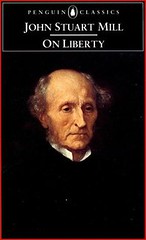 John Stuart Mill’s On Liberty turns 150 this year. Published in 1859, this slender manifesto for human liberty went on to become a classic of modern philosophy and political science. It remains a beautiful articulation of the core principles of human liberty and a just society.
Anyone familiar with the book recognizes the importance of the opening chapter and Mill’s “one very simple principle” for “the dealings of society with the individual in the way of compulsion and control, whether the means used be physical force in the form of legal penalties, or the moral coercion of public opinion”:
That principle is, that the sole end for which mankind are warranted, individually or collectively, in interfering with the liberty of action of any of their number, is self-protection. That the only purpose for which power can be rightfully exercised over any member of a civilized community, against his will, is to prevent harm to others. His own good, either physical or moral, is not a sufficient warrant. He cannot rightfully be compelled to do or forbear because it will be better for him to do so, because it will make him happier, because, in the opinions of others, to do so would be wise, or even right. These are good reasons for remonstrating with him, or reasoning with him, or persuading him, or entreating him, but not for compelling him, or visiting him with any evil in case he do otherwise. To justify that, the conduct from which it is desired to deter him, must be calculated to produce evil to some one else. The only part of the conduct of any one, for which he is amenable to society, is that which concerns others. In the part which merely concerns himself, his independence is, of right, absolute. Over himself, over his own body and mind, the individual is sovereign.
Mill went on to outline “the appropriate region of human liberty,” and divided it into:
- “liberty of conscience, in the most comprehensive sense; liberty of thought and feeling; absolute freedom of opinion and sentiment on all subjects, practical or speculative, scientific, moral, or theological. The liberty of expressing and publishing opinions may seem to fall under a different principle, since it belongs to that part of the conduct of an individual which concerns other people; but, being almost of as much importance as the liberty of thought itself, and resting in great part on the same reasons, is practically inseparable from it.”
- “liberty of tastes and pursuits; of framing the plan of our life to suit our own character; of doing as we like, subject to such consequences as may follow: without impediment from our fellow-creatures, so long as what we do does not harm them, even though they should think our conduct foolish, perverse, or wrong”
- “freedom to unite, for any purpose not involving harm to others”
Bringing it altogether, he argued:
The only freedom which deserves the name, is that of pursuing our own good in our own way, so long as we do not attempt to deprive others of theirs, or impede their efforts to obtain it. Each is the proper guardian of his own health, whether bodily, or mental and spiritual. Mankind are greater gainers by suffering each other to live as seems good to themselves, than by compelling each to live as seems good to the rest.
To this day, I do not believe there has been a more eloquent or concise summation of the central principles of libertarianism than those passages from Chapter 1 of the book.
But what many fail to remember or appreciate is the equally powerful second chapter of Mill’s treatise, “On the Liberty of Thought and Discussion.” It was a bold defense of freedom of speech and expression that was many decades ahead of its time. And it still has lessons and warnings worth heeding in our modern Information Age.
Continue reading →
With today’s historic Supreme Court decision in FCC v. Fox, I have been commenting on the logic and implications of the decision. Part 3 dealt with the majority’s decision in the case, which was driven solely by procedural / admin law considerations. This installment will discuss the very interesting concurring opinion penned by Justice Thomas, which is the only one that takes a serious look at the constitutional foundations of the FCC’s current regulatory regime. While I was sad to see Justice Thomas join the majority’s decision upholding the FCC’s radical expansion of speech regulation in recent years, he joined that majority only on straightforward procedural grounds. On the underlying constitutional issues at stake here, it is clear from his concurring statement that he is ready for the Court to hear a challenge to the previous court precedents and traditional regulatory doctrines that have long supported FCC speech and media controls.
“I write separately,” Justice Thomas says “to note the questionable viability of the two precedents that support the FCC’s assertion of constitutional authority to regulate the programming at issue in this case.” Specifically, he addresses the two key cases upon which almost all FCC speech regulation rests: Red Lion Broadcasting Co. v. FCC, 395 U. S. 367 (1969) and FCC v. Pacifica Foundation, 438 U. S. 726 (1978). Thomas continues: “Red Lion and Pacifica were unconvincing when they were issued, and the passage of time has only increased doubt regarding their continued validity.”
BOOM! With those words, Justice Thomas has dropped the hammer and taken what will hopefully be the first swing at toppling the house of cards that is modern FCC speech regulation. Justice Thomas goes on to itemize the many problems with what I have referred to as “America’s Jurisprudential Twilight Zone” when it comes to how we apply the First Amendment to media platforms in this country. He states:
Continue reading →
Doug Feaver, a former Washington Post reporter and editor, has published a very interesting editorial today entitled “Listening to the Dot-Commenters.” In the piece, Feaver discusses his personal change of heart about “the anonymous, unmoderated, often appallingly inaccurate, sometimes profane, frequently off point and occasionally racist reader comments that washingtonpost.com allows to be published at the end of articles and blogs.” When he worked at the Post, he fought to keep anonymous and unmoderated comments off the WP.com site entirely because it was too difficult to pre-screen them all and “the bigger problem with The Post’s comment policy, many in the newsroom have told me, is that the comments are anonymous. Anonymity is what gives cover to racists, sexists and others to say inappropriate things without having to say who they are.”
But Feaver now believes those anonymous, unmoderated comment have value because:
I believe that it is useful to be reminded bluntly that the dark forces are out there and that it is too easy to forget that truth by imposing rules that obscure it. As Oscar Wilde wrote in a different context, “Man is least in himself when he talks in his own person. Give him a mask, and he will tell you the truth.” Too many of us like to think that we have made great progress in human relations and that little remains to be done. Unmoderated comments provide an antidote to such ridiculous conclusions. It’s not like the rest of us don’t know those words and hear them occasionally, depending on where we choose to tread, but most of us don’t want to have to confront them.
It seems a bit depressing that the best argument in favor of allowing unmoderated, anonymous comments is that it allows us to see the dark underbelly of mankind, but the good news, Feaver points out, is that:
But I am heartened by the fact that such comments do not go unchallenged by readers. In fact, comment strings are often self-correcting and provide informative exchanges. If somebody says something ridiculous, somebody else will challenge it. And there is wit.
He goes on to provide some good examples. And he also notes how unmoderated comments let readers provide their heartfelt views on the substance of sensitive issues and let journalists and editorialists know how they feel about what is being reported or
how it is being reported. “We journalists need to pay attention to what our readers say, even if we don’t like it,” he argues. “There are things to learn.”
Continue reading →

 The Technology Liberation Front is the tech policy blog dedicated to keeping politicians' hands off the 'net and everything else related to technology.
Anonymity, Reader Comments & Section 230
by Adam Thierer on April 9, 2009 · 18 comments
Doug Feaver, a former Washington Post reporter and editor, has published a very interesting editorial today entitled “Listening to the Dot-Commenters.” In the piece, Feaver discusses his personal change of heart about “the anonymous, unmoderated, often appallingly inaccurate, sometimes profane, frequently off point and occasionally racist reader comments that washingtonpost.com allows to be published at the end of articles and blogs.” When he worked at the Post, he fought to keep anonymous and unmoderated comments off the WP.com site entirely because it was too difficult to pre-screen them all and “the bigger problem with The Post’s comment policy, many in the newsroom have told me, is that the comments are anonymous. Anonymity is what gives cover to racists, sexists and others to say inappropriate things without having to say who they are.”
But Feaver now believes those anonymous, unmoderated comment have value because:
It seems a bit depressing that the best argument in favor of allowing unmoderated, anonymous comments is that it allows us to see the dark underbelly of mankind, but the good news, Feaver points out, is that:
He goes on to provide some good examples. And he also notes how unmoderated comments let readers provide their heartfelt views on the substance of sensitive issues and let journalists and editorialists know how they feel about what is being reported or how it is being reported. “We journalists need to pay attention to what our readers say, even if we don’t like it,” he argues. “There are things to learn.”
Continue reading →