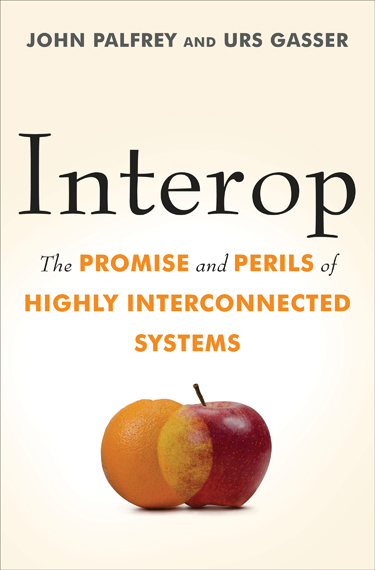
 I’m pretty rough on all the Internet and info-tech policy books that I review. There are two reasons for that. First, the vast majority of tech policy books being written today should never have been books in the first place. Most of them would have worked just fine as long-form (magazine-length) essays. Too many authors stretch a promising thesis into a long-winded, highly repetitive narrative just to say they’ve written an entire book about a subject. Second, many info-tech policy books are poorly written or poorly argued. I’m not going to name names, but I am frequently unimpressed by the quality of many books being published today about digital technology and online policy issues.
The books of Harvard University cyberlaw scholars John Palfrey and Urs Gasser offer a welcome break from this mold. Their recent books, Born Digital: Understanding the First Generation of Digital Natives, and Interop: The Promise and Perils of Highly Interconnected Systems, are engaging and extremely well-written books that deserve to be books. There’s no wasted space or mindless filler. It’s all substantive and it’s all interesting. I encourage aspiring tech policy authors to examine their works for a model of how a book should be done.
In a 2008 review, I heaped praise on Born Digital and declared that this “fine early history of this generation serves as a starting point for any conversation about how to mentor the children of the Web.” I still recommend highly to others today. I’m going to be a bit more critical of their new book, Interop, but I assure you that it is a text you absolutely must have on your shelf if you follow digital policy debates. It’s a supremely balanced treatment of a complicated and sometimes quite contentious set of information policy issues.
In the end, however, I am concerned about the open-ended nature of the standard that Palfrey and Gasser develop to determine when government should intervene to manage or mandate interoperability between or among information systems. I’ll push back against their amorphous theory of “optimal interoperability” and offer an alternative framework that suggests patience, humility, and openness to ongoing marketplace experimentation as the primary public policy virtues that lawmakers should instead embrace. Continue reading →
Check out “Magic Flute: Primal Find Sings of Music’s Mystery” in yesterday’s WSJ. The article describes the development of music as a central part of what Jacob Bronowski called the “Ascent of Man“:
“I believe that before we evolved language, our communication was more musical than it is now,” says cognitive archaeologist Steven Mithen at the University of Reading in England, author of “The Singing Neanderthals: The Origins of Music, Language, Mind and Body.” Unlike Darwin, Dr. Mithen is convinced that music was crucial to human survival. “Using music to express emotion or build a sense of group belonging would have been essential to the function of human society, especially before language evolved prior to modern humans.”
The discovery of the world’s oldest musical instrument—a 35,000-year-old flute made from a wing bone—highlights a prehistoric moment when the mind learned to soar on flights of melody and rhythm.
Researchers announced last week in Nature that they had unearthed the flute from the Ice Age rubbish of cave bear bones, reindeer horn and stone tools discarded in a cavern called Hohle Fels near Ulm, Germany. No one knows the melodies that were played in this primordial concert hall, which sheltered the humans who first settled Europe. The delicate wind instrument, though, offers evidence of how music pervaded daily life eons before iTunes, satellite radio and Muzak.
…the ability to create musical instruments reflects a profound mental awakening that gave these early humans a crucial edge over the more primitive Neanderthal people who lived in the same epoch. “The expansion of modern humans hinged in part on new ways of storing symbolic information that seemed to confer an advantage on these people in competition with Neanderthals,” Dr. Conard says.
To Dr. Patel, music-making was a conscious innovation, like the invention of writing or the control of fire. “It is something that we humans invented that then transformed human life,” he says. “It has a profound impact on how individual humans experience the world, by connecting us through space and time to other minds.”
If even something as central to our daily lives as music is, in fact the result of technological innovation over time and if technology can, as with music, change the way we think, communicate and build communities, I can’t help but wonder: What will our descendants think thousands of years from now as they look back on the rise of today’s web and social networking technologies? If nothing else, this sense of perspective should make us better appreciate how important the development of communications media really is to the future of the human species.
Impossible as it is to predict how that staggeringly complex process will unfold—
e.g., will Google make us smarter or stupider?—I’ll just humbly suggest that, rather than try to tinker with the future course of the species by trying to fine-tune public policy today to produce the “right” outcome, we would do better to follow the same principle that has guided the medical profession for 24 centuries: First, Do No Harm. In other words, if we don’t know what the effects of regulatory intervention in new media will be in the long-term, we’d be better off to leave well enough alone.

 The Technology Liberation Front is the tech policy blog dedicated to keeping politicians' hands off the 'net and everything else related to technology.