In my July essay on “Understanding The True Cost of Video Game Censorship Efforts,” I pointed out how outrageous it was that politicians continue to burn money on fruitless regulatory measures that are destined to be struck down as unconstitutional. I argued that the nearly $2 million in legal fees and expenses recovered by the video game industry after winning its legal cases against various governments could have been spent much better by public policy makers:
That $2 million in recovered legal fees could have been plowed into educational efforts to help explain to parents how to use the excellent voluntary ratings systems or console-based parental control tools that are at their disposal. Moreover, that $2 million in recovered industry legal fees does not account for the resources that state and local officials put into these regulatory efforts. So, we are talking about a much greater deadweight loss for society and taxpayers.
Well, that opportunity cost / deadweight loss grew even higher today when the state of California reimbursed the Entertainment Software Association (ESA) $282,794 for attorney’s fees after losing a recent legal battle in the case
Video Software Dealers Association v. Schwarzenegger. The ESA sent out a press release about the case today that dramatically points out the opportunity cost of such regulation:
The ESA noted that this payment comes at an especially troubling time for the state, calling to mind other pressing budgetary and legislative priorities and issues, including:
* California is currently facing a $15-billion budget gap
* More than 10,000 California state employees were laid off last week in light of the budget crisis
* Governor Schwarzenegger is seeking to cut wages for nearly 200,000 state employees
* The state already cut 10 percent to its Medicaid reimbursement rate and deferred payments to vendors
“Caregivers are not well-served by court battles and legal fees. Rather, they would have been far better off if state officials worked together with our industry to raise awareness about video game ratings and the parental controls available on all new game consoles — both of which help ensure that the games children play are parent-approved.”
Indeed. And yet, the video game censorship bandwagon rolls on. Will it never end?
 Each year the Entertainment Software Association (ESA), which represents the video game and computer game industry, produces a great little report entitled “Essential Facts About the Computer and Video Game Industry.” The 2008 edition is out and it has some interesting stats:
- 65 percent of American households play computer and video games;
- 38 percent of American homes have a video game console;
- The average game player is 35 years old;
- One out of four gamers are over age 50;
- Women age 18 or older represent a significantly greater portion of the game-playing population (33 percent) than boys age 17 or younger (18 percent); and,
- 41 percent of Americans expect to purchase one or more games this year.
Those findings make it clear that gaming really has gone mainstream. As I noted in an essay earlier this week, “gaming is now fully integrated into the fabric of my life and the lives of my children. It has become one of the most enjoyable media experiences for my generation and the generation of kids that we are raising.”
Some other important stats that have relevance for debates about public policy:
- 94 percent of parents are present when games are purchased or rented;
- 88 percent of parents report always or sometimes monitoring the games their children play; and,
- 63 percent of parents believe games are a positive part of their children’s lives.
Those are impressive numbers, and it makes it clear, as I have argued before, that parents are parenting! (And that reflects what is going on for television as well).
GamePolitics.com points out that Minnesota will reimburse the video game industry to the tune of $65,000 for their attorneys fees it incurred when challenging Minnesota’s 2006 “fine-the-buyer” law. The Minnesota law was unique in that it sought to impose fines on the buyers rather than the sellers of games rated either “M” for Mature or “AO” for Adults Only under the industry’s voluntary ratings system. Other state and local laws that have been struck down in recent years imposed penalties mostly on game retailers who sold games rated M or AO to minors. In a scathing opinion handed down back in August 2006, James M. Rosenbaum, Chief District Judge of the District Court of Minnesota, struck down the Minnesota law as unconstitutional.
But here’s what’s really important about the fact that the industry recovered legal fees in this case and others. As the Entertainment Software Association noted in its press release about the Minnesota settlement: “The ESA [has] prevailed over similar unconstitutional laws in nine other jurisdictions [and] now has been awarded close to $2 million in fees and expenses spent in defending gamers, developers and publishers’ First Amendment rights.”
As I have noted previously, these cases make it clear that there is a significant opportunity cost associated with censorship efforts. That $2 million in recovered legal fees could have been plowed into educational efforts to help explain to parents how to use the excellent voluntary ratings systems or console-based parental control tools that are at their disposal. Moreover, that $2 million in recovered industry legal fees does not account for the resources that state and local officials put into these regulatory efforts. So, we are talking about a much greater deadweight loss for society and taxpayers.
Continue reading →
Over at the popular gaming site 1up.com, a gentleman who worked briefly for the Entertainment Software Rating Board (ESRB) has posted a provocative article entitled, “How to Fix the Game Ratings System: An insider’s take on what’s wrong with the ESRB.” In the piece, Jerry Bonner, who worked at the ESRB for 6 months according to GamePolitics.com, argues that “Something desperately needs to happen [to reform the ESRB] because the alternative — a government mandated and controlled rating scheme — is a downright frightening concept.” He continues:
“let’s fix [the ESRB ratings process] before things really get out of hand and a new government-appointed ‘Secretary of Interactive Entertainment’ is making the decisions as to what we can and can’t play. I know I don’t want that. I know you don’t want that. And I know that the people at the ESRB don’t want that. Let’s all make damn sure it doesn’t happen, shall we?”
Well, I can certainly agree with Mr. Bonner that a “Secretary of Interactive Entertainment,” or any sort of extensive government regulation of video games, is a very frightening prospect. The problem is, the “solutions” he outlines in his essay could actual put us on that path.
Continue reading →
GamePolitics.com reports on a murder trial in Alabama in which the attorney for a disturbed teenager is blaming video games for his barbaric behavior:
The lawyer for a man being tried for murder is trying to convince an Alabama jury that the defendant believed he was acting out a video game when he murdered an 80-year-old man on Halloween, 2005.
As reported by the Decatur Daily, Andrew Reid Lackey, 24, does not dispute that he stabbed, shot and gouged out the eye of his victim, Charlie Newman. However, Lackey’s attorney, Randy Gladden, is pointing the finger at video games. From the newspaper report:
Actions that led to a deadly confrontation between a defendant and an 80-year-old widower resembled a video game to the accused… [Attorney] Gladden described Lackey… as a computer geek who had immersed himself in video games and lived in “a different world than you and I.”
Tapes of a 911 call made by the victim during the fatal confrontation, however, indicate that old-school greed may have been the motive. Lackey is heard to demand of the victim, ”Where’s the vault?” seven different times. Charlie Newman’s grandson had previously told Lackey that the victim kept a large sum of money in a vault under the stairs. However, no such vault existed.
It’s just disgraceful–but perhaps not all that surprising–that this desperate defense attorney would employ tactics like this. Video games have become the universal excuse
du jour for violent behavior. It’s absurd for all the reasons I have pointed out here before. It’s abundantly clear that old fashion greed and a disturbed mind motivated this particular crime, and if you think that sort of thing didn’t happen before video games came along, then you just haven’t read any history. Of course, they instead just blamed movies, comics, and books for the crimes back then! There’s always someone else or something else to blame. It’s the never-ending search for a universal scapegoat for irrational or criminal behavior. The twisted logic = Don’t blame the individual, blame the media.
Pathetic.
Anthony Prestia of Laws of Play, a blog dedicated to covering legal developments in the gaming industry, somehow got some face time with Supreme Court Justice Scalia and was able to ask for his feelings concerning the constitutionality of recent state video game legislation. “In particular,” Prestia says, “I asked him whether as an originalist he believed that state laws banning the sale of mature-rated video games to minors ran afoul of the First Amendment.” Here’s Prestia’s summary and analysis of Scalia’s answer:
In his most succinct reply of the day, Justice Scalia replied that he did believe such legislation was constitutional. He began by explaining his belief that sound constitutional precedent holds that minors may be subjected to prohibitions that adults are not–-he instantly drew the parallel to regulation of pornography sales. However, Justice Scalia emphasized that unprotected speech, such as obscenity–which he was unwilling to define for reasons that are immediately evident to any constitutional scholar–-can be prohibited from sale regardless of the purchaser’s age. I think the important thing to note here is that Justice Scalia did not suggest that violent and/or sexual content in games rises to the level of unprotected speech. In fact, he did not even suggest that video games themselves are not protected by the First Amendment despite his strict originalist beliefs.
That’s an interesting response in that Scalia’s latter comments imply that even older, more conservative judges are coming around to understanding how video games are a form of artistic expression deserving the protection of the First Amendment. But Scalia’s earlier suggestion that state laws banning sales of certain video games to minors maybe constitutional deserves a response.
Continue reading →
One of the things I find most interesting about calls to regulate “excessively violent” content on television, in movies, or in video games is the way critics make massive leaps of logic and draw outrageous conclusions based on myopic, anecdotal reasoning. I was reminded of that again today when reading through an interview with Sen. Jay Rockefeller (D-W.Va), one of the most vociferous critics of all sorts of media content and a long-time proponent of regulation to censor such violent content in particular (however it is defined). (I have written about his past regulatory proposals here and here).
Here’s what he recently told the editorial board of The Register-Herald of West Virginia:
Continue reading →
The video game industry’s string of unbroken First Amendment court victories continued this week with a win in the case of Video Software Dealers Association v. Schwarzenegger. [Decision here.] In this case, the VSDA and the Entertainment Software Association brought a suit seeking a permanent injunction against a California law passed in October 2005 (A.B.1179), which would have blocked the sale of violent video games to those under 18. Offending retailers could have been fined for failure to comply with the law.
The court’s decision overturning the law was written by Judge Ronald Whyte and it echoed what every previous decision on this front has held, namely:
Continue reading →
Some lawmakers at the federal, state and local level have advocated video game industry regulation in the name of protecting children from potentially objectionable content, usually of a violent nature. In my opinion, the better approach–and one that doesn’t involve government censorship or regulation of games–is to empower parents to better make these decisions for their own families. And the key to that effort is an effective rating / labeling system for game content that parents understand and use.
Luckily, there are good signs that the video game industry’s voluntary ratings system–the ESRB (the Entertainment Software Rating Board)–is doing exactly that. The game industry established the ESRB in 1994 and it has rated thousands of games since then. (The ESRB estimates it rates over 1,000 games per year). Virtually every title produced by major game developers for retail sale today carries an ESRB rating and content descriptors. Generally speaking, the only games that do not carry ESRB ratings today are those developed by web amateurs that are freely traded or downloaded via the Internet.
The ESRB applies seven different rating symbols and over 30 different content “descriptors” that it uses to give consumers highly detailed information about games. Thus, by simply glancing at the back of each game container, parents can quickly gauge the appropriateness of the title for their children.
So, how effective is this system, as measured by parental awareness and usage of the ESRB ratings and labels? Since 1999, the ESRB has asked Peter D. Hart Research Associates to study that question and conduct polls asking parents if they are aware of the ESRB ratings and if they use them. As this chart illustrates, the results are impressive with both awareness and use growing rapidly since 1999:
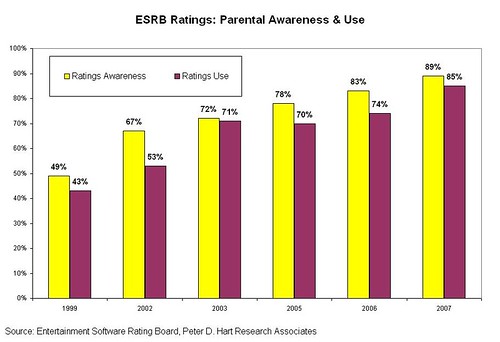
Better yet, all gaming platforms and most PCs can read these ratings and labels and allow parents to block games rated above a certain level they find unacceptable. But the real strength of the ESRB’s ratings system lies in the content descriptors, which give parents plenty of warning about what they will see or hear in each title. That way, parents can talk to their kids about those games or just not buy them for their kids until they think they are ready.
The game industry deserves credit not only for creating such an excellent content rating / labeling system, but also putting significant resources into public education / awareness efforts to ensure parents know how to take advantage of it. So then, why are lawmakers continuing to waste millions of taxpayer dollars litigating unneeded regulatory efforts?
Over at National Review Online today, Peter Suderman has a good discussion of the current state of video game politics. As usual, a lot of politicians are playing games; political games, that is. Suderman notes that:
…attacking the video-game industry has long been a favored sport amongst politicians eager to shore up their credibility with the concerned parent crowd. At the state level, at least ten laws banning the sale of certain video games to minors have been brought to life. In California, Governor Arnold Schwarzenegger, a guy who made his name hacking and slashing his enemies to a bloody pulp on the big screen, apparently didn’t want high schoolers doing digital imitations: He tried to ban the sale of violent games to minors back in 2005. Oregon is currently considering a similar law, and New York Governor Eliot Spitzer recently stated that he intends to pursue one as well. But these laws go down like a final level boss once they hit the courts. To date, not one of the dubious proposals has stood up to a court challenge.
Some lawmakers can’t even be bothered to worry about anything so insignificant as considering whether a law is constitutional. Regarding one video-game ban, Minnesota state legislator Sandy Poppas shrugged off any such responsibility, saying, “Legislators don’t worry too much about what’s constitutional. We just try to do what’s right, and we let the courts figure that out.” The recurrent bashing of the game industry tends to resemble a major league team taking on a troop of t-ballers: Politicians get to knock a couple of balls out of the park in front of parents, but the whole thing is just a show.
Indeed it is. I made a similar argument in a piece for NRO last year as well as my big PFF study, “Fact and Fiction in the Debate over Video Game Regulation.”

 The Technology Liberation Front is the tech policy blog dedicated to keeping politicians' hands off the 'net and everything else related to technology.