Wall Street Journal columnist Holman Jenkins has a terrific, wide-ranging interview with Google CEO Eric Schmidt in today’s paper that is well worth reading. One thing worth highlighting is Schmidt’s comments on the “economic disaster that is the American newspaper.” He argues that, “The only way the problem [of insufficient revenue for news gathering] is going to be solved is by increasing monetization, and the only way I know of to increase monetization is through targeted ads.”
Absolutely correct. It’s a point that Berin Szoka, Ken Ferree and I tried to make in PFF’s mega-filing in the FCC’s “Future of Media” proceeding in early May, and Berin and I stressed it in even more detail in our piece on”Chairman Leibowitz’s Disconnect on Privacy Regulation & the Future of News.” The key takeaway: If Washington goes to war against advertising — and targeted advertising in particular — then there will be no future for private news. As we stated there:
The reason for the indispensability of advertising is simple: Information (including news and other forms of “content”) has “public good” characteristics that make it is very difficult (and occasionally impossible) for information-publishers to recoup their investments. Simply put, they quite literally lack pricing power: Whatever they charge, someone else will charge less for a close substitute, inevitably leading to “free” distribution of the content, even though the content is anything but free to produce. Advertising is the one business model that has traditionally saved the day by rewarding publishers for attracting the attention of an audience.
Thus an attack on advertising is an attack on media / news itself. And yet Washington is currently engaged in an all-out assault on advertising, marketing, and data collection efforts / business models.
Incidentally, Google recently submitted comments with the Federal Trade Commission in reaction to its Staff Discussion Draft about the future of journalism and laid out their views on many of these issues. More importantly, as summarized on pg. 30 (of the pdf) of this Newspaper Association of America filing to the FTC, Google has proposed an interesting monetization model that utilizes Google Search, Google Checkout and DoubleClick ad server, “to build a premium content system for newspapers.” Worth checking out. Kudos to Google for taking these steps and to Schmidt for again stressing the importance of targeted advertising for the future of media.
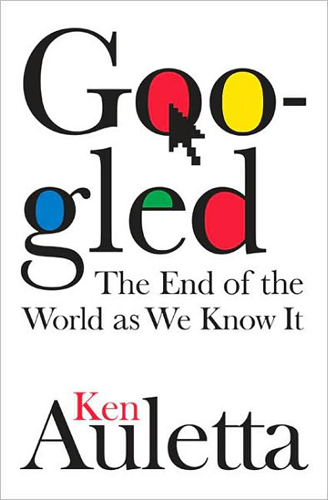 I just finished Ken Auletta’s latest book,
Googled: The End of the World As We Know It, and I highly recommend it. Auletta is an amazingly gifted journalist and knows how put together a hell of good story. It helps in this case that he was granted unprecedented access to the Google team and their day-to-day workings at the Googleplex. I’m really shocked by the level of access he was granted to important meetings and officials–over 150 interviews with Googlers, including 11 with CEO Eric Schmidt and several with founders Sergey Brin and Larry Page. That’s impressive.
I just finished Ken Auletta’s latest book,
Googled: The End of the World As We Know It, and I highly recommend it. Auletta is an amazingly gifted journalist and knows how put together a hell of good story. It helps in this case that he was granted unprecedented access to the Google team and their day-to-day workings at the Googleplex. I’m really shocked by the level of access he was granted to important meetings and officials–over 150 interviews with Googlers, including 11 with CEO Eric Schmidt and several with founders Sergey Brin and Larry Page. That’s impressive.
The book shares much in common with Randall Stross’s excellent Planet Google: One Company’s Audacious Plan to Organize Everything We Know, which I reviewed here earlier this year. Both books recount the history of Google from its early origins to present. And both survey a great deal of ground in terms of the challenges that Google faces as it matures and the policy issues that are relevant to the company (privacy, free speech, copyright law, etc).
What makes Auletta’s book unique is the way we taps his extensive “old media” world contacts and integrates such a diverse cast of characters into the narrative — Mel Karmazin (former Viacom, now Sirius XM), Bob Iger (Disney), Howard Stringer (Sony), Martin Sorrrell (WPP), Irwin Gotlieb (Group M), and even the Internet’s “inventor”–Al Gore! Auletta interviews them or recounts stories about their interactions with Google to show the growing tensions being created by this disruptive company and its highly disruptive technologies. There are some terrifically entertaining anecdotes in the book, but the bottom line is clear: Google has made a lot of enemies in a very short time.
Indeed, the book is as much about the decline of old media as it is about Google’s ascendancy. What Auletta has done so brilliantly here is to tell their stories together and ask how much old media’s recent woes can be blamed on Google and digital disintermediation in general. “If Google is destroying or weakening old business models,” Auletta argues, “it is because the Internet inevitably destroys old ways of doing things, spurs ‘creative destruction.’ This does not mean that Google is not ambitious to grow, and will not grow at the expense of others. But the rewards, and the pain, are unavoidable,” he concludes. Continue reading →
Maybe Obama should invite Google CEO Eric Schmidt and Microsoft CEO Steve Ballmer over to the White House for a beer to settle the two companies’ differences!
http://www.youtube.com/v/Q0umKaGxkkE
While he’s at it, Obama might want to invite Apple CEO Steve Jobs, too, since the common cause Apple and Google once made against Microsoft now seems to be giving way to increased rivalry between the two titans of Internet cool. Or how about Facebook CEO Mark Zuckerberg, given Facebook’s growing challenge to Google? Yahoo!’s Carol Bartz seems to get along much better with everyone than the boys in the group, so she’d probably help Obama keep things under control.
The Internet industry’s war-of-all-against-all is reminiscent of Tom Lehrer‘s classic 1960s satire “National Brotherhood Week”:
http://www.youtube.com/v/aIlJ8ZCs4jY
Continue reading →
 Google recently experienced failures of its core services — a phenomenon that quickly spawned the hashtag “googlefail” on the popular social networking platform Twitter. These failures show that a company once thought of as the odds-on favorite for dominating the global market in all things web — the monolith of Mountain View — is looking more and more like a search-only player.
Big firms consistently fail to use their “market dominance” to take over adjacent markets, something that should give antitrust warriors in the Obama administration reason for pause. The renewed call for tough antitrust enforcement comes at a time when Google, a poster-child for market dominance, simply can’t leverage its position at all.
Continue reading →

 The Technology Liberation Front is the tech policy blog dedicated to keeping politicians' hands off the 'net and everything else related to technology.