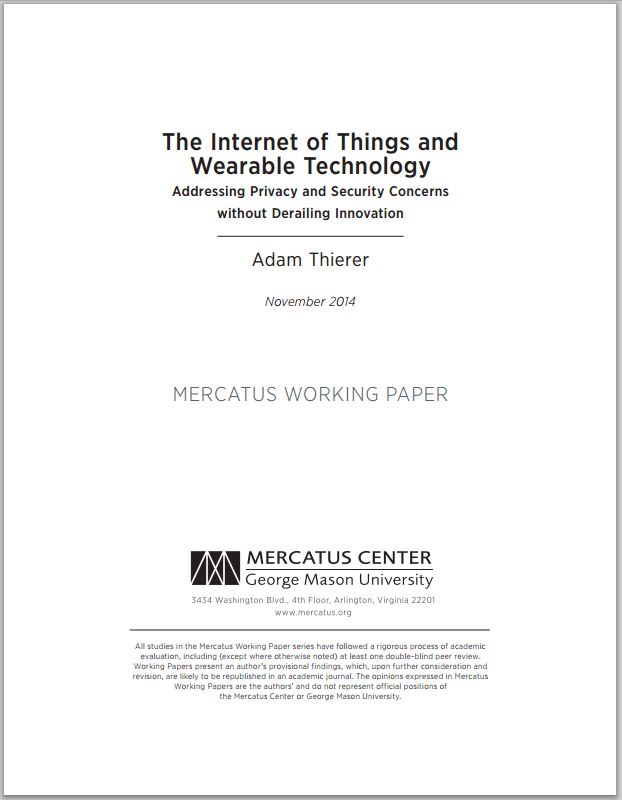
 The Mercatus Center at George Mason University has just released my latest working paper, “The Internet of Things and Wearable Technology: Addressing Privacy and Security Concerns without Derailing Innovation.” The “Internet of Things” (IoT) generally refers to “smart” devices that are connected to both the Internet and other devices. Wearable technologies are IoT devices that are worn somewhere on the body and which gather data about us for various purposes. These technologies promise to usher in the next wave of Internet-enabled services and data-driven innovation. Basically, the Internet will be “baked in” to almost everything that consumers own and come into contact with.
Some critics are worried about the privacy and security implications of the Internet of Things and wearable technology, however, and are proposing regulation to address these concerns. In my new 93-page article, I explain why preemptive, top-down regulation would derail the many life-enriching innovations that could come from these new IoT technologies. Building on a recent book of mine, I argue that “permissionless innovation,” which allows new technology to flourish and develop in a relatively unabated fashion, is the superior approach to the Internet of Things.
As I note in the paper and my earlier book, if we spend all our time living in fear of the worst-case scenarios — and basing public policies on them — then best-case scenarios can never come about. As the old saying goes: nothing ventured, nothing gained. Precautionary principle-based regulation paralyzes progress and must be avoided. We instead need to find constructive, “bottom-up” solutions to the privacy and security risks accompanying these new IoT technologies instead of top-down controls that would limit the development of life-enriching IoT innovations. Continue reading →
On Thursday, it was my great pleasure to present a draft of my forthcoming paper, “The Internet of Things & Wearable Technology: Addressing Privacy & Security Concerns without Derailing Innovation,” at a conference that took place at the Federal Communications Commission on “Regulating the Evolving Broadband Ecosystem.” The 3-day event was co-sponsored by the American Enterprise Institute and the University of Nebraska College of Law.
The 65-page working paper I presented is still going through final peer review and copyediting, but I posted a very rough first draft on SSRN for conference participants. I expect the paper to be released as a Mercatus Center working paper in October and then I hope to find a home for it in a law review. I will post the final version once it is released. [UPDATE:The final version of this working paper was released on November 19, 2014.]
In the meantime, however, I thought I would post the 46 slides I presented at the conference, which offer an overview of the nature of the Internet of Things and wearable technology, the potential economic opportunities that exist in this space, and the various privacy and security challenges that could hold this technological revolution back. I also outlined some constructive solutions to those concerns. I plan to be very active on these issues in coming months.
Continue reading →
 I’m pleased to announce the release of my latest law review article, “A Framework for Benefit-Cost Analysis in Digital Privacy Debates.” It appears in the new edition of the George Mason University Law Review. (Vol. 20, No. 4, Summer 2013)
This is the second of two complimentary law review articles I am releasing this year dealing with privacy policy. The first, “The Pursuit of Privacy in a World Where Information Control is Failing,” was published in Vol. 36 of the Harvard Journal of Law & Public Policy
this Spring. (FYI: Both articles focus on privacy claims made against private actors — namely, efforts to limit private data collection — and not on privacy rights against governments.)
My new article on benefit-cost analysis in privacy debates makes a seemingly contradictory argument: benefit-cost analysis (“BCA”) is extremely challenging in online child safety and digital privacy debates, yet it remains essential that analysts and policymakers attempt to conduct such reviews. While we will never be able to perfectly determine either the benefits or costs of online safety or privacy controls, the very act of conducting a regulatory impact analysis (“RIA”) will help us to better understand the trade-offs associated with various regulatory proposals. Continue reading →
Today I’ll be testifying at a Senate Commerce Committee hearing on online privacy and commercial data collection issues. In my remarks, I make three primary points:
- First, no matter how well-intentioned, restrictions on data collection could negatively impact the competitiveness of America’s digital economy, as well as consumer choice.
- Second, it is unwise to place too much faith in any single, silver-bullet solution to privacy, including “Do Not Track,” because such schemes are easily evaded or defeated and often fail to live up to their billing.
- Finally, with those two points in mind, we should look to alternative and less costly approaches to protecting privacy that rely on education, empowerment, and targeted enforcement of existing laws. Serious and lasting long-term privacy protection requires a layered, multifaceted approach incorporating many solutions.
The testimony also contains 4 appendices elaborating on some of these themes.
Down below, I’ve embedded my testimony, a list of 10 recent essays I’ve penned on these topics, and a video in which I explain “How I Think about Privacy” (which was taped last summer at an event up at the University of Maine’s Center for Law and Innovation). Finally, the best summary of my work on these issues can be found in this recent Harvard Journal of Law & Public Policy article, “The Pursuit of Privacy in a World Where Information Control is Failing.” (This is the first of two complimentary law review articles I will be releasing this year dealing with privacy policy. The second, which will be published early this summer by the George Mason University Law Review, is entitled, “A Framework for Benefit-Cost Analysis in Digital Privacy Debates.”) Continue reading →
Last week on his personal blog, Peter Fleischer, Global Privacy Counsel for Google, posted an interesting essay entitled “We Need a Better, Simpler Narrative of US Privacy Laws.” Fleischer says that Europe has done a better job marketing its privacy regime to the world than the United States and argues that “The US has to figure out how to explain its privacy laws on the global stage” since “Europe is convincing many countries around the world to implement privacy laws that follow the European model.” He notes that “in the last year alone, a dozen countries in Latin America and Asia have adopted euro-style privacy laws [while] not a single country, anywhere, has followed the US model.” Fleischer argues that this has ramifications for long-term trade policy and global Internet regulation more generally.
I found this essay very interesting because I deal with some of these issues in my latest law review article, “The Pursuit of Privacy in a World Where Information Control is Failing” (Harvard Journal of Law & Public Policy, vol. 36, no. 2, Spring 2013). In the article, I suggest that the U.S. does have a unique privacy regime and it is one that is very similar in character to the regime that governs online child safety issues. Whether we are talking about online safety or digital privacy, the defining characteristics of the U.S. regime are that it is bottom-up, evolutionary, education-based, empowerment-focused, and resiliency-centered. It focuses on responding to safety and privacy harms after exhausting other alternatives, including market responses and the evolution of societal norms.
The EU regime, by contrast, is more top-down in character and takes a more static, inflexible view of privacy rights. It tries to impose a one-size-fits-all model on a diverse citizenry and it attempts to do so through heavy-handed data directives and ongoing “agency threats.” It is a regime that makes more sweeping pronouncements about rights and harms and generally recommends a “precautionary principle” approach to technological change in which digital innovation is more “permissioned.”
Put simply, the U.S. regime is
reactive in character while the E.U. regime is more preemptive. The U.S. system focuses on responding to safety and privacy problems using a more diverse toolbox of solutions, some of which are governmental in character while others are based on evolving social and market norms and responses. To be clear, law does enter the picture here in the U.S., but it does so in a very different way than it does in the E.U. Continue reading →
 I’m excited to announce the release of my latest law review article, “The Pursuit of Privacy in a World Where Information Control is Failing,” which appears in the next edition (vol. 36) of the Harvard Journal of Law & Public Policy. This is the first of two complimentary law review articles that I will be releasing this year dealing with privacy policy. The second, which will be published later this summer by the George Mason University Law Review, is entitled, “A Framework for Benefit-Cost Analysis in Digital Privacy Debates.” (FYI: Both articles focus on privacy claims made against private actors — namely, efforts to limit private data collection — and not on privacy rights against governments.)
The new
Harvard Journal article is divided into three major sections. Part I focuses on some of normative challenges we face when discussing privacy and argues that there may never be a widely accepted, coherent legal standard for privacy rights or harms here in the United States. It also explores the tensions between expanded privacy regulation and online free speech. Part II turns to the many enforcement challenges that are often ignored when privacy policies are being proposed or formulated and argues that legislative and regulatory efforts aimed at protecting privacy must now be seen as an increasingly intractable information control problem. Most of the problems policymakers and average individuals face when it comes to controlling the flow of private information online are similar to the challenges they face when trying to control the free flow of digitalized bits in other information policy contexts, such as online safety, cybersecurity, and digital copyright.
If the effectiveness of law and regulation is limited by the normative considerations discussed in Part I and the practical enforcement complications discussed in Part II, what alternatives remain to assist privacy-sensitive individuals? I address that question in Part III of the paper and argue that the approach America has adopted to deal with concerns about objectionable online speech and child safety offers a path forward on the privacy front as well. Continue reading →
[UPDATE
4/30/13: This article was subsequently published in Volume 65, Issues 2 of the Federal Communications Law Journal in April 2013. The links below now point to the final FCLJ version.]
The Mercatus Center at George Mason University has just released a new paper by Brent Skorup and me entitled, “Uncreative Destruction: The War on Vertical Integration in the Information Economy.” Brent, who is the research director for the Information Economy Project at the George Mason University School of Law, and I have been working on this paper since the Spring and we are looking forward to getting it published in a law review shortly. The paper focuses on Tim Wu’s “separations principle” for the digital economy, something I’ve spent some time critiquing here in the past. Here’s the introduction from the 44-page paper that Brent and I just released:
Are information sectors sufficiently different from other sectors of the economy such that more stringent antitrust standards should be applied to them preemptively? Columbia Law School professor Tim Wu responds in the affirmative in his book The Master Switch: The Rise and Fall of Information Empires. Having successfully pushed net-neutrality regulation into the policy spotlight, Wu has turned his attention to what he regards as excessive market concentration and threats to free speech throughout the entire information economy.To support his call for increased antitrust intervention, Wu explains his view of competition in the information economy—a view that deviates substantially from current mainstream antitrust theory.
Continue reading →
This week, we’ve seen reports in both The New York Times (“Stage Set for Showdown on Online Privacy“) and The Wall Street Journal (“Watchdog Planned for Online Privacy“) that the Obama Administration is inching closer toward adopting a new Internet regulatory regime in the name of protecting privacy online. In this essay, I want to talk about information control regimes, not from a normative perspective, but from a practical one. In doing so, I will compare the relative complexities associated with controlling various types of information flows to protect against four theoretical information harms: objectionable content, defamation, copyright, and privacy.
From a normative perspective, there are many arguments for and against various forms of information control. Here, for example, are the reasons typically given for why society might want to impose regulations on the Internet (or other communications channels) to address each of the four issues identified above:
- Content control / Censorship: We must control information flows to protect children from objectionable content or all citizens against some other form of supposedly harmful speech (hate speech, terrorist recruitment, etc).
- Defamation control: We must control information flows to protect people’s reputations.
- Copyright control: We must control information flows to protect the property rights of creators against unauthorized use / distribution.
- Privacy control: We must control information flows to protect against information flows that include information about individuals.
Again, there are plenty of good normative arguments in the opposite direction, many of which are based on free speech considerations since, by definition, information control regimes limit the flow of forms of speech. For privacy, I discussed such speech-related considerations in my essay on “Two Paradoxes of Privacy Regulation.” But what about the administrative or enforcement burdens associated with each form of information control? I increasingly find that question as interesting as the normative considerations.
Continue reading →
Like James Gattuso, I have a lot of questions about the Federal Trade Commission’s new “Guides Concerning the Use of Endorsements and Testimonials in Advertising,” especially as they apply to bloggers. (And over at Silicon Angle, Mark ‘Rizzn’ Hopkins has been doing a great job keeping tabs on the many questions and hypothetical situations that others have been posing about the new rules). But the one thing I just can’t wrap my head around is how the FTC plans to enforce these rules against those speakers or media outlets who have print publications which are fully protected by the First Amendment. So, I was pleased to see my favorite press critic Jack Shafer of Salon, ask the same question in his latest column on “The FTC’s Mad Power Grab”:
Because of a pesky thing called the First Amendment, the guidelines don’t apply to news organizations, which receive thousands of free books, CDs, and DVDs each day from media companies hoping for reviews. But if the guidelines don’t apply to established media like the New York Review of Books, which also happens to publish reviews on the Web, why should they apply to Joe Blow’s blog? Regulating bloggers via the FTC while exempting establishment reporters looks like a back-door means of licensing journalists and policing speech.
Exactly. Is the FTC just going to ignore such speakers or media organizations but enforce against everyone else? Isn’t that just a bit silly and radically unfair? Moreover, might such a policy end up incentivizing some folks to create token print publications to get around such the regulations? I doubt it, but you never know.
Regardless, as Shafer notes, the rules are so hopelessly open-ended and arbitrary that they are bound to pose problems for whomever they are enforced against: Continue reading →


 The Technology Liberation Front is the tech policy blog dedicated to keeping politicians' hands off the 'net and everything else related to technology.