[This is a draft of a section of a forthcoming study on “A Flexible Governance Framework for Artificial Intelligence,” which I hope to complete shortly. I welcome feedback. I have also cross-posted this essay at Medium.]
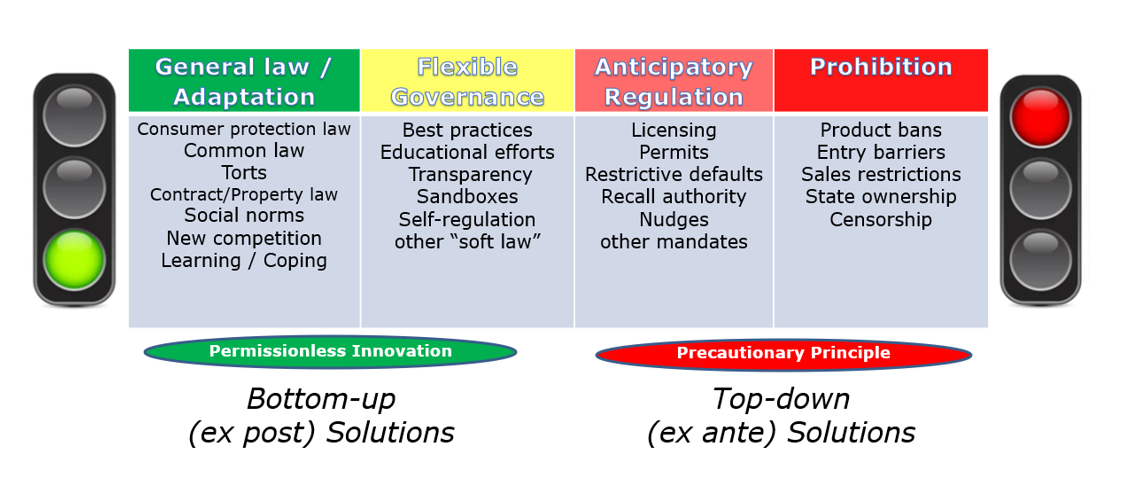
Debates about how to embed ethics and best practices into AI product design is where the question of public policy defaults becomes important. To the extent AI design becomes the subject of legal or regulatory decision-making, a choice must be made between two general approaches: the precautionary principle or the proactionary principle.[1] While there are many hybrid governance approaches in between these two poles, the crucial issue is whether the initial legal default for AI technologies will be set closer to the red light of the precautionary principle (i.e., permissioned innovation) or to the green light of the proactionary principle (i.e., (permissionless innovation). Each governance default will be discussed.
Discourse magazine has just published my review of Where Is My Flying Car?, by J. Storrs Hall, which I argue is the most important book on technology policy written in the past quarter century. Hall perfectly defines what is at stake if we fail to embrace a pro-progress policy vision going forward. Hall documents how a “Jetsons” future was within our grasp, but it was stolen away from us. What held back progress in key sectors like transportation, nanotech & energy was anti-technological thinking and the overregulation that accompanies it. “[T]he Great Stagnation was really the Great Strangulation,” he argues. The culprits: negative cultural attitudes toward innovation, incumbent companies or academics looking to protect their turf, litigation-happy trial lawyers, and a raft of risk-averse laws and regulations.
Hall coins the term “the Machiavelli Effect” to identify why many people simultaneously fear the new and different, and they also want to protect whatever status quo they benefit from (or at least feel comfortable with). He builds on this passage from Niccolò Machiavelli’s classic 1532 study of political power, “The Prince”: Continue reading →
I’ve always been perplexed by tech critiques that seek to pit “humanist” values against technology or technological processes, or that even suggest a bright demarcation exists between these things. Properly understood, “technology” and technological innovation are simply extensions of our humanity and represent efforts to continuously improve the human condition. In that sense, humanism and technology are compliments, not opposites.
I started thinking about this again after reading a recent article by Christopher Mims of The Wall Street Journal, which introduced me to the term “techno-chauvinism.” Techno-chauvinism is a new term that some social critics are using to identify when technologies or innovators are apparently not behaving in a “humanist” fashion. Mims attributes the term techno-chauvinism to Meredith Broussard of New York University, who defines it as “the idea that technology is always the highest and best solution, and is superior to the people-based solution.” [Italics added.] Later on Twitter, Mims defined and critiqued techno-chauvinism as “the belief that the best solution to any problem is technology, not changing our culture, habits or mindset.”
Everything Old is New Again
There are other terms critics have used to describe the same notion, including: “techno-fundamentalism” (Siva Vaidhyanathan), “cyber-utopianism,” and “technological solutionism” (Evgeny Morozov). In a sense, all these terms are really just variants of what scholars in the field of Science and Technology Studies (STS) have long referred to as “technological determinism.”
As I noted in a recent essay about determinism, the traditional “hard” variant of technological determinism refers to the notion that technology almost has a mind of its own and that it will plow forward without much resistance from society or governments. Critics argue that determinist thinking denies or ignores the importance of the human element in moving history forward, or what Broussard would refer to as “people-based solutions.”
The first problem with this thinking is there are no bright lines in these debates and many “softer” variants of determinism exist. The same problem is at work when we turn to discussions about both “humanism” and “technology.” Things get definitionally murky quite quickly, and everyone seemingly has a preferred conception of these terms to fit their own ideological dispositions. “Humanism is a rather vague and contested term with a convoluted history,” observes tech philosopher Michael Sacasas. And here’s an essay that I have updated many times over the years to catalog the dozens of different definitions of “technology” I have unearthed in my ongoing research. Continue reading →
“The quickest way to find out who your enemies are is to try doing something new.” Thus begins Innovation and Its Enemies, an ambitious new book by Calestous Juma that will go down as one of the decade’s most important works on innovation policy.
Juma, who is affiliated with the Harvard Kennedy School’s Belfer Center for Science and International Affairs, has written a book that is rich in history and insights about the social and economic forces and factors that have, again and again, lead various groups and individuals to oppose technological change. Juma’s extensive research documents how “technological controversies often arise from tensions between the need to innovate and the pressure to maintain continuity, social order, and stability” (p. 5) and how this tension is “one of today’s biggest policy challenges.” (p. 8)
What Juma does better than any other technology policy scholar to date is that he identifies how these tensions develop out of deep-seated psychological biases that eventually come to affect attitudes about innovations among individuals, groups, corporations, and governments. “Public perceptions about the benefits and risks of new technologies cannot be fully understood without paying attention to intuitive aspects of human psychology,” he correctly observes. (p. 24) Continue reading →
I was honored to be asked by the editors at Reason magazine to be a part of their “Revolutionary Reading” roundup of “The 9 Most Transformative Books of the Last 45 Years.” Reason is celebrating its 45th anniversary and running a wide variety of essays looking back at how liberty has fared over the past half-century. The magazine notes that “Statism has hardly gone away, but the movement to roll it back is stronger than ever.” For this particular feature, Reason’s editors “asked seven libertarians to recommend some of the books in different fields that made [the anti-statist] cultural and intellectual revolution possible.”
When Jesse Walker of
Reason first contacted me about contributing my thoughts about which technology policy books made the biggest difference, I told him I knew exactly what my choices would be: Ithiel de Sola Pool’s Technologies of Freedom (1983) and Virginia Postrel’s The Future and Its Enemies (1998). Faithful readers of this blog know all too well how much I love these two books and how I am constantly reminding people of their intellectual importance all these years later. (See, for example, this and this.) All my thinking and writing about tech policy over the past two decades has been shaped by the bold vision and recommendations set forth by Pool and Postrel in these beautiful books.
I finally got around to readingPlanet Google: One Company’s Audacious Plan to Organize Everything We Know, by Randall Stross. It’s very well done. Stross is a frequently contributor to the New York Times and the author of several other interesting books on the technology industry. He knows how to weave a story together, and it helps that Google’s story is a pretty amazing one.
Each chapter discusses a different part of Google’s growing family of services — GMail, Google Maps, Google Earth, Book Search, and YouTube. Of course, it all started with search and Stross does a good job explaining how the ingenious Google search algorithm has grown from dorm room project to the greatest aggregator of human knowledge that the world has ever known. This, in turn, has powered Google’s hugely successful online advertising system. The real secret of their success with online advertising, Stross argues, is that “Google’s impersonal, mathematical approach search also provides you with the ability to serve advertisements that are tailored to a search, rather than to the person submitting the search request, whose identity would have to be known.”
Despite the benefits of such generally anonymous searching, as Google has grown and added new services and capabilities, concerns about the sheer volume of data that the company collects have led to heightened privacy concerns. Indeed, privacy is a core theme that Stross uses in the book to tie many of the chapters and issues together. Google is constantly struggling to strike the right balance between providing more access to the world’s information while also being careful not to raise privacy concerns. But it’s unclear exactly how much more information collection that users (or public officials) will tolerate before advocating stricter limits on Google’s reach. As Stross points out:
Guided by its founding mission, to organize all the world’s information, Google has created storage capacity that allows it to gain control of what its users are you doing in a comprehensive way that no other company has done, and to preserve those records indefinitely, without the need to clear out old records to make way for new ones. Moreover, Google differentiates its service by refining its own proprietary software formula to mine and massage the data, technology that it zealously protects from the sight of rivals. This sets up a conflict between Google’s wish to operate a “black box” (completely opaque to the outside) and its users’ wish for transparency.
The Technology Liberation Front is the tech policy blog dedicated to keeping politicians' hands off the 'net and everything else related to technology. Learn more about TLF →

 Discourse magazine has just published



 The Technology Liberation Front is the tech policy blog dedicated to keeping politicians' hands off the 'net and everything else related to technology.