Sen. Josh Hawley (R-MO) recently delivered remarks at the National Conservatism Conference and a Young America’s Foundation conference in which he railed against political and academic elites, arguing that, “the old era is ending and the old ways will not do.” “It’s time that we stood up to big government, to the people in government who think they know better,” Hawley noted at the YAF event. “[W]e are for free competition… we are for the free market.”
That’s all nice-sounding rhetoric but it sure doesn’t seem to match up with Hawley’s recent essays and policy proposals, which are straight out of the old era’s elitist and highly paternalistic Washington-Knows-Best playbook. Specifically, Hawley has called for a top-down, technocratic regulatory regime for the Internet and the digital economy more generally. Hawley has repeatedly made claims that digital technology companies have gotten a sweetheart deal from government and they they have censored conservative voices. That’s utter nonsense, but those arguments have driven his increasingly fanatic rhetoric and command-and-control policy proposals. If he succeeds in his plan to empower unelected bureaucrats inside the Beltway to reshape the Internet, it will destroy one of the greatest American success stories in recent memory. It’s hard to understand how that could be labelled “conservative” in any sense of the word. Continue reading →
I spend a lot of my time as an Internet policy analyst railing against elitist suggestions that “ordinary” users are just too dumb to take care of themselves online, no matter how effectively technology empowers them to make decisions for themselves about the content they and their children consume, what data they allow to be shared about themselves on social networking sites or while browsing, etc. Indeed, Adam Thierer and I wrote a lengthy paper about What Unites Advocates of Speech Controls & Privacy Regulation? attacking such elitism when enforced by paternalist laws that assume everyone has the same values and that only the wise philosopher-kings of technology policy can possibly protect us all from our own stupidity.
But of course there
are plenty of stupid people in the world, and they often do very stupid things—like walking on the side of a highway with just a few feet between a noise barrier and passing cars just because “Google Maps told you to do so!” That’s essentially what Lauren Rosenberg claims in her very stupid lawsuit against Google, after she was hit by a passing car following directions from the beta walking directions tool in Google Maps—and despite the warning Google provided. Danny Sullivan tells the full story at SearchEngine Land, complete with photos that should have caused any reasonably prudent person to think, “Hey, what a minute, maybe that warning label I saw telling me the suggested route might lack sidewalks or pedestrian paths was actually there for a reason!”
Rosenberg seeks several hundred thousand dollars in damages from Harwood (the driver who hit her) and Google, asserting Google was negligent and failed to adequately warn her. The key policy issue this case raises is the same as in many, many aspects of Internet policy: How much disclosure is enough? As clearly shown by the photos in Danny’s post, Google did warn Rosenberg; so the real danger in this case is that the courts (or lawmakers in the future) could set ever-higher standards for increasingly obnoxious warning labels on websites than they would provide on their own. This reminds me of my all-time favorite warning label (on a collapsible baby stroller): “REMOVE BABY BEFORE FOLDING!” (A contest for similarly inane real-life warnings can be found here.) Continue reading →
Then: The Wealth of NationsNow: Invisible Hands: The Mysterious Market Forces That Control Our Lives and How to Profit from Them
Funny how empowering consumers to choose for themselves is “manipulative.” Oh, right, I forgot: people are stupid and/or lazy, so so elites should chose for them!
Google today unveiled the Data Liberation Front, a team of engineers in Chicago dedicated to ensuring that Google build “liberated products”—ones that have “built in features that make it easy (and free) to remove your data from the product in the event that you’d like to take it elsewhere.” We’ve spent a lot of time here warning about the dangers of Googlephobia, but now that Google has brazenly appropriated the TLF’s unique mock-Communist iconography, we’re starting to think that Jeff Chester and Scott Cleland may be right: Maybe Google really is trying to take over the world!
But seriously… We heartily agree with our Data Liberation Front comrades that users should be fully empowered to switch from one service to another online. This kind of competition is clearly the best protection for consumers in the Digital Age. Making switching easy should assuage not just antitrust concerns, but also concerns about how much privacy or security each web service offers to its users, no matter how big its market share: If you don’t like what a service offers, just take your data and leave! Who needs the government micro-managing the Internet when users have that kind of control?
Viva la (Technology) Revolution!
P.S. In case you haven’t seen it the Monty Python video we’re all riffing on:
What Unites Advocates of Speech Controls & Privacy Regulation? [pdf]
by Adam Thierer & Berin Szoka
The Progress & Freedom Foundation,
Progress on Point No. 16.19
Anyone who has spent time following debates about speech and privacy regulation comes to recognize the striking parallels between these two policy arenas. In this paper we will highlight the common rhetoric, proposals, and tactics that unite these regulatory movements. Moreover, we will argue that, at root, what often animates calls for regulation of both speech and privacy are two remarkably elitist beliefs:
People are too ignorant (or simply too busy) to be trusted to make wise decisions for themselves (or their children); and/or,
All or most people share essentially the same values or concerns and, therefore, “community standards” should trump household (or individual) standards.
While our use of the term “elitism” may unduly offend some understandably sensitive to populist demagoguery, our aim here is not to launch a broadside against elitism as
Time magazine culture critic William H. Henry once defined it: “The willingness to assert unyieldingly that one idea, contribution or attainment is better than another.”[1] Rather, our aim here is to critique that elitism which rises to the level of political condescension and legal sanction. We attack not so much the beliefs of some leaders, activists, or intellectuals that they have a better idea of what it in the public’s best interest than the public itself does, but rather the imposition of those beliefs through coercive, top-down mandates.
That sort of elitism—elitism enforced by law—is often the objective of speech and privacy regulatory advocates. Our goal is to identify the common themes that unite these regulatory movements, explain why such political elitism is unwarranted, and make it clear how it threatens individual liberty as well as the future of free and open Internet. As an alternative to this elitist vision, we advocate an empowerment agenda: fostering an environment in which users have the tools and information they need to make decisions for themselves and their families. Continue reading →
John Stuart Mill’sOn Liberty turns 150 this year. Published in 1859, this slender manifesto for human liberty went on to become a classic of modern philosophy and political science. It remains a beautiful articulation of the core principles of human liberty and a just society.
Anyone familiar with the book recognizes the importance of the opening chapter and Mill’s “one very simple principle” for “the dealings of society with the individual in the way of compulsion and control, whether the means used be physical force in the form of legal penalties, or the moral coercion of public opinion”:
That principle is, that the sole end for which mankind are warranted, individually or collectively, in interfering with the liberty of action of any of their number, is self-protection. That the only purpose for which power can be rightfully exercised over any member of a civilized community, against his will, is to prevent harm to others. His own good, either physical or moral, is not a sufficient warrant. He cannot rightfully be compelled to do or forbear because it will be better for him to do so, because it will make him happier, because, in the opinions of others, to do so would be wise, or even right. These are good reasons for remonstrating with him, or reasoning with him, or persuading him, or entreating him, but not for compelling him, or visiting him with any evil in case he do otherwise. To justify that, the conduct from which it is desired to deter him, must be calculated to produce evil to some one else. The only part of the conduct of any one, for which he is amenable to society, is that which concerns others. In the part which merely concerns himself, his independence is, of right, absolute. Over himself, over his own body and mind, the individual is sovereign.
Mill went on to outline “the appropriate region of human liberty,” and divided it into:
“liberty of conscience, in the most comprehensive sense; liberty of thought and feeling; absolute freedom of opinion and sentiment on all subjects, practical or speculative, scientific, moral, or theological. The liberty of expressing and publishing opinions may seem to fall under a different principle, since it belongs to that part of the conduct of an individual which concerns other people; but, being almost of as much importance as the liberty of thought itself, and resting in great part on the same reasons, is practically inseparable from it.”
“liberty of tastes and pursuits; of framing the plan of our life to suit our own character; of doing as we like, subject to such consequences as may follow: without impediment from our fellow-creatures, so long as what we do does not harm them, even though they should think our conduct foolish, perverse, or wrong”
“freedom to unite, for any purpose not involving harm to others”
Bringing it altogether, he argued:
The only freedom which deserves the name, is that of pursuing our own good in our own way, so long as we do not attempt to deprive others of theirs, or impede their efforts to obtain it. Each is the proper guardian of his own health, whether bodily, or mental and spiritual. Mankind are greater gainers by suffering each other to live as seems good to themselves, than by compelling each to live as seems good to the rest.
To this day, I do not believe there has been a more eloquent or concise summation of the central principles of libertarianism than those passages from Chapter 1 of the book. But what many fail to remember or appreciate is the equally powerful second chapter of Mill’s treatise, “On the Liberty of Thought and Discussion.” It was a bold defense of freedom of speech and expression that was many decades ahead of its time. And it still has lessons and warnings worth heeding in our modern Information Age.
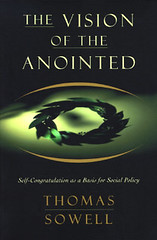
Berin recently encouraged me to re-read Thomas Sowell’sThe Vision of the Anointed: Self-Congratulation as a Basis for Social Policy, which I hadn’t looked at since I first read it back in 1995 or 96. I’m glad I did since Sowell’s work has always been profoundly influential on my thinking (especially his masterpiece, A Conflict of Visions) and I had forgotten how useful The Vision of the Anointed was in helping me understand the reoccurring model that drives ideological crusades to expand government power over our lives and economy.
“The great ideological crusades of the twentieth-century intellectuals have ranged across the most disparate fields,” Sowell noted in the book. But what they all had in common, he argued, was “their moral exaltation of the anointed above others, who are to have their different views nullified and superseded by the views of the anointed, imposed via the power of government.” (p. 5) These elitist, government-expanding crusades shared several key elements, which Sowell identified as follows:
Assertion of a great danger to the whole society, a danger to which the masses of people are oblivious.
An urgent need for government action to avert impending catastrophe.
A need for government to drastically curtail the dangerous behavior of the many, in response to the prescient conclusions of the few.
A disdainful dismissal of arguments to the contrary as either uninformed, irresponsible, or motivated by unworthy purposes.
You can see this model at work on a daily basis today with our government’s various efforts to reshape our economy, but I think this model is equally applicable to debates over social policy and speech control. In particular, the various “technopanics” I have been writing about recently fit this model. (See 1, 2, 3, 4, 5). For example, consider how this plays out in the debate over online social networking:
The Technology Liberation Front is the tech policy blog dedicated to keeping politicians' hands off the 'net and everything else related to technology. Learn more about TLF →



 The Technology Liberation Front is the tech policy blog dedicated to keeping politicians' hands off the 'net and everything else related to technology.