[originally published on Plaintext on June 21, 2017.]
This summer, we celebrate the 20th anniversary of two developments that gave us the modern Internet as we know it. One was a court case that guaranteed online speech would flow freely, without government prior restraints or censorship threats. The other was an official White House framework for digital markets that ensured the free movement of goods and services online.
The result of these two vital policy decisions was an unprecedented explosion of speech freedoms and commercial opportunities that we continue to enjoy the benefits of twenty years later.
While it is easy to take all this for granted today, it is worth remembering that, in the long arc of human history, no technology or medium has more rapidly expanded the range of human liberties — both speech and commercial liberties — than the Internet and digital technologies. But things could have turned out much differently if not for the crucially important policy choices the United States made for the Internet two decades ago. Continue reading →
What sort of public policy vision should govern the Internet of Things? I’ve spent a lot of time thinking about that question in essays here over the past year, as well as in a new white paper (“The Internet of Things and Wearable Technology: Addressing Privacy and Security Concerns without Derailing Innovation”) that will be published in the Richmond Journal of Law & Technology early next year.
But I recently heard three policymakers articulate their recommended vision for the Internet of Things (IoT) and I found their approach so inspiring that I wanted to discuss it here in the hopes that it will become the foundation for future policy in this arena.
Last Thursday, it was my pleasure to attend a Center for Data Innovation (CDI) event on “How Can Policymakers Help Build the Internet of Things?” As the title implied, the goal of the event was to discuss how to achieve the vision of a more fully-connected world and, more specifically, how public policymakers can help facilitate that objective. It was a terrific event with many excellent panel discussions and keynote addresses.
Two of those keynotes were delivered by Senators Deb Fischer (R-Neb.) and Kelly Ayotte (R-N.H.). Below I will offer some highlights from their remarks and then relate them to the vision set forth by Federal Trade Commission (FTC) Commissioner Maureen K. Ohlhausen in some of her recent speeches. I will conclude by discussing how the Ayotte-Fischer-Ohlhausen vision can be seen as the logical extension of the Clinton Administration’s excellent 1997
Framework for Global Electronic Commerce, which proposed a similar policy paradigm for the Internet more generally. This shows how crafting policy for the IoT can and should be a nonpartisan affair. Continue reading →
If there are two general principles that unify my recent work on technology policy and innovation issues, they would be as follows. To the maximum extent possible:
- We should avoid preemptive and precautionary-based regulatory regimes for new innovation. Instead, our policy default should be innovation allowed (or “permissionless innovation”) and innovators should be considered “innocent until proven guilty” (unless, that is, a thorough benefit-cost analysis has been conducted that documents the clear need for immediate preemptive restraints).
- We should avoid rigid, “top-down” technology-specific or sector-specific regulatory regimes and/or regulatory agencies and instead opt for a broader array of more flexible, “bottom-up” solutions (education, empowerment, social norms, self-regulation, public pressure, etc.) as well as reliance on existing legal systems and standards (torts, product liability, contracts, property rights, etc.).
I was very interested, therefore, to come across two new essays that make opposing arguments and proposals. The first is this recent
Slate oped by John Frank Weaver, “We Need to Pass Legislation on Artificial Intelligence Early and Often.” The second is Ryan Calo’s new Brookings Institution white paper, “The Case for a Federal Robotics Commission.”
Weaver argues that new robot technology “is going to develop fast, almost certainly faster than we can legislate it. That’s why we need to get ahead of it now.” In order to preemptively address concerns about new technologies such as driverless cars or commercial drones, “we need to legislate early and often,” Weaver says. Stated differently, Weaver is proposing “precautionary principle”-based regulation of these technologies. The precautionary principle generally refers to the belief that new innovations should be curtailed or disallowed until their developers can prove that they will not cause any harms to individuals, groups, specific entities, cultural norms, or various existing laws, norms, or traditions.
Calo argues that we need “the establishment of a new federal agency to deal with the novel experiences and harms robotics enables” since there exists “distinct but related challenges that would benefit from being examined and treated together.” These issues, he says, “require special expertise to understand and may require investment and coordination to thrive.
I’ll address both Weaver and Calo’s proposals in turn. Continue reading →
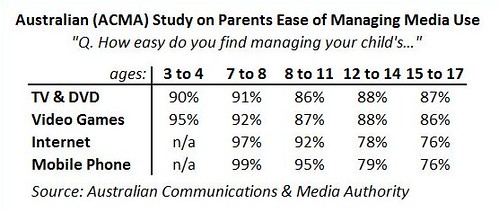
An interesting new survey has just been released by the Australian Communications and Media Authority (ACMA), which is the rough equivalent of the Federal Communications Commission here in the U.S., but with somewhat broader authority. ACMA’a latest report is entitled Use of Electronic Media and Communications: Early Childhood to Teenage Years and it takes a look at media technology usage among Australian youngsters in 5 age groupings (3 to 4 years of age, 7 to 8, 8 to 11, 12 to 14, and 15 to 17).
The survey also asked Australian parents “How easy do you find managing your child’s ___ use.” They asked that question for four different media or communications technologies: TV & DVD; video games; Internet; and mobile devices. They results, summarized in the table below, were quite interesting and seem to indicate that Australian parents find it much easier to manage their children’s media use than some of their elected leaders imagine.
Continue reading →

 The Technology Liberation Front is the tech policy blog dedicated to keeping politicians' hands off the 'net and everything else related to technology.