Profectus is an excellent new online magazine featuring essays and interviews on the intersection of academic literature, public policy, civilizational progress, and human flourishing. The Spring 2022 edition of the magazine features a “Progress Roundtable” in which six different scholars were asked to contribute their thoughts on three general questions:
What is progress?
What are the most significant barriers holding back further progress?
If those challenges can be overcome, what does the world look like in 50 years?
I was honored to be asked by Clay Routledge to contribute answers to those questions alongside others, including: Steven Pinker (Harvard University), Jason Crawford (Roots of Progress), Matt Clancy (Institute for Progress), Marian Tupy (HumanProgress.org), James Pethokoukis (AEI). I encourage you to jump over the roundtable and read all their excellent responses. I’ve included my answers down below:
[This is a draft of a section of a forthcoming study on “A Flexible Governance Framework for Artificial Intelligence,” which I hope to complete shortly. I welcome feedback. I have also cross-posted this essay at Medium.]
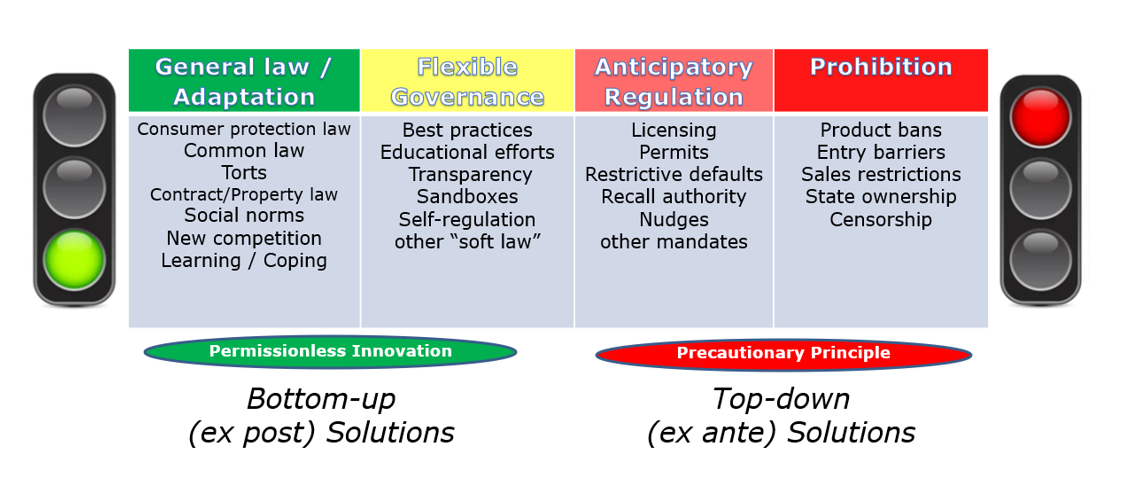
Debates about how to embed ethics and best practices into AI product design is where the question of public policy defaults becomes important. To the extent AI design becomes the subject of legal or regulatory decision-making, a choice must be made between two general approaches: the precautionary principle or the proactionary principle.[1] While there are many hybrid governance approaches in between these two poles, the crucial issue is whether the initial legal default for AI technologies will be set closer to the red light of the precautionary principle (i.e., permissioned innovation) or to the green light of the proactionary principle (i.e., (permissionless innovation). Each governance default will be discussed.
This is a compendium of readings on “progress studies,” or essays and books which generally make the case for technological innovation, dynamism, economic growth, and abundance. I will update this list as additional material of relevance is brought to my attention.
I was my pleasure to appear on the latest episode of the Dissed podcast to discuss economic liberty and the right to earn a living. The show was hosted by Anastasia Boden and Elizabeth Slattery of the Pacific Legal Foundation and it included legal scholars Hadley Arkes, Timothy Sandefur, and Clark Neily. I appear in the second half of the program.
Over at Discourse magazine, my Mercatus Center colleague Matt Mitchell and I have a new essay on, “Industrial Policy is a Very Old, New Idea.” We argue that, despite having a long history of disappointments and failures, that isn’t stopping many policymakers from proposing it industrial policies again. We compare national industrial policy efforts alongside state-based economic development policies, noting their many similarities. In both cases, the crucial issue comes down to targeting versus generality in terms of how policymakers go about encouraging innovation and economic growth. We note how:
The building blocks of the general approach—a mix of broadly applicable tax, spending, regulatory and legal rules—are often rejected because they seem less exciting than targeting specific companies or industries for help. Pundits and policymakers are fond of using machine-like metaphors to suggest they can “fine-tune” innovation or “dial-in” economic development according to a precise formula they believe they have concocted. They also savor the attention that goes along with ribbon-cutting ceremonies and the big headlines often generated by political targeting efforts.
We discuss the spectrum of economic development options (depicted in chart below) in more detail and explain the many pitfalls associated with some of the most highly targeted efforts. “The predicament for policymakers is that, while it is wiser to focus on the generalized approaches, the temptation will remain strong to jump to targeted gambles that may grab headlines but are far more risky and costly,” we argue. Head over to
Discourseto read the entire thing.
I was speaking at a conference recently and discussing my life’s work, which for 30 years has been focused on the importance of innovation and intellectual battles over what we mean progress. I put together up a short list of some things I have written over the last few years on this topic and thought I would just re-post them here. I will try to keep this regularly updated, at least for a few years.
This week, the Trump Administration proposed a new policy framework for artificial intelligence (AI) technologies that attempts to balance the need for continued innovation with a set of principles to address concerns about new AI services and applications. This represents an important moment in the history of emerging technology governance as it creates a policy vision for AI that is generally consistent with earlier innovation governance frameworks established by previous administrations.
Generally speaking, the Trump governance vision for AI encourages regulatory humility and patience in the face of an uncertain technological future. However, the framework also endorses a combination of “hard” and “soft” law mechanisms to address policy concerns that have already been raised about developing or predicted AI innovations.
AI promises to revolutionize almost every sector of the economy and can potentially benefit our lives in numerous ways. But AI applications also raise a number of policy concerns, specifically regarding safety or fairness. On the safety front, for example, some are concerned about the AI systems that control drones, driverless cars, robots, and other autonomous systems. When it comes to fairness considerations, critics worry about “bias” in algorithmic systems that could deny people jobs, loans, or health care, among other things.
These concerns deserve serious consideration and some level of policy guidance or else the public may never come to trust AI systems, especially if the worst of those fears materialize as AI technologies spread. But
how policy is formulated and imposed matters profoundly. A heavy-handed, top-down regulatory regime could undermine AI’s potential to improve lives and strengthen the economy. Accordingly, a flexible governance framework is needed and the administration’s new guidelines for AI regulation do a reasonably good job striking that balance. Continue reading →
Over at the Mercatus Center Bridge blog, Trace Mitchell and I just posted an essay entitled, “A Non-Partisan Way to Help Workers and Consumers,” which discusses the new Federal Trade Commission’s (FTC) Economic Liberty Task Force report on occupational licensing.
We applaud the FTC’s calls for greater occupational licensing uniformity and portability, but regret the missed opportunity to address root problem of excessive licensing more generally. But while FTC is right to push for greater occupational licensing uniformity and portability, policymakers need to confront the sheer absurdity of licensing so many jobs that pose
zero risk to public health & safety. Licensing has become completely detached from risk realities and actual public needs.
As the FTC notes, excessive licensing limits employment opportunities, worker mobility, and competition while also “resulting in higher prices, reduced quality, and less convenience for consumers.” These are unambiguous facts that are widely accepted by experts of all stripes. Both the Obama and Trump Administrations, for example, have been completely in league on the need for comprehensive licensing reforms. Continue reading →
FCC Chairman Ajit Pai recently delivered an excellent speech at the Resurgent Conference, Austin, TX. In it, he stressed the importance of adopting a permissionless innovation policy vision to ensure a bright future for technology, economic growth, and consumer welfare. The whole thing is worth your time, but the last two paragraphs make two essential points worth highlighting.
Pai correctly notes that we should reject the sort of knee-jerk hysteria or technopanic mentality that sometimes accompanies new technologies. Instead, we should have some patience and humility in the face of uncertainty and be open to new ideas and technologies creations.
“Here’s the bottom line,” Pai concludes:
Whenever a technological innovation creates uncertainty, some will always have the knee-jerk reaction to presume it’s bad. They’ll demand that we do whatever’s necessary to maintain the status quo. Strangle it with a study. Call for a commission. Bemoan those supposedly left behind. Stipulate absolute certainty. Regulate new services with the paradigms of old.
But we should resist that temptation. “Guilty until proven innocent” is not a recipe for innovation, and it doesn’t make consumers better off. History tells us that it is not preemptive regulation, but permissionless innovation made possible by competitive free markets that best guarantees consumer welfare. A future enabled by the next generation of technology can be bright, if only we choose to let the light in.
Read the whole thing here. Good stuff. I also appreciate him citing my work on the topic, which you can find in my last book and other publications.
The Technology Liberation Front is the tech policy blog dedicated to keeping politicians' hands off the 'net and everything else related to technology. Learn more about TLF →


 The Technology Liberation Front is the tech policy blog dedicated to keeping politicians' hands off the 'net and everything else related to technology.