For my latest column in The Hill, I explored the European Union’s (EU) endlessly expanding push to regulate all facets of the modern data economy. That now includes a new effort to regulate artificial intelligence (AI) using the same sort of top-down, heavy-handed, bureaucratic compliance regime that has stifled digital innovation on the continent over the past quarter century.
The European Commission (EC) is advancing a new Artificial Intelligence Act, which proposes banning some AI technologies while classifying many others under a heavily controlled “high-risk” category. A new bureaucracy, the European Artificial Intelligence Board, will be tasked with enforcing a wide variety of new rules, including “prior conformity assessments,” which are like permission slips for algorithmic innovators. Steep fines are also part of the plan. There’s a lengthy list of covered sectors and technologies, with many others that could be added in coming years. It’s no wonder, then, that the measure has been labelled the measure “the mother of all AI laws” and analysts have argued it will further burden innovation and investment in Europe.
As I noted in my new column, the consensus about Europe’s future on the emerging technology front is dismal to put it mildly.
The International Economy journal recently asked 11 experts from Europe and the U.S. where the EU currently stood in global tech competition. Responses were nearly unanimous and bluntly summarized by the symposium’s title: “The Biggest Loser.” Respondents said Europe is “lagging behind in the global tech race,” and “unlikely to become a global hub of innovation.” “The future will not be invented in Europe,” another analyst bluntly concluded. Continue reading →
The European Commission has a new report out today on “Implementation of the Safer Social Networking Principles for the EU.” It’s a status report on the implementation of “Safer Social Networking Principles for the EU“, a “self-regulatory” agreement the EC brokered with 17 social networking sites and other online operators back in 2009. (Co-regulatory would be more accurate here, since the EC is steering, and industry is simply rowing.) The goal was to make the profiles of minors more private and provide other safeguards.
Generally speaking, the EC’s evaluation suggests that great progress has been made, although there’s always room for improvement. For example, the report found that “13 out of the 14 sites tested provide safety information, guidance and/or educational materials specifically targeted at minors;” “Safety information for minors is quite clear and age-appropriate on all sites that provide it, good progress since the first assessment last year; “Reporting mechanisms are more effective now than in 2010;” and most sites have improved Terms of Use that are easy for minors to understand and/or a child-friendly version of the Terms of Use or Code of Conduct; and many “provide safety information for children and parents which is both easy to find and to understand.” Again, there’s always room for improvement, but the general direction is encouraging, especially considering how new many of these sites are.
Unfortunately, Neelie Kroes, Vice President of the European Commission for the Digital Agenda, spun the report in the opposite direction. She issued a statement saying: Continue reading →
A report in the U.K. Telegraph notes that the European Union is seeking to create a so-called “right to be forgotten” online, and has “drafted potential legislation that would include new, unprecedented privacy rights for citizens sharing personal data.” Details are sparse at this point, but according to this new 20-page European Commission document, “A Comprehensive Approach on Personal Data Protection in the European Union,” the EU will be:
clarifying the so-called ‘right to be forgotten’, i.e. the right of individuals to have their data no longer processed and deleted when they are no longer needed for legitimate purposes. This is the case, for example, when processing is based on the person’s consent and when he or she withdraws consent or when the storage period has expired. (p.8)
Two brief comments on this. First, it should be apparent that any “right to be forgotten” conflicts mightily with free speech rights and press freedom. As I discussed at greater length in this review of Solove’s Understanding Privacy as well as my essay on “Two Paradoxes of Privacy Regulation,” the problem with enshrining expansive privacy “rights” into law is that it means there will need to be stricter limits placed on speech and press freedoms. As Eugene Volokh noted in his 2000 law review article entitled, “Freedom of Speech, Information Privacy, and the Troubling Implications of a Right to Stop People from Speaking About You“: Continue reading →
Really, what would we do without European antitrust regulators protecting us from the evils of browser innovation? If Microsoft was allowed to actually bundle its Internet Explorer browser alongside its operating system we might actually do something really crazy… like perhaps try it! After all, the latest browser stats make it pretty clear most of us have a choice and that fewer and fewer of us rely on IE. As Erick Schonfeld noted on Tech Crunch today:
The new browser wars on on. More than a decade after Microsoft killed off Netscape with Internet Explorer, competition in the browser market has never been stronger. Just last week, Mozilla released Firefox 3.5, which has now been downloaded nearly 14 million times. Earlier in June, Apple released Safari 4. In March, Microsoft introduced Internet Explorer 8, and Google came out with a speedier beta of its Chrome browser. Some early data is coming in showing relative market share and how fast people are upgrading. If you look at the chart above from Statcounter, it indicates that since March Internet Explorer has lost 11.4 percent market share to other browsers. [..] Where did that go? It went to Firefox, Safari, and Chrome. Nearly 5 percent of that, or about half, went to Firefox 3.0, which currently has 27.6 percent market share. That doesn’t count last week’s upgrade.
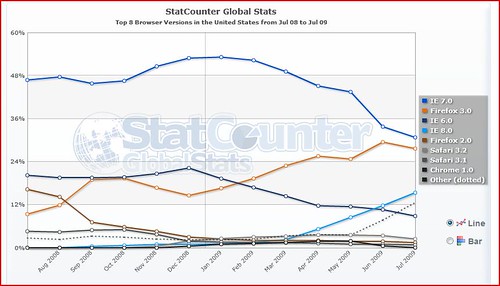
Alas, as I pointed out in my essay a few weeks ago (“European Regulators Think Consumers Too Stupid to Know How to Download a Different Browser“), some Euro-crats still seem to believe that changing browsers requires great detective skills to unearth alternatives. It’s just pure poppycock and yet another sad example of how antitrust law is usually hopelessly behind the times and has absolutely nothing to do with protecting consumers or fostering innovation.
Now, please excuse me while I get back to surfing the Net via Firefox and Chrome (and Opera on my mobile phone). My God, how did I ever find these browser alternatives!

 The Technology Liberation Front is the tech policy blog dedicated to keeping politicians' hands off the 'net and everything else related to technology.