by Adam Thierer & Trace Mitchell
[originally published on
The Bridge on August 30, 2018.]
What is an entrepreneur?
While it may seem straightforward, this question is deceptively complex. The term can be used in many different ways to describe a variety of individuals who engage in economic, political, or even social activities. Entrepreneurs affect almost every aspect of modern society. While most people probably have a general sense of what is meant when they hear the term entrepreneur, it can be difficult to provide a precise definition. This is due in no small part to the fact that some of the primary thinkers who have given substance to the term have placed their focus on different aspects of entrepreneurialism.
How Economists Talk About Entrepreneurs
Austrian economist Joseph Schumpeter thought that the purpose of an entrepreneur was “to reform or revolutionize the pattern of production by exploiting an invention.”
Schumpeterian entrepreneurs are highly creative, disruptive innovators who challenge the status quo in order to bring about new economic opportunities. American economist Israel Kirzner viewed the defining characteristic of entrepreneurs as “alertness.” Kirznerian entrepreneurs are individuals who are able to identify the ways in which a market could be moved closer to its equilibrium, such as recognizing a gap in knowledge between different economic actors.
In the time since Schumpeter and Kirzner helped lay the groundwork, a number of George Mason University-affiliated scholars have made major contributions to our understanding of entrepreneurialism. Continue reading →
One of my favorite themes, and not just in the field of tech policy, is the “Unintended Consequences of Well-Intentioned Regulations.” I believe that all laws and regulations have dynamic effects and that to fully appreciate the true impact of any particular public policy, you must always closely investigate the potential opportunity costs and unintended consequences associated with those policies. Because all too often laws and regulations are hastily put on the books with the very best of intentions in mind, only to later be shown to produce the opposite of what was intended.
Today’s case in point comes from a Wall Street Journal article by Rachel Bachman and it involves how the growing wave of cycling helmet laws are having a net negative impact on public health because they discourage ridership in the aggregate. Thus, those potential riders are then either (a) just less active overall or (b) driving their cars to get where they need to go. And both of those results are, ultimately, riskier than cycling without a helmet. For that reason, Bachman reports, cycling advocates “are pushing back against mandatory bike-helmet laws in the U.S. and elsewhere. They say mandatory helmet laws, particularly for adults, make cycling less convenient and seem less safe, thus hindering the larger public-health gains of more people riding bikes.” Supporting evidence comes from this 2012 paper in the journal Risk Analysis by Piet de Jong, a professor in the department of applied finance and actuarial studies at Sydney’s Macquarie University. His paper included an empirical model that showed how mandatory bike-helmet laws “have a net negative health impact.”
This strikes me as one of the very best examples of how to do dynamic benefit-cost analysis and show the full range of societal impacts associated with well-intentioned regulations. And it reminds me of the playground example I use in several of my papers: Laws and liability threats discouraged tall playground climbing structures in the ’80s and ’90s. Continue reading →
With each booth I pass and presentation I listen to at the 2014 International Consumer Electronics Show (CES), it becomes increasingly evident that the “Internet of Things” era has arrived. In just a few short years, the Internet of Things (IoT) has gone from industry buzzword to marketplace reality. Countless new IoT devices are on display throughout the halls of the Las Vegas Convention Center this week, including various wearable technologies, smart appliances, remote monitoring services, autonomous vehicles, and much more.
This isn’t vaporware; these are devices or services that are already on the market or will launch shortly. Some will fail, of course, just as many other earlier technologies on display at past CES shows didn’t pan out. But many of these IoT technologies will succeed, driven by growing consumer demand for highly personalized, ubiquitous, and instantaneous services.
But will policymakers let the Internet of Things revolution continue or will they stop it dead in its tracks? Interestingly, not too many people out here in Vegas at the CES seem all that worried about the latter outcome. Indeed, what I find most striking about the conversation out here at CES this week versus the one about IoT that has been taking place in Washington over the past year is that there is a large and growing disconnect between consumers and policymakers about what the Internet of Things means for the future.
When every device has a sensor, a chip, and some sort of networking capability, amazing opportunities become available to consumers. And that’s what has them so excited and ready to embrace these new technologies. But those same capabilities are exactly what raise the blood pressure of many policymakers and policy activists who fear the safety, security, or privacy-related problems that might creep up in a world filled with such technologies.
But at least so far, most consumers don’t seem to share the same worries. Continue reading →
 Ian Brown and Christopher T. Marsden’s new book, Regulating Code: Good Governance and Better Regulation in the Information Age, will go down as one of the most important Internet policy books of 2013 for two reasons. First, their book offers an excellent overview of how Internet regulation has unfolded on five different fronts: privacy and data protection; copyright; content censorship; social networks and user-generated content issues; and net neutrality regulation. They craft detailed case studies that incorporate important insights about how countries across the globe are dealing with these issues. Second, the authors endorse a specific normative approach to Net governance that they argue is taking hold across these policy arenas. They call their preferred policy paradigm “prosumer law” and it envisions an active role for governments, which they think should pursue “smarter regulation” of code.
In terms of organization, Brown and Marsden’s book follows the same format found in Milton Mueller’s important 2010 book Networks and States: The Global Politics of Internet Governance; both books feature meaty case studies in the middle bookended by chapters that endorse a specific approach to Internet policymaking. (Incidentally, both books were published by MIT Press.) And, also like Mueller’s book, Brown and Marsden’s Regulating Code does a somewhat better job using case studies to explore the forces shaping Internet policy across the globe than it does making the normative case for their preferred approach to these issues. Continue reading →
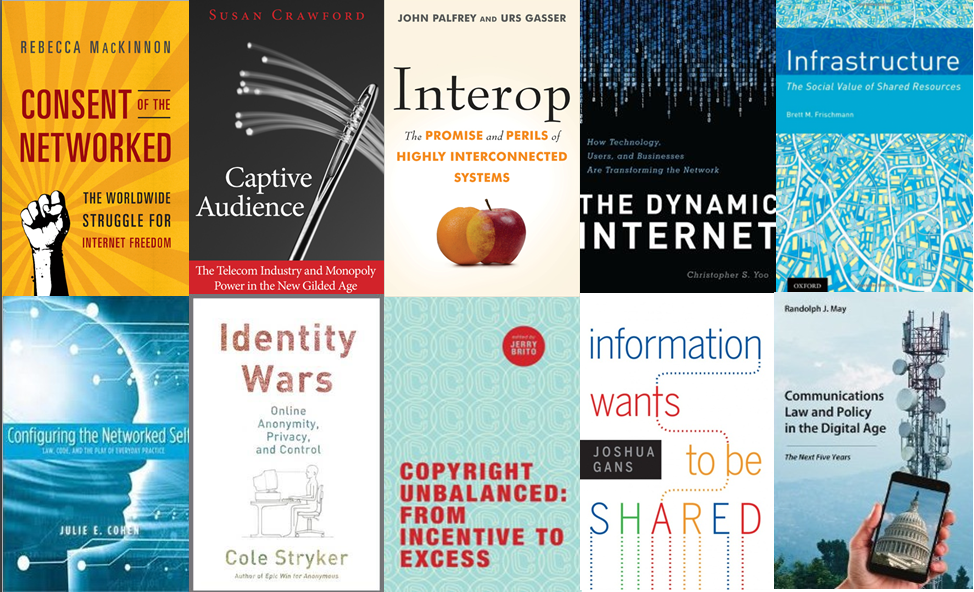
The number of major cyberlaw and information tech policy books being published annually continues to grow at an astonishing pace, so much so that I have lost the ability to read and review all of them. In past years, I put together end-of-year lists of important info-tech policy books (here are the lists for 2008, 2009, 2010, and 2011) and I was fairly confident I had read just about everything of importance that was out there (at least that was available in the U.S.). But last year that became a real struggle for me and this year it became an impossibility. A decade ago, there was merely a trickle of Internet policy books coming out each year. Then the trickle turned into a steady stream. Now it has turned into a flood. Thus, I’ve had to become far more selective about what is on my reading list. (This is also because the volume of journal articles about info-tech policy matters has increased exponentially at the same time.)
So, here’s what I’m going to do. I’m going to discuss what I regard to be the five most important titles of 2012, briefly summarize a half dozen others that I’ve read, and then I’m just going to list the rest of the books out there. I’ve read most of them but I have placed an asterisk next to the ones I haven’t. Please let me know what titles I have missed so that I can add them to the list. (Incidentally, here’s my compendium of all the major tech policy books from the 2000s and here’s the running list of all my book reviews.)
Continue reading →
[UPDATE
4/30/13: This article was subsequently published in Volume 65, Issues 2 of the Federal Communications Law Journal in April 2013. The links below now point to the final FCLJ version.]
The Mercatus Center at George Mason University has just released a new paper by Brent Skorup and me entitled, “Uncreative Destruction: The War on Vertical Integration in the Information Economy.” Brent, who is the research director for the Information Economy Project at the George Mason University School of Law, and I have been working on this paper since the Spring and we are looking forward to getting it published in a law review shortly. The paper focuses on Tim Wu’s “separations principle” for the digital economy, something I’ve spent some time critiquing here in the past. Here’s the introduction from the 44-page paper that Brent and I just released:
Are information sectors sufficiently different from other sectors of the economy such that more stringent antitrust standards should be applied to them preemptively? Columbia Law School professor Tim Wu responds in the affirmative in his book The Master Switch: The Rise and Fall of Information Empires. Having successfully pushed net-neutrality regulation into the policy spotlight, Wu has turned his attention to what he regards as excessive market concentration and threats to free speech throughout the entire information economy.To support his call for increased antitrust intervention, Wu explains his view of competition in the information economy—a view that deviates substantially from current mainstream antitrust theory.
Continue reading →
 Looking for a concise overview of how Internet architecture has evolved and a principled discussion of the public policies that should govern the Net going forward? Then look no further than Christopher Yoo‘s new book, The Dynamic Internet: How Technology, Users, and Businesses are Transforming the Network. It’s a quick read (just 140 pages) and is worth picking up. Yoo is a Professor of Law, Communication, and Computer & Information Science at the University of Pennsylvania and also serves as the Director of the Center for Technology, Innovation & Competition there. For those who monitor ongoing developments in cyberlaw and digital economics, Yoo is a well-known and prolific intellectual who has established himself as one of the giants of this rapidly growing policy arena.
Yoo makes two straight-forward arguments in his new book. First, the Internet is changing. In Part 1 of the book, Yoo offers a layman-friendly overview of the changing dynamics of Internet architecture and engineering. He documents the evolving nature of Internet standards, traffic management and congestion policies, spam and security control efforts, and peering and pricing policies. He also discusses the rise of peer-to-peer applications, the growth of mobile broadband, the emergence of the app store economy, and what the explosion of online video consumption means for ongoing bandwidth management efforts. Those are the supply-side issues. Yoo also outlines the implications of changes in the demand-side of the equation, such as changing user demographics and rapidly evolving demands from consumers. He notes that these new demand-side realities of Internet usage are resulting in changes to network management and engineering, further reinforcing changes already underway on the supply-side.
Yoo’s second point in the book flows logically from the first: as the Internet continues to evolve in such a highly dynamic fashion, public policy must as well. Yoo is particularly worried about calls to lock in standards, protocols, and policies from what he regards as a bygone era of Internet engineering, architecture, and policy. “The dramatic shift in Internet usage suggests that its founding architectural principles form the mid-1990s may no longer be appropriate today,” he argues. (p. 4) “[T]he optimal network architecture is unlikely to be static. Instead, it is likely to be dynamic over time, changing with the shifts in end-user demands,” he says. (p. 7) Thus, “the static, one-size-fits-all approach that dominates the current debate misses the mark.” (p. 7) Continue reading →
In my last post, I discussed an outstanding new paper from Ronald Cass on “Antitrust for High-Tech and Low: Regulation, Innovation, and Risk
.” As I noted, it’s one of the best things I’ve ever read about the relationship between antitrust regulation and the modern information economy. That got me thinking about what other papers on this topic that I might recommend to others. So, for what it’s worth, here are the 12 papers that have most influenced my own thinking on the issue. (If you have other suggestions for what belongs on the list, let me know. No reason to keep it limited to just 12.)
- J. Gregory Sidak & David J. Teece, “Dynamic Competition in Antitrust Law,” 5 Journal of Competition Law & Economics (2009).
- Geoffrey A. Manne & Joshua D. Wright, “Innovation and the Limits of Antitrust,” 6 Journal of Competition Law & Economics, (2010): 153
- Joshua D. Wright, “Antitrust, Multi-Dimensional Competition, and Innovation: Do We Have an Antitrust-Relevant Theory of Competition Now?” (August 2009).
- Daniel F. Spulber, “Unlocking Technology: Antitrust and Innovation,” 4(4) Journal of Competition Law & Economics, (2008): 915.
- Ronald Cass, “Antitrust for High-Tech and Low: Regulation, Innovation, and Risk
,” 9(2) Journal of Law, Economics and Policy, Forthcoming (Spring 2012)
- Richard Posner, “Antitrust in the New Economy,” 68 Antitrust Law Journal, (2001).
- Stan J. Liebowitz & Stephen E. Margolis,”Path Dependence, Lock-in, and History,” 11(1) Journal of Law, Economics and Organization, (April 1995): 205-26.
- Robert Crandall and Charles Jackson, “Antitrust in High-Tech Industries,” Technology Policy Institute (December 2010).
- Bruce Owen, “Antitrust and Vertical Integration in ‘New Economy’ Industries,” Technology Policy Institute (November 2010).
- Douglas H. Ginsburg & Joshua D. Wright, “Dynamic Analysis and the Limits of Antitrust Institutions,” 78 (1) Antitrust Law Journal (2012): 1-21.
- Thomas Hazlett, David Teece, Leonard Waverman, “Walled Garden Rivalry: The Creation of Mobile Network Ecosystems,” George Mason University Law and Economics Research Paper Series, (November 21, 2011), No. 11-50.
- David S. Evans, “The Antitrust Economics of Two Sided Markets.”
 Ronald Cass, Dean Emeritus of Boston University School of Law, has penned the best paper on antitrust regulation that you will read this year, especially if you’re interested in the relationship between antitrust and information technology sectors. His paper is entitled, “Antitrust for High-Tech and Low: Regulation, Innovation, and Risk,” and it makes two straightforward points:
- Antitrust enforcement has characteristics and risks similar to other forms of regulation.
- Antitrust authorities need to exercise special care in making enforcement decisions respecting conduct of individual dominant firms in high-technology industries.
Here are some highlights from the paper that build on those two points. Continue reading →
I liked the title of this new Cecilia Kang article in the Washington Post: “In Silicon Valley, Fast Firms and Slow Regulators.” Kang notes:
As federal regulators launch fresh investigations into Silicon Valley, their history of drawn-out cases has companies on edge. In taking on an industry that moves at lightening speed, federal officials risk actions that could appear to be too heavy-handed or embarrassingly outdated, some analysts and antitrust experts say.
For example, she cites ongoing regulatory oversight of Microsoft and MySpace, even though both companies have fallen from the earlier King of the Hill status in their respective fields. Kang notes that some “want the government to aggressively pursue abusive practices but question whether antitrust laws are too dated to rein in firms that are continually redefining themselves and using their dominance in one arena to press into others.”
Simply put, antitrust can’t keep up with an economy built on Moore’s Law, which refers to the rule of thumb that the processing power of computers doubles roughly every 18 months while prices remain fairly constant. This issue has been the topic of several of my
Forbes columns over the past year, as well as several other essays I’ve written here and elsewhere. [See the list at bottom of this essay.] Moore’s Law has been a relentless regulator of markets and has helped keep the power of “tech titans” in check better than any Beltway regulator ever could. As I noted here before in my essay, “Antitrust & Innovation in the New Economy: The Problem with the Static Equilibrium Mindset“: Continue reading →

 The Technology Liberation Front is the tech policy blog dedicated to keeping politicians' hands off the 'net and everything else related to technology.