Americans have schizophrenic opinions about artificial intelligence (AI) technologies. Ask the average American what they think of AI and they will often respond with a combination of fear, loathing, and dread. Yet, the very same AI applications they claim to be so anxious about are already benefiting their lives in profound ways.
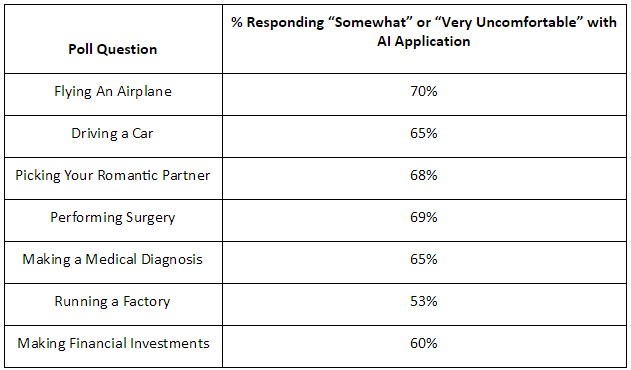
Last week, we posted complementary essays about the growing “technopanic” over artificial intelligence and the potential for that panic to undermine many important life-enriching medical innovations or healthcare-related applications. We were inspired to write those essays after reading the results of a recent poll conducted by Morning Consult, which suggested that the public was very uncomfortable with AI technologies. “A large majority of both Republicans and Democrats believe there should be national and international regulations on artificial intelligence,” the poll found, Of the 2,200 American adults surveyed, the poll revealed that “73 percent of Democrats said there should be U.S. regulations on artificial intelligence, as did 74 percent of Republicans and 65 percent of independents.”
We noted that there were reasons to question the significance of those in light of the binary way in which the questions were asked. Nonetheless, there are clearly some serious concerns among the public about AI and robotics. You see that when you read deeper into the poll results for specific questions and find respondents saying that they are “somewhat” to “very uncomfortable” about a wide range of specific AI applications.
Yet, in each case, Americans are already deriving significant benefits from each of the AI applications they claim to be so uncomfortable with.
The National Transportation Safety Board recommended yesterday that states ban all non-emergency use of portable electronic devices while driving, except for devices that assist the driver in driving (such as GPS). The recommendation followed the NTSB’s investigation of a tragic accident in Missouri triggered by a driver who was texting.
Personally I don’t see how someone can pay attention to the road while texting. (I’m having a hard enough time paying attention to a conference presentation while I’m typing this!) But the National Transportation Safety Board’s recommendation is a classic example of regulatory overreach based on anecdote. The NTSB wants to use one tired driver’s indefensible and extreme texting (which led to horrific results) as an excuse to ban all use of portable electronic devices while driving – including hands-free phone conversations. Before states act on this recommendation, they should carefully examine systematic evidence – not just anecdotes — to determine whether different uses of handheld devices pose different risks. They should also consider whether bans on some uses would expose drivers to risks greater than the risk the ban would prevent.
Texting while driving is generally a bad idea, since it involves taking one’s hands off the wheel and eyes off the road. While not wearing your seatbelt in a car or a helmet on a motorcycle probably only risks your own life, there’s a good argument to be made that distracted drivers put the lives of others at risk. The WSJ reports that 17 states have banned texting while driving outright. But is such regulation really the best way to address the problem?
Technological Empowerment. The WSJ highlights innovative technological solutions that:
Block calls and texts while the user is driving; OR
Let drivers “speak” their texts using voice-to-text technology.
Those who consider even hands-free cell phone use unsafe will probably insist on the more draconian blocking solution—and want government to mandate it! Such mandates would indeed probably be more effective than relying on the police write tickets to drivers they see texting while driving (especially since such offenses, like calling while driving, usually require some other, more serious offense before an officer can pull over a driver). But do we really need the government telling us when we can use a technology that really might be essential in certain circumstances, or totally safe in others (say, when we’re behind the wheel but stopped at a long light or in a traffic jam)?
The fascinating thing is that these solutions need not be mandated by government: At least some users will actually
pay for them! Why? Because, sometimes we’re better off by being able to “bind” our future selves—just as Ulysses asked his crew to tie him to his ship’s mast so he could enjoy the Siren’s enchanting song without giving in to their spell. Similarly, these texting-blocking technologies empower users in three senses:
Some users know they shouldn’t text while driving but—like smokers and people who casually pick their noses—just can’t stop, so they wantexternal discipline;
Others just want the monthly discount on their car insurance; and
Parents want to make sure they can discipline their children, who have a hard time resisting the impulse to pick up the phone.
The Technology Liberation Front is the tech policy blog dedicated to keeping politicians' hands off the 'net and everything else related to technology. Learn more about TLF →

 The Technology Liberation Front is the tech policy blog dedicated to keeping politicians' hands off the 'net and everything else related to technology.