Here’s the notice I’ve been getting the last few days when, logged into Facebook from a computer, I try to post a comment or update my status.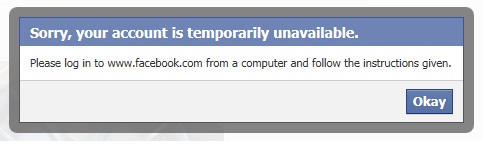
Clever observers will note that the recommendation to log in from a computer is misplaced, as I get it when I’m logged in from a computer. Facebook gives me no instructions when I log in (or when I log out and log in again), though it did once ask me to change my password, which I did.
Most likely, Facebook’s algorithms believe I’ve violated some part of the Terms of Service, such as by repetitive posting or other spammy behavior. My exclusion from the site began contemporaneous with my attempt to post a single comment that failed for reasons I couldn’t discern in several tries.
Undoubtedly, my friends at Facebook will leap to my aid and clear this up for me in short order, feeling slightly stung that I “went public” with the problem rather than going to them. But I wanted to experience this as an ordinary consumer, not as a member of the digerati with insider access to people at important companies. In the past, I’ve used insider access with services like PayPal and (the now defunct) Bitcoin7 to get help that an ordinary user couldn’t have gotten. Bully for me that I can do that, but my experience is atypical and no basis for observing how the world works.
Some observations: Continue reading →
I’ve grown increasingly tired of the fight over not just retransmission consent, but almost all TV regulation in general. Seriously, why is our government still spending time fretting over a market that is more competitive, diverse and fragmented than most other economic sectors? It’s almost impossible to keep track of all the innovation happening on this front, although I’ve tried here before. Every metric — every single one — is not just improving but exploding. Just what’s happening on the kids’ TV front is amazing enough, but the same story is playing out across other programming genres and across multiple distribution platforms.
More proof of just how much more diverse and fragmented content and audiences are today comes in this excellent new guest editorial over at GigaOm, “The Golden Age of Choice and Cannibalization in TV,” by Mike Hudack, CEO of Blip.tv. Hudack notes that, compared to the Scarcity Era, when we had fewer choices and were all forced to watch pretty much the same thing, today’s media cornucopia is overflowing, and audiences are splintering as a result. “Media naturally trends towards fragmentation,” he notes. “As capacity increases so does choice. As choice increases audiences fragment. When given a choice people generally prefer media that speaks to them as individuals over media that speaks to the ‘masses.’”
Indeed, he cites Nielsen numbers I’ve used here before illustrating how the top shows of the 50’s (like Texaco Star Theater) netted an astonishing 60-80% of U.S. television households while more recent hits, like American Idol is lucky if it can manage over 15% audience share. He concludes, therefore, that: Continue reading →
Today I am testifying at an FCC hearing on “Serving the Public Interest in the Digital Era.” [Speaker lineup here.] The purpose of the workshop is to explore:
- A brief history and overview of policies involving “public interest” requirements for commercial media and telecommunications companies;
- The state of local commercial broadcast TV and radio news and information; and
- The impact of media convergence and the emergence of the Internet, mobile technologies, and digital media on FCC media policy.
In my remarks, I focused on “Why Expansion of the FCC’s Public Interest Regulatory Regime is Unwise, Unneeded, Unconstitutional, and Unenforceable.” Down below I have attached my written remarks. Continue reading →
No one disputes that a key goal of the FCC is to help foster diversity in, and minority access to, channels of communication. In practice, this all too often has been interpreted to mean ownership limits, set-asides, preferences and other mandates imposed by the Commission. Usually lost in the heated debates is the fact that ill-considered regulation itself can impede minority access and diversity.
In comments filed last week, a group of sixteen minority and civil rights organizations — ranging from the Lawyers’ Committee for Civil Rights Under Law to the National Conference of Black Mayors — argue that net neutrality regulation may do just that. “[T]his proceeding implicates one of the most important civil rights issues of our time,” the comments –written by David Honig of the Minority Media and Telecommunications Council — assert. Continue reading →
I’ve just released a new PFF white paper looking at the hysteria that has often accompanied major media mergers and then taking a look at the marketplace reality years after the fact. Here‘s the PDF, but I have also pasted the entire thing down below.
_____________________________
A Brief History of Media Merger Hysteria:
From AOL-Time Warner to Comcast-NBC
by Adam Thierer
Although the pending union of Comcast and NBC Universal has not yet made it to the altar, Chicken Little-esque wails about the marriage have already begun in earnest. For example, the pro-regulatory media organization Free Press has already set up a website to complain about the deal.[1] And Jeff Chester, executive director of the Center for Digital Democracy, has called it “an unholy marriage.”[2] The fever only promises to spread once the deal is formally announced, and a lengthy fight over the deal is expected at the Federal Communications Commission (FCC) and whichever antitrust agency reviews the deal.[3]
But reality tends to play out somewhat less dramatically than the script penned by the media worrywarts. It’s worth looking back at some of the more prominent examples of media merger hysteria in recent years to understand why such panic is unwarranted, and why a deal between Comcast and NBC Universal is unlikely to lead to the sort of problems that the pessimists suggest.[4] Continue reading →
Adam Thierer & I have just released a detailed examination (PDF) of brewing efforts to expand the Children’s Online Privacy Protection Act of 1998 to cover adolescents and potentially all social networking sites—an approach we call “COPPA 2.0.”
As Adam explained on Larry Magid’s CNET podcast, COPPA mandates certain online privacy protections for children under 13, most importantly that websites obtain the “verifiable consent” of a child’s parent before collecting personal information about that child or giving that child access to interactive functionality that might allow the child to share their personal information with others. The law was intended primarily to “enhance parental involvement in a child’s online activities” as a means of protecting the online privacy and safety of children.
Yet advocates of expanding COPPA—or “COPPA 2.0″—see COPPA’s verifiable parental consent framework as a means for imposing broad regulatory mandates in the name of online child safety and concerns about social networking, cyber-harassment,
etc. Two COPPA 2.0 bills are currently pending in New Jersey and Illinois. The accelerated review of COPPA to be conducted by the FTC next year (five years ahead of schedule) is likely to bring to Washington serious talk of expanding COPPA—even though Congress clearly rejected covering adolescents age 13-16 when COPPA was first proposed back in 1998.
We’ll discuss some of the key points of our paper in a series of blog posts, but here are the top nine reasons for rejecting COPPA 2.0, in that such an approach would:
- Burden the free speech rights of adults by imposing age verification mandates on many sites used by adults, thus restricting anonymous speech and essentially converging—in terms of practical consequences—with the unconstitutional Children’s Online Protection Act (COPA), another 1998 law sometimes confused with COPPA;
- Burden the free speech rights of adolescents to speak freely on—or gather information from—legal and socially beneficial websites;
- Hamper routine and socially beneficial communication between adolescents and adults;
- Reduce, rather than enhance, the privacy of adolescents, parents and other adults because of the massive volume of personal information that would have to be collected about users for authentication purposes (likely including credit card data);
Continue reading →
 I haven’t been blogging much lately because, along with my PFF colleagues Berin Szoka and Adam Marcus, I’m working on a lengthy paper about the importance of Section 230 to Internet freedom. Section 230 is the sometimes-forgotten portion of the Communications Decency Act of 1996 that shielded Internet Service Providers (ISP) from liability for information posted or published on their systems by users or other third parties. It was enshrined into law with the passage of the historic Telecommunications Act of 1996. Importantly, even though the provisions of the CDA seeking to regulate “indecent” speech on the Internet were struck down as unconstitutional, Sec. 230 was left untouched.
Section 230 of the CDA may be the most important and lasting legacy of the Telecom Act and it is indisputable that it has been remarkably important to the development of the Internet and online free speech and expression in particular. In many ways, Section 230 is the cornerstone of “Internet freedom” in its truest and best sense of the term.
In recent years, however, Sec. 230 has come under fire from some academics, judges, and other lawmakers. Critics raise a variety of complaints — all of which we will be cataloging and addressing in our forthcoming PFF paper. But what unifies most of the criticisms of Sec. 230 is the belief that Internet “middlemen” (which increasingly includes almost any online intermediary, from ISPs, to social networking sites, to search engines, to blogs) should do more to police their networks for potentially “objectionable” or “offensive” content. That could include many things, of course: cyberbullying, online defamation, harassment, privacy concerns, pornography, etc. If the online intermediaries failed to engage in that increased policing role, they would open themselves up to lawsuits and increased liability for the actions of their users.
The common response to such criticisms — and it remains a very good one — is that the alternative approach of strict secondary liability on ISPs and other online intermediaries would have a profound “chilling effect” on online free speech and expression. Indeed, we should not lose sight of what Section 230 has
already done to create vibrant, diverse online communities. Brian Holland, a visiting professor at Penn State University’s Dickinson School of Law, has written a brilliant paper that does a wonderful job of doing just that. It’s entitled “In Defense of Online Intermediary Immunity: Facilitating Communities of Modified Exceptionalism” and it can be found on SSRN here. I cannot recommend it highly enough. It is a masterpiece.
Continue reading →
 Faithful readers will recall that, several months ago, I penned a 7-part “Media Metrics” series that took a hard look at the health of the media marketplace. Today, the Progress & Freedom Foundation is releasing a greatly expanded version of these essays that I have put together with my PFF colleague Grant Eskelsen. In this 100-page special report, “Media Metrics: The True State of the Modern Media Marketplace,” we begin by noting that heated debates about the state of the media marketplace continue to rage in Washington, and opinions seem to range from grim to outright apocalyptic. As we note on pg. 1:
Many people—including a large number of legislators and regulators—argue that America’s media marketplace is in a miserable state. Some claim that citizens lack choice in media outlets and that options are just as scarce as ever. Others believe that media “localism” is dead or that many groups or niches go underserved because of a lack of true “diversity” in media. Others argue that the market is hopelessly over-concentrated in the hands of a few evil media barons who are hell-bent on force-feeding us corporate propaganda. And still others say that the quality of news and entertainment in our society has deteriorated because of a combination of all of the above. It all sounds quite troubling, but is any of it true?
After taking an objective look at the true state of America’s media marketplace, we conclude that such pessimism is unwarranted. Indeed, a careful review of the facts reveals that—contrary to what those media critics suggest—we have more media choice, more media competition, and more media diversity than ever before. Indeed, to the extent there was ever a “golden age” of media in America, we are living in it today. The media sky has never been brighter and it is getting brighter with each passing year.
Continue reading →

 The Technology Liberation Front is the tech policy blog dedicated to keeping politicians' hands off the 'net and everything else related to technology.