I have a new R Street Institute policy study out this week doing a deep dive into the question: “Can We Predict the Jobs and Skills Needed for the AI Era?” There’s lots of hand-wringing going on today about AI and the future of employment, but that’s really nothing new. In fact, in light of past automation panics, we might want to step back and ask: Why isn’t everyone already unemployed due to technological innovation?
To get my answers, please read the paper! In the meantime, here’s the executive summary:
To better plan for the economy of the future, many academics and policymakers regularly attempt to forecast the jobs and worker skills that will be needed going forward. Driving these efforts are fears about how technological automation might disrupt workers, skills, professions, firms and entire industrial sectors. The continued growth of artificial intelligence (AI), robotics and other computational technologies exacerbate these anxieties.
Yet the limits of both our collective knowledge and our individual imaginations constrain well-intentioned efforts to plan for the workforce of the future. Past attempts to assist workers or industries have often failed for various reasons. However, dystopian predictions about mass technological unemployment persist, as do retraining or reskilling programs that typically fail to produce much of value for workers or society. As public efforts to assist or train workers move from general to more specific, the potential for policy missteps grows greater. While transitional-support mechanisms can help alleviate some of the pain associated with fast-moving technological disruption, the most important thing policymakers can do is clear away barriers to economic dynamism and new opportunities for workers.
I do discuss some things that government can do to address automation fears at the end of the paper, but it’s important that policymakers first understand all the mistakes we’ve made with past retraining and reskilling efforts. The easiest thing to do to help in the short-term is clear away barriers to labor mobility and economic dynamism, I argue. Again, read the study for details.
For more info on other AI policy developments, check out my running list of research on AI, ML robotics policy.
We hear a lot today about the importance of “disruptive innovation,” “deep technologies,” “moonshots,” and even “technological miracles.” What do these terms mean and how are they related? Are they just silly clichés used to hype techno-exuberant books, articles, and speeches? Or do these terms have real meaning and importance?
This article explores those questions and argues that, while these terms are confronted with definitional challenges and occasional overuse, they retain real importance to human flourishing, economic growth, and societal progress.
Basic Concepts
Don Boudreaux defines moonshots as, “radical but feasible solutions to important problems” and Mike Cushing has referred to them as “innovation that achieves the previously unthinkable.” “Deep technology” is another buzzword being used to describe such revolutionary and important innovations. Swati Chaturvedi of investment firm Propel[x] says deep technologies are innovations that are “built on tangible scientific discoveries or engineering innovations” and “are trying to solve big issues that really affect the world around them.”
“Disruptive technology” or “game-changing innovations” are other terms that are often used in reference to technologies and inventions with major societal impacts. “Transformative technologies” is another increasingly popular term, albeit one focused mostly on health and wellness-related innovations. Continue reading →
I recently posted an essay over at The Bridge about “The Pacing Problem and the Future of Technology Regulation.” In it, I explain why the pacing problem—the notion that technological innovation is increasingly outpacing the ability of laws and regulations to keep up—“is becoming the great equalizer in debates over technological governance because it forces governments to rethink their approach to the regulation of many sectors and technologies.”
In this follow-up article, I wanted to expand upon some of the themes developed in that essay and discuss how they relate to two other important concepts: the “Collingridge Dilemma” and technological determinism. In doing so, I will build on material that is included in a forthcoming law review article I have co-authored with Jennifer Skees, Ryan Hagemann (“Soft Law for Hard Problems: The Governance of Emerging Technologies in an Uncertain Future”) as well as a book I am finishing up on the growth of “evasive entrepreneurialism” and “technological civil disobedience.”
Recapping the Nature of the Pacing Problem
First, let us quickly recap that nature of “the pacing problem.” I believe Larry Downes did the best job explaining the “problem” in his 2009 book on
The Laws of Disruption. Downes argued that “technology changes exponentially, but social, economic, and legal systems change incrementally” and that this “law” was becoming “a simple but unavoidable principle of modern life.” Continue reading →
What happens when technological innovation outpaces the ability of laws and regulations to keep up?
This phenomenon is known as “the pacing problem,” and it has profound ramifications for the governance of emerging technologies. Indeed, the pacing problem is becoming the great equalizer in debates over technological governance because it forces governments to rethink their approach to the regulation of many sectors and technologies.
The Innovation Cornucopia
Had Rip Van Winkle woken up his famous nap today, he’d be shocked by all the changes around him. At-home genetics tests, personal drones, driverless cars, lab-grown meats, and 3D-printed prosthetic limbs are just some of the amazing innovations that would boggle his mind. New devices and services are flying at us so rapidly that we sometimes forget that most did not even exist a short time ago. Continue reading →
“The quickest way to find out who your enemies are is to try doing something new.” Thus begins Innovation and Its Enemies, an ambitious new book by Calestous Juma that will go down as one of the decade’s most important works on innovation policy.
Juma, who is affiliated with the Harvard Kennedy School’s Belfer Center for Science and International Affairs, has written a book that is rich in history and insights about the social and economic forces and factors that have, again and again, lead various groups and individuals to oppose technological change. Juma’s extensive research documents how “technological controversies often arise from tensions between the need to innovate and the pressure to maintain continuity, social order, and stability” (p. 5) and how this tension is “one of today’s biggest policy challenges.” (p. 8)
What Juma does better than any other technology policy scholar to date is that he identifies how these tensions develop out of deep-seated psychological biases that eventually come to affect attitudes about innovations among individuals, groups, corporations, and governments. “Public perceptions about the benefits and risks of new technologies cannot be fully understood without paying attention to intuitive aspects of human psychology,” he correctly observes. (p. 24) Continue reading →
I recently finishedLearning by Doing: The Real Connection between Innovation, Wages, and Wealth, by James Bessen of the Boston University Law School. It’s a good book to check out if you are worried about whether workers will be able to weather this latest wave of technological innovation. One of the key insights of Bessen’s book is that, as with previous periods of turbulent technological change, today’s workers and businesses will obviously need find ways to adapt to rapidly-changing marketplace realities brought on by the Information Revolution, robotics, and automated systems.
That sort of adaptation takes time, but for technological revolutions to take hold and have meaningful impact on economic growth and worker conditions, it requires that large numbers of ordinary workers acquire new knowledge and skills, Bessen notes. But, “that is a slow and difficult process, and history suggests that it often requires social changes supported by accommodating institutions and culture.” (p 223) That is not a reason to resist disruptive forms of technological change, however. To the contrary, Bessen says, it is crucial to allow ongoing trial-and-error experimentation and innovation to continue precisely because it represents a learning process which helps people (and workers in particular) adapt to changing circumstances and acquire new skills to deal with them. That, in a nutshell, is “learning by doing.” As he elaborates elsewhere in the book:
Major new technologies become ‘revolutionary’ only after a long process of learning by doing and incremental improvement. Having the breakthrough idea is not enough. But learning through experience and experimentation is expensive and slow. Experimentation involves a search for productive techniques: testing and eliminating bad techniques in order to find good ones. This means that workers and equipment typically operate for extended periods at low levels of productivity using poor techniques and are able to eliminate those poor practices only when they find something better. (p. 50)
Luckily, however, history also suggests that, time and time again, that process has happened and the standard of living for workers and average citizens alike improved at the same time. Continue reading →
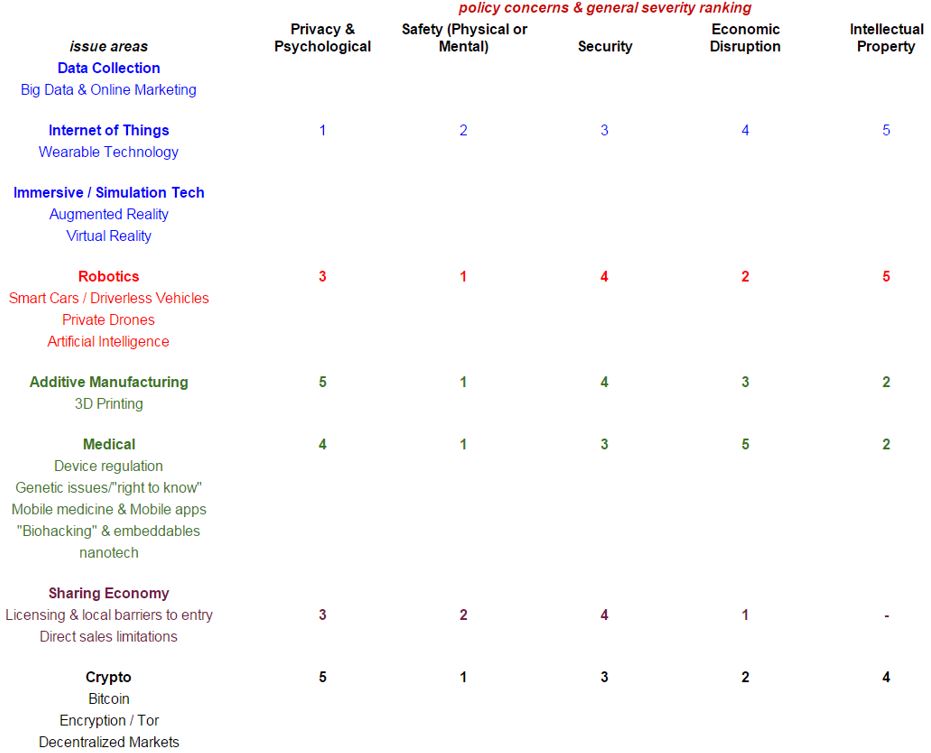
On the whiteboard that hangs in my office, I have a giant matrix of technology policy issues and the various policy “threat vectors” that might end up driving regulation of particular technologies or sectors. Along with my colleagues at the Mercatus Center’s Technology Policy Program, we constantly revise this list of policy priorities and simultaneously make an (obviously quite subjective) attempt to put some weights on the potential policy severity associated with each threat of intervention. The matrix looks like this: [Sorry about the small fonts. You can click on the image to make it easier to see.]
I use 5 general policy concerns when considering the likelihood of regulatory intervention in any given area. Those policy concerns are:
privacy (reputation issues, fear of “profiling” & “discrimination,” amorphous psychological / cognitive harms);
safety (health & physical safety or, alternatively, child safety and speech / cultural concerns);
security (hacking, cybersecurity, law enforcement issues);
Ian Brown and Christopher T. Marsden’s new book, Regulating Code: Good Governance and Better Regulation in the Information Age, will go down as one of the most important Internet policy books of 2013 for two reasons. First, their book offers an excellent overview of how Internet regulation has unfolded on five different fronts: privacy and data protection; copyright; content censorship; social networks and user-generated content issues; and net neutrality regulation. They craft detailed case studies that incorporate important insights about how countries across the globe are dealing with these issues. Second, the authors endorse a specific normative approach to Net governance that they argue is taking hold across these policy arenas. They call their preferred policy paradigm “prosumer law” and it envisions an active role for governments, which they think should pursue “smarter regulation” of code.
In terms of organization, Brown and Marsden’s book follows the same format found in Milton Mueller’s important 2010 book Networks and States: The Global Politics of Internet Governance; both books feature meaty case studies in the middle bookended by chapters that endorse a specific approach to Internet policymaking. (Incidentally, both books were published by MIT Press.) And, also like Mueller’s book, Brown and Marsden’s Regulating Code does a somewhat better job using case studies to explore the forces shaping Internet policy across the globe than it does making the normative case for their preferred approach to these issues. Continue reading →
A reporter recently interviewed me for a story and asked a terrific question: Why is it that business model disruption and creative destruction seem to have sped up in recent times? My guess — and excuse me if this seems too obvious — is that it must have something to do with the very nature of intangible, digital technologies of the new economy versus the tangible, analog technologies of the old economy. That is, in markets built largely upon binary code, the pace and nature of change becomes relentlessly hyper-Schumpeterian precisely because digital technologies and platforms are more easily disintermediated and leap-frogged than earlier tangible technologies and platforms were. And so we get creative destruction on steroids.
Consider, for example, what constituted a “social networking site” in the old days versus today. Our old social networking sites and services in the past were town squares, parks, school parking lots, shopping malls, as well as media like newspapers, magazines, and even the mail. When we socially networked in those environments, we were creatures of our fixed, “real-space” environments as well as their many natural constraints. Disrupting, replacing, or even replicating those environments, technologies, or platforms was a monumental undertaking precisely because of the enormous costs associated with doing so. Continue reading →
Jack Shafer, editor at large of Slate, is my favorite media pundit. Everything he does is worth reading, and his column this week is no different. It’s entitled “The Digital Slay-Ride: What’s killing newspapers is the same thing that killed the slide rule,” and in it he notes how “Hardly a day goes by, it seems, without some laid-off or bought-out journalist writing a letter of condolence to himself and his profession.” “The underlying cause of their grief,” Shafer argues, “can be traced to the same force that has destroyed other professions and industries: digital technology.” He recalls how people scoffed back in 1993 when Wired founder Louis Rossetto’s said that the “digital revolution is whipping through our lives like a Bengali typhoon” and destroying the old order. But no one is laughing anymore. As I noted in my Media Metrics report, digital disruption and disintermediation has completely upended the media marketplace, as well as countless others. Toward that end, Shafer actually starts a list of professions or technologies that have been “typhooned” by the digital revolution. It’s a pretty amazing (and entertaining) list for those of us old enough to remember when all these things were dominate in our society and economy. Can you think of others?
• Bank tellers
• Typewriters
• Typesetting
• Carburetors
• Vacuum tubes
• Slide rules
• Disc jockeys
• Stockbrokers
• Telephone operators
• Yellow pages
• Repair guys
• Bookbinders
• Pimps (displaced by the cell phone and the Web)
• Cassette and reel-to-reel recorders
• VCRs
• Turntables
• Video stores
• Record stores
• Bookstores
• Recording industry
• Courier/messenger services
• Travel agencies
• Print and cinematic porn
• Porn actors
• Stenographers
• Wired telcos
• Drummers
• Toll collectors (slayed by the E-ZPass)
• Book publishing (especially reference works)
• Conventional-watch makers
• “Browse” shopping
• U.S. Postal Service
• Printing-press makers
• Film cameras
• Kodak (and other film-stock makers)
The Technology Liberation Front is the tech policy blog dedicated to keeping politicians' hands off the 'net and everything else related to technology. Learn more about TLF →



 The Technology Liberation Front is the tech policy blog dedicated to keeping politicians' hands off the 'net and everything else related to technology.