At this week’s excellent State of the Net 2011 event, I participated in a panel discussion about the future of the online video marketplace. Unsurprisingly, a great deal of time was spent discussing the Federal Communications Commission’s (FCC) recent approval of the proposed merger of Comcast and NBC Universal (NBCU). On Tuesday, the agency voted 4-1 to approve the deal with myriad conditions and “voluntary” concessions being attached. The FCC voted on the matter and issued a short press release and late today issued its final 279-page order.
The Commission’s Comcast-NBCU order represents an unprecedented regulatory shakedown of a company that obviously would have done just about anything to gain approval of the deal. I believe the conditions the FCC has imposed on the deal, which are to run for seven years, are tantamount to a death by a thousand cuts for the deal and, ultimately, could lead to its failure. That’s because the requirements placed on the new entity make it practically impossible for Comcast to leverage the content it is acquiring from NBCU and profit from it such that they can recoup the significant costs associated with the deal.
In essence, Comcast-NBCU was forced to preemptively surrender much of its intellectual property rights by agreeing to share most of their content properties with others on terms someone else will determine. That’s a recipe for disaster. If Comcast-NBCU doesn’t have the right and ability to cut deals on terms that they find advantageous to the company and its shareholders, then why go through with this deal at all? Isn’t the whole point of such a deal with get some additional in-house content properties — something Comcast almost completely lacked previously — such that it would have some content gems to highlight and leverage in an attempt to attract new customers (or just keep old ones)? If someone else is constantly setting the terms of their deals, it will limit the inherent value of the IP owned by Comcast-NBCU and sap most of the value from the deal. Continue reading →
By Adam Thierer & Berin Szoka
The Wall Street Journal reports (see Financial Times, too) that “CBS Corp. and Walt Disney Co. are considering participating in Apple Inc.’s plan to offer television subscriptions over the Internet, according to people familiar with the matter, as Apple prepares a potential new competitor to cable and satellite TV.”
If Apple signs up enough networks to launch a viable service—still a very big if—it could ultimately alter the economics of the television business. The service could undermine the big bundles of channels that cable, satellite and telecommunications companies, including Comcast Corp. and DirecTV Inc., have traditionally sold in packages to subscribers.
And Brian Stelter of The New York Times says of the plan:
Broadband Internet subscriptions to TV networks could potentially destabilize the bedrock of the television business, which relies on subscribers paying for dozens of bundled channels.
As we have noted have noted here in our ongoing “Cutting the Video Cord” series, it’s just another sign that the video marketplace is vibrantly competitive and experiencing unprecedented innovation. So, why is Washington regulating this marketplace like we still live in the disco era?
The
New York Times itself seems to be of two minds on this: Brian seems to recognize that the rise of Internet television means that cable providers no longer have any sort of special “gatekeeper” or “bottleneck” control over the programming available to consumers, just as his colleague Nick Bilton at the Times‘ BITS blog recently declared that “Cable Freedom Is a Click Away.” And yet, as Berin recently noted, when the DC Circuit struck down the FCC’s outdated 30% cap on the number of homes a single cable provider could serve (based on “gatekeeper” concerns) back in September, the Times editorial page bemoaned the decision and demanded further regulation of the cable industry—even as Internet TV is fundamentally changing the marketplace for video programming and rendering moot “gatekeeper” concerns far more effectively than any law could ever do.
“Right hand, meet Left hand. Howyadoinnicetameetcha!”
Thanks to comments on my earlier post, Copyright Duration and the Mickey Mouse Curve, I’ve been encouraged to reflect on what would happen if, in fact, Steamboat Willie had fallen into the public domain. Could we then reuse Mickey Mouse, the star of that show, without facing any liability to the Walt Disney Company? I drafted this answer for my book, Intellectual Privilege (here edited for blogging):
Scholars have made surprisingly strong arguments that
Steamboat Willie, a cartoon that the Walt Disney Company cites as establishing its copyright rights in Mickey Mouse, has fallen into the public domain. As a thought experiment, let us assume the truth of that claim. What would happen if Walt Disney Company—if, indeed, nobody—held a copyright in Steamboat Willie? Certainly, each of use would by default enjoy complete freedom to copy, distribute, display, or perform the cartoon, because the expiration of the work’s copyright would also end the exclusive rights of the Walt Disney Company and its assigns the exercise those statutory privileges. So, too, would we escape copyright’s limitations on making derivative versions of Steamboat Willie—versions that might show Mickey standing at a lectern rather than at a pilot’s wheel, for instance, or have him expounding on copyright law.
The Walt Disney Company would retain its copyrights in later, plumper versions of the Mickey Mouse, of course. Contemporary artists wanting to reinterpret the character free from the company’s veto would thus have to draw inspiration primarily from the earlier, skinnier, version. Given that the characters would share a common ancestor, however, even mice derived solely from
Steamboat Willie would often strongly resemble the modern-day Mickey Mouse.
Continue reading →
Herewith another recent addition to my draft book, Intellectual Privilege: A Libertarian View of Copyright, (inspired, in part, by Berin Szoka’s recent claim, “I just don’t know what the right balance [for copyright] is! I’m glad there are others patient enough to try to figure it out. This is why we have economists and… yes, even lawyers!”):
As an illustration of the public choice pressures that drive copyright policy, consider the fate of the copyright in
Steamboat Willie, a 1928 cartoon that the Walt Disney Company cites as establishing its copyright claim in Mickey Mouse. Scholars have made a surprisingly strong case that, because the requisite formalities of the 1909 Copyright Act were not satisfied, Steamboat Willie has fallen into the public domain. The Walt Disney Company has responded to such claims by threatening to bring suit for “slander of title,” demonstrating how seriously it takes its copyright in Steamboat Willie. Let us take that copyright seriously, too, then, so that we might better understand the public choice effects of the Walt Disney Company’s interests.
Term&MMCurve.gif%20)
This is just a listing of the installments of my ongoing “Media Deconsolidation Series.” I needed to create a single repository of all the essays so I could point back to them in future articles and papers. For those not familiar with it, this series represents an effort to set the record straight regarding the many myths surrounding the media marketplace. These myths are usually propagated by a group of radical anti-media regulatory activists who I call the “media reformistas.” Sadly, however, many policymakers, journalists, and members of the public are buying into some of these myths, too.
In particular, I have spent much time here debunking the notion that rampant consolidation is taking place and that media operators are only growing larger and devouring more and more companies. In fact, nothing could be further from the truth. Over the past several years, traditional media operators and sectors have been coming apart at the seams in the face of unprecedented innovation and competition. The volume of divestiture activity has been quite intense, and most traditional media operators have been getting smaller, not bigger. As a result, America’s media marketplace is growing more fragmented and atomistic with each passing day.
Anyway, here’s the series so far…
Continue reading →
In her latest column, Media Post media market guru Diane Mermigas wonders how long it will be before we see a traditional over-the-air (OTA) broadcast TV network (like ABC, NBC, CBS, or Fox) dump their old broadcast business altogether and just move all their properties to cable and satellite TV. And, in response to Mermigas, Cory Bergman of Lost Remote argues, as I did last week, “the real future of TV is not linear cable, but non-linear video delivered seamlessly via IP to multiple devices, including your TV set. But mass adoption of this approach is still several years away.”
Bergman is right. It would be foolish to think any traditional network is going to rely exclusively on IP-based distribution any time soon; they see it as more of a compliment (or another product window). But Mermigas may be on to something in predicting that broadcast networks may soon be looking to get out of the OTA television business altogether and essentially become “a glorified general entertainment cable network.”
The strain on their dysfunctional paradigm is emanating from a devastating recession and the ongoing digital revolution. Both are permanently altering the rules of play for the networks. A case can be made for at least one of the Big 4 broadcast networks emerging as a glorified general entertainment cable network within the next several years. The economic advantages: more steady ad revenues and consistent subscriber fees as content is distributed cross-platform.
It would be a bold move that a free-spirited company such as News Corp. might already be contemplating for its Fox Broadcast TV Network, or NBC Universal for its peacock network. Industry analysts increasingly wonder how an independent CBS can prattle on under the crumbling old rules. In a world of exploding access and choices, the prime-time ratings (even with Live plus 3 configurations) spell diminishing returns. For Disney, ABC’s general entertainment status is on par with ESPN in sports; the new multi-platform model is in place except for formally moving the ABC TV Network to the cable side of the ledger.
Continue reading →
Over at Ars, Ben Kuchera has a review of Ask.com’s redesign of its web portal for kids, AskKids.com. It’s a great new addition to the growing list of safe seach tools and web portals geared toward younger surfers.

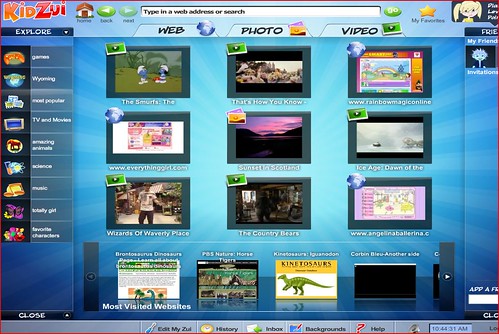
I’m also a big fan of KidZui, the new browser for kids that provides access to over 800,000 kid-friendly websites, videos, and pictures that have been pre-screened by over 200 trained teachers and parents. The company employs a rigorous 5-step “content selection process” to determine if it is acceptable for kids between 3-12 years of age. My kids, both under the age of 7, just love it, but I can’t see many kids older than 10 enjoying it because it is mostly geared toward the youngest web surfers.
Last year, as part of my 10-part series coinciding with “Internet Safety Month,” I wrote about the market for safe search tools and web portals for kids. I generally divide these sites and services into two groups:
(1)
“Safe Search” Tools and Portals for Kids
(2)
Child- and Teen-Oriented Websites
Below I will describe each group and list the many sites and services currently available. I encourage readers to offer additional suggestions for sites that belong on the list. (I keep a running list of these sites and services in my book, “Parental Controls and Online Child Protection: A Survey of Tools & Methods.”)
Continue reading →

 The Technology Liberation Front is the tech policy blog dedicated to keeping politicians' hands off the 'net and everything else related to technology.