Yesterday at Forbes, William Pentland had an interesting piece on possible disintermediation in the electricity market.
In New York and New England, the price of electricity is a function of the cost of natural gas plus the cost of the poles and wires that carry electrons from remotely-sited power plants to end users. It is not unusual for customers to spend two dollars on poles and wires for every dollar they spend on electrons.
The poles and wires that once reduced the price of electricity for end users are now doing the opposite. To make matters worse, electricity supplied through the power grid is frequently less reliable than electricity generated onsite. In other words, rather than adding value in the form of enhanced reliability, the poles and wires diminish the reliability of electricity.
If two thirds of the cost of electricity is the distribution mechanism, then, as Pentland notes, there is a palpable opportunity to switch to at-home electricity generation. Some combination of solar power, batteries, and natural gas-fired backup generators could displace the grid entirely for some customers. And if I understand my electricity economics correctly, if a significant fraction of customers go off-grid, the fixed cost of maintaining the grid will be split over fewer remaining customers, making centrally-generated electricity even more expensive. The market for such electricity could quickly unravel. Continue reading →
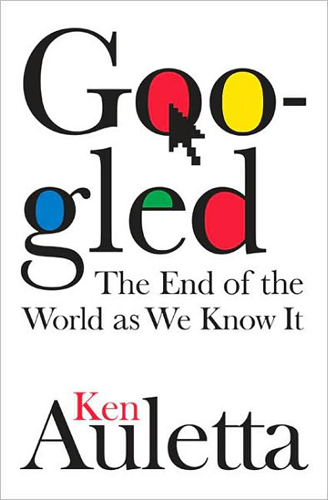 I just finished Ken Auletta’s latest book,
Googled: The End of the World As We Know It, and I highly recommend it. Auletta is an amazingly gifted journalist and knows how put together a hell of good story. It helps in this case that he was granted unprecedented access to the Google team and their day-to-day workings at the Googleplex. I’m really shocked by the level of access he was granted to important meetings and officials–over 150 interviews with Googlers, including 11 with CEO Eric Schmidt and several with founders Sergey Brin and Larry Page. That’s impressive.
I just finished Ken Auletta’s latest book,
Googled: The End of the World As We Know It, and I highly recommend it. Auletta is an amazingly gifted journalist and knows how put together a hell of good story. It helps in this case that he was granted unprecedented access to the Google team and their day-to-day workings at the Googleplex. I’m really shocked by the level of access he was granted to important meetings and officials–over 150 interviews with Googlers, including 11 with CEO Eric Schmidt and several with founders Sergey Brin and Larry Page. That’s impressive.
The book shares much in common with Randall Stross’s excellent Planet Google: One Company’s Audacious Plan to Organize Everything We Know, which I reviewed here earlier this year. Both books recount the history of Google from its early origins to present. And both survey a great deal of ground in terms of the challenges that Google faces as it matures and the policy issues that are relevant to the company (privacy, free speech, copyright law, etc).
What makes Auletta’s book unique is the way we taps his extensive “old media” world contacts and integrates such a diverse cast of characters into the narrative — Mel Karmazin (former Viacom, now Sirius XM), Bob Iger (Disney), Howard Stringer (Sony), Martin Sorrrell (WPP), Irwin Gotlieb (Group M), and even the Internet’s “inventor”–Al Gore! Auletta interviews them or recounts stories about their interactions with Google to show the growing tensions being created by this disruptive company and its highly disruptive technologies. There are some terrifically entertaining anecdotes in the book, but the bottom line is clear: Google has made a lot of enemies in a very short time.
Indeed, the book is as much about the decline of old media as it is about Google’s ascendancy. What Auletta has done so brilliantly here is to tell their stories together and ask how much old media’s recent woes can be blamed on Google and digital disintermediation in general. “If Google is destroying or weakening old business models,” Auletta argues, “it is because the Internet inevitably destroys old ways of doing things, spurs ‘creative destruction.’ This does not mean that Google is not ambitious to grow, and will not grow at the expense of others. But the rewards, and the pain, are unavoidable,” he concludes. Continue reading →
A few months ago, I penned a mega book review about the growing divide between “Internet optimists and pessimists.” I noted that the Internet optimists — people like Chris Anderson, Clay Shirky, Yochai Benkler, Kevin Kelly, and others — believe that the Internet is generally improving our culture, economy, and society for the better. They believe the Net has empowered and liberated the masses, sparked unparalleled human creativity and communication, provided greater personalization and customization of media content, and created greater diversity of thought and a more deliberative democracy. By contrast, the Internet pessimists — including Nick Carr, Andrew Keen, Lee Siegel, and others — argue that the Internet is destroying popular culture and professional media, calling “truth” and “authority” into question by over-glamorizing amateurism and user-generated content, and that increased personalization is damaging deliberative democracy by leading to homogenization, close-mindedness, and an online echo-chamber. Needless to say, it’s a very heated debate!
I am currently working on a greatly expanded version of my “Net optimists vs. pessimists” essay for a magazine in which I will draw out more of these distinctions and weigh the arguments made by those in both camps. I plan on concluding that article by arguing that the optimists generally have the better of the argument, but that the pessimists make some fair points about the downsides of the Net’s radically disintermediating role on culture and economy.
So, this got me thinking that I needed to come up with some sort of a label for my middle-of-the-road position as well as a statement of my personal beliefs. As far as labels go, I guess I would call myself a “pragmatic optimist” since I generally side with the optimists in most of these debates, but not without some occasional reservations. Specifically, I don’t always subscribe to the Pollyanna-ish, rose-colored view of the world that some optimists seem to adopt. But the outright Chicken Little-like Ludditism of some Internet pessimists is even more over-the-top at times. Anyway, what follows is my “Pragmatic (Internet) Optimist’s Creed” which better explains my views. (Again, read my old essay first for some context about the relevant battle lines in this intellectual war).
Continue reading →

 The Technology Liberation Front is the tech policy blog dedicated to keeping politicians' hands off the 'net and everything else related to technology.