 CBS and Time Warner Cable have been embroiled in a heated contractual battle over the past week that has resulted in viewers in some major markets losing access to CBS programming. When disputes like these go nuclear and signal blackouts occur, it is inevitable that some folks will call for policy interventions since nobody likes it when the content they love goes dark.
While some policy responses are warranted in this matter, policymakers should proceed with caution. Heated contractual negotiations are a normal part of any capitalist marketplace. We shouldn’t expect lawmakers to intervene to speed up negotiations or set content prices because that would disrupt the normal allocation of programming by placing a regulatory thumb too heavily on one side of the scale. This is why I am somewhat sympathetic to CBS in this fight. In an age when content creators struggle to protect their copyrighted content and get compensation for it, the last thing we need is government intervention that undermines the few distribution schemes that actually work well.
On the other hand, Time Warner Cable deserves sympathy here, too, since CBS currently enjoys some preexisting regulatory benefits. As I noted in this 2012
Forbes oped, “Toward a True Free Market in Television Programming,” many layers of red tape still encumber America’s video marketplace and prevent a truly free market in video programming from developing. The battle here revolves around the “retransmission consent” rules that were put in place as part of the Cable Act of 1992 and govern how video distributors carry signals from TV broadcasters, which includes CBS.
But those “retrans” rules are not the only part of the regulatory mess here. Continue reading →
Here are some quick thoughts on the proposed AT&T – T-Mobile merger, mostly borrowed from my previous writing on the wireless marketplace. First, however, I highly recommend this excellent analysis of the issue by Larry Downes, which cuts through the hysteria we’re already hearing and offers a sober look at the issues at stake here. Anyway, here are a few of my random thoughts on the deal:
-
The deal will likely be approved: First, to cut to the chase.. After much wrangling, the deal will probably be approved primarily because of two factors, both of which help political officials as much as AT&T: (1) The deal delivers upon the National Broadband Plan promise of getting the country blanketed with wireless broadband; and (2) it “brings home” T-Mobile by giving an American company control of a German-held interest. As Larry Dignan of ZNet says, it is tantamount to “playing the patriotism card.”
-
One reason it might not be approved: Some Administration critics, especially from the more liberal part of the Democratic base, could make this a litmus test for Obama administration’s antitrust enforcement efforts. In the wake of the Comcast merger approval — albeit after several pounds of flesh were handed over “voluntarily” to get the deal approved — some of the Administration’s base will be looking for blood. I remember how the Powell FCC was under real heat to “get tough” on mergers back in 2001-02 and during that time blocked the proposed DirecTV-EchoStar deal, possibly as a result of the pressure. The same thing could happen to AT&T – T-Mobile here.
-
It’s all about spectrum: From AT&T’s perspective, this deal is all about getting more high-quality spectrum, which is in increasingly short supply. Indeed, as Jerry Brito noted earlier, this merger should serve as another wake-up call regarding the need to get spectrum reform going again to ensure that existing players can reallocate their spectrum to those who demand it most. (Hint: Incentivize the TV broadcasters to sell... NOW!) But, in the short-term, this deal helps AT&T built out a more robust nationwide wireless network. Over the long-haul, that should help T-Mobile deliver better service to its customers. Continue reading →
I’ve just released a new PFF white paper looking at the hysteria that has often accompanied major media mergers and then taking a look at the marketplace reality years after the fact. Here‘s the PDF, but I have also pasted the entire thing down below.
_____________________________
A Brief History of Media Merger Hysteria:
From AOL-Time Warner to Comcast-NBC
by Adam Thierer
Although the pending union of Comcast and NBC Universal has not yet made it to the altar, Chicken Little-esque wails about the marriage have already begun in earnest. For example, the pro-regulatory media organization Free Press has already set up a website to complain about the deal.[1] And Jeff Chester, executive director of the Center for Digital Democracy, has called it “an unholy marriage.”[2] The fever only promises to spread once the deal is formally announced, and a lengthy fight over the deal is expected at the Federal Communications Commission (FCC) and whichever antitrust agency reviews the deal.[3]
But reality tends to play out somewhat less dramatically than the script penned by the media worrywarts. It’s worth looking back at some of the more prominent examples of media merger hysteria in recent years to understand why such panic is unwarranted, and why a deal between Comcast and NBC Universal is unlikely to lead to the sort of problems that the pessimists suggest.[4] Continue reading →
The D.C. Circuit has struck down as arbitrary and capricious the FCC’s “cable cap.” The cap prevented a single cable operator from serving more than 30% of U.S. homes—precisely the same percentage limit struck down by the court in 2001. The court ruled that the FCC had failed to demonstrate that “allowing a cable operator to serve more than 30% of all cable subscribers would threaten to reduce either competition or diversity in programming.”
The court’s decision rested on the two critical charts (both generated by my PFF colleague Adam Thierer in his excellent
Media Metrics special report) at the heart of the PFF amicus brief I wrote with our president, Ken Ferree:
First, the record is replete with evidence of ever increasing competition among video providers: Satellite and fiber optic video providers have entered the market and grown in market share since the Congress passed the 1992 Act, and particularly in recent years. Cable operators, therefore, no longer have the bottleneck power over programming that concerned the Congress in 1992.
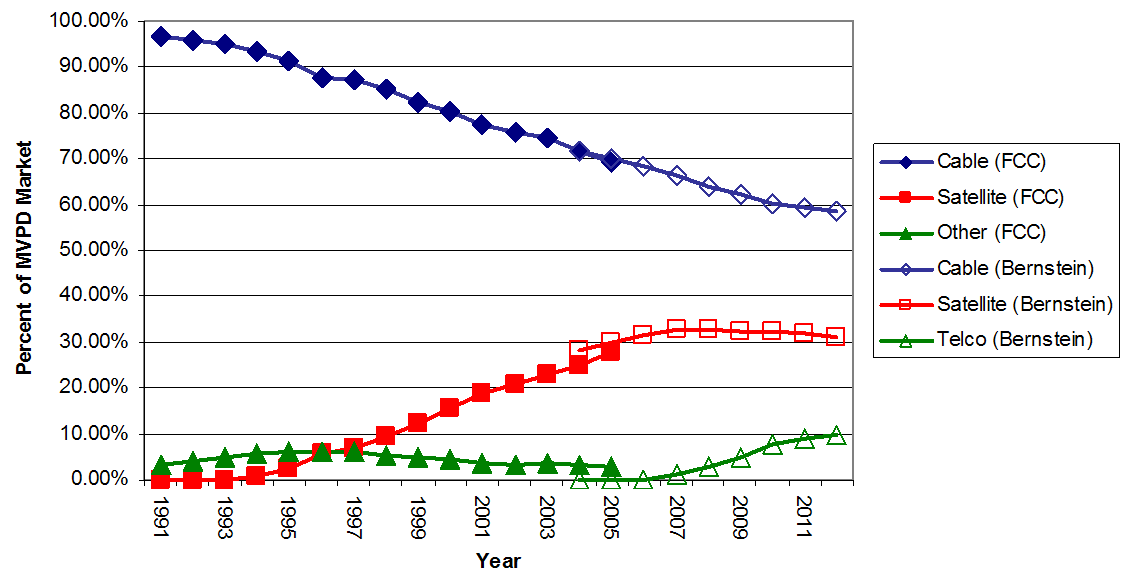
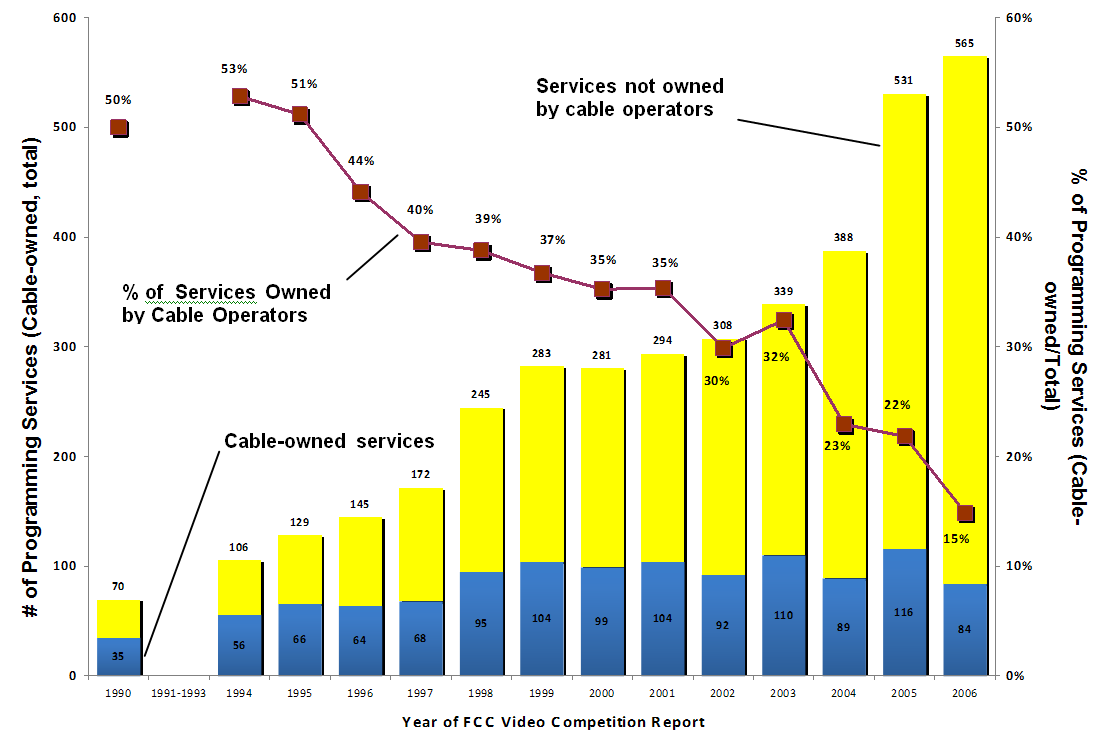
Second, over the same period there has been a dramatic increase both in the number of cable networks and in the programming available to subscribers.
Our chart shows the explosion in the number of programmers (though not the total amount of programming), as well as the falling rate of affiliation between cable operators and programmers, which was among the prime factors motivating Congress when it authorized a cable cap in the 1992 Cable Act:
Continue reading →
Just as the 505-day XM Sirius antitrust saga comes to a bittersweet end, reports have resurfaced that a new satellite merger may be in the works. Dish Network is floating the idea of merging with competitor DirecTV. Dish Network and DirecTV, the two largest satellite television providers in the U.S., tried to merge back in 2001. Antitrust officials ultimately blocked that merger, concluding that it would hurt competition in television programming. Naturally, a renewed merger attempt would likely encounter similar obstacles, according to industry observers.
This time around, though, the deal may have a better shot of surviving regulatory scrutiny, buoyed by the approval of the XM-Sirius merger. Compared to 2001, competition among video providers is thriving, and there are more alternatives to satellite television than ever before. Many consumers can now choose from a multitude of terrestrial television providers—phone companies are rapidly rolling out IPTV-based video services like FiOS TV and U-Verse, and cable overbuilders like RCN are gaining momentum in densely populated areas.
In addition, a growing number of viewers are shunning traditional television services entirely, turning to a la carte substitutes like the iTunes episode store, Netflix, and Xbox Live Marketplace. With an $8.99 per month subscription to Netflix, it’s possible to stream instantly a video library eclipsing that available on cable or satellite TV. Ad-supported video websites like Hulu and Comedy Central, which offer hundreds of archived TV shows on the Web for free, may soon render the television channel obsolete.
Dish Network’s talk of a potential merger comes on the heels of the company’s first ever quarterly loss of subscribers, and that may just be the tip of an iceberg. Until recently, television subscribers were largely content with watching programs on a predefined schedule, but on-demand services are changing that. As viewers come to expect the ability to watch any show anytime, without bothering to record it in advance, the lack of bidirectionality inherent in Direct-Broadcast Satellite is a glaring deficiency that cable and telecom firms will exploit at every juncture. Unless satellite providers can negotiate arrangements with broadband carriers, or succeed in building wireless networks with newly acquired spectrum, Dish and DirecTV face a bleak future, especially if they are unable to trim costs and enhance content choice.
Continue reading →
 CBS and Time Warner Cable have been embroiled in a heated contractual battle over the past week that has resulted in viewers in some major markets losing access to CBS programming. When disputes like these go nuclear and signal blackouts occur, it is inevitable that some folks will call for policy interventions since nobody likes it when the content they love goes dark.
 The Technology Liberation Front is the tech policy blog dedicated to keeping politicians' hands off the 'net and everything else related to technology.