“The only thing Europe exports now on the digital-technology front is regulation,” I noted in my response, and that makes it all the more mind-boggling that Biden and Barr want to go down that same path. “[T]he EU’s big-government regulatory crusade against digital tech: Stagnant markets, limited innovation and a dearth of major players. Overregulation by EU bureaucrats led Europe’s best entrepreneurs and investors to flee to the U.S. or elsewhere in search of the freedom to innovate.”
Thus, the Biden and Barr plans for importing European-style tech mandates, “would be a stake through the heart of the ‘permissionless innovation’ that made America’s info-tech economy a global powerhouse.” In a longer response to the Biden oped that I published on the R Street blog, I note that:
“It is remarkable to think that after years of everyone complaining about the lack of bipartisanship in Washington, we might get the one type of bipartisanship America absolutely does not need: the single most destructive technological suicide in U.S. history, with mandates being substituted for markets, and permission slips for entrepreneurial freedom.”
What makes all this even more remarkable is that they calls for hyper-regulation come at a time when China is challenging America’s dominance in technology and AI. Thus, “new mandates could compromise America’s lead,” I conclude. “Shackling our tech sectors with regulatory chains will hobble our nation’s ability to meet global competition and undermine innovation and consumer choice domestically.”
Everywhere you look in tech policy land these days, people decry China as a threat to America’s technological supremacy or our national security. Many of these claims are well-founded, while others are somewhat overblown. Regardless, as I argue in a new piece for National Review this week, “America Won’t Beat China by Becoming China.” Many pundits and policymakers seem to think that only a massive dose of central planning and Big Government technocratic bureaucracy can counter the Chinese threat. It’s a recipe for a great deal of policy mischief.
Some of these advocates for a ‘let’s-be-more-like-China’ approach to tech policy also engage in revisionist histories about America’s recent success stories in the personal computing revolution and internet revolution. As I note in my essay, “[t]he revisionists instead prefer to believe that someone high up in government was carefully guiding this decentralized innovation. In the new telling of this story, deregulation had almost nothing to do with it.” In fact, I was asked by
National Review to write this piece in response to a recent essay by Wells King of American Compass, who has penned some rather remarkable revisionist tales of government basically being responsible for all the innovation in digital tech sectors over the past quarter century. Markets and venture capital had nothing to do with it by his reasoning. It’s what Science writer Matt Ridley correctly labels “innovation creationism,” or the notion that it basically takes a village to raise an innovator. Continue reading →
For my latest column in The Hill, I explored the European Union’s (EU) endlessly expanding push to regulate all facets of the modern data economy. That now includes a new effort to regulate artificial intelligence (AI) using the same sort of top-down, heavy-handed, bureaucratic compliance regime that has stifled digital innovation on the continent over the past quarter century.
The European Commission (EC) is advancing a new Artificial Intelligence Act, which proposes banning some AI technologies while classifying many others under a heavily controlled “high-risk” category. A new bureaucracy, the European Artificial Intelligence Board, will be tasked with enforcing a wide variety of new rules, including “prior conformity assessments,” which are like permission slips for algorithmic innovators. Steep fines are also part of the plan. There’s a lengthy list of covered sectors and technologies, with many others that could be added in coming years. It’s no wonder, then, that the measure has been labelled the measure “the mother of all AI laws” and analysts have argued it will further burden innovation and investment in Europe.
As I noted in my new column, the consensus about Europe’s future on the emerging technology front is dismal to put it mildly.
The International Economy journal recently asked 11 experts from Europe and the U.S. where the EU currently stood in global tech competition. Responses were nearly unanimous and bluntly summarized by the symposium’s title: “The Biggest Loser.” Respondents said Europe is “lagging behind in the global tech race,” and “unlikely to become a global hub of innovation.” “The future will not be invented in Europe,” another analyst bluntly concluded. Continue reading →
On December 13th, I will be participating in an Atlas Network panel on, “Big Tech, Free Speech, and Censorship: The Classical Liberal Approach.” In anticipation of that event, I have also just published a new op-ed for The Hill entitled, “Left and right take aim at Big Tech — and the First Amendment.” In this essay, I expand upon that op-ed and discuss the growing calls from both the Left and the Right for a variety of new content regulations. I then outline the classical liberal approach to concerns about free speech platforms more generally, which ultimately comes down to the proposition that innovation and competition are always superior to government regulation when it comes to content policy.
In the current debates, I am particularly concerned with calls by many conservatives for more comprehensive governmental controls on speech policies enforced by various private platforms, so I will zero in on those efforts in this essay. First, here’s what both the Left and the Right share in common in these debates: Many on both sides of the aisle desire more government control over the editorial decisions made by private platforms. They both advocate more political meddling with the way private firms make decisions about what types of content and communications are allowed on their platforms. In today’s hyper-partisan world,” I argue in my
Hill column, “tech platforms have become just another plaything to be dominated by politics and regulation. When the ends justify the means, principles that transcend the battles of the day — like property rights, free speech and editorial independence — become disposable. These are things we take for granted until they’ve been chipped away at and lost.”
Despite a shared objective for greater politicization of media markets, the Left and the Right part ways quickly when it comes to the underlying objectives of expanded government control. As I noted in my
Hill op-ed:
there is considerable confusion in the complaints both parties make about “Big Tech.” Democrats want tech companies doing more to limit content they claim is hate speech, misinformation, or that incites violence. Republicans want online operators to do less, because many conservatives believe tech platforms already take down too much of their content.
This makes life very lonely for free speech defenders and classical liberals. Usually in the past, we could count on the Left to be with us in some free speech battles (such as putting an end to “indecency” regulations for broadcast radio and television), while the Right would be with us on others (such as opposition to the “Fairness Doctrine,” or similar mandates). Today, however, it is more common for classical liberals to be fighting with both sides about free speech issues.
My focus is primarily on the Right because, with the rise of Donald Trump and “national conservatism,” there seems to be a lot of soul-searching going on among conservatives about their stance toward private media platforms, and the editorial rights of digital platforms in particular. Continue reading →
Interoperability is a topic that has long been of interest to me. How networks, platforms, and devices work with each other–or sometimes fail to–is an important engineering, business, and policy issue. Back in 2012, I spilled out over 5,000 words on the topic when reviewing John Palfrey and Urs Gasser’s excellent book, Interop: The Promise and Perils of Highly Interconnected Systems.
I’ve always struggled with the interoperability issues, however, and often avoided them became of the sheer complexity of it all. Some interesting recent essays by sci-fi author and digital activist Cory Doctorow remind me that I need to get back on top of the issue. His latest essay is a call-to-arms in favor of what he calls “adversarial interoperability.” “[T]hat’s when you create a new product or service that plugs into the existing ones without the permission of the companies that make them,” he says. “Think of third-party printer ink, alternative app stores, or independent repair shops that use compatible parts from rival manufacturers to fix your car or your phone or your tractor.”
Doctorow is a vociferous defender of expanded digital access rights of many flavors and his latest essays on interoperability expand upon his previous advocacy for open access and a general freedom to tinker. He does much of this work with the Electronic Frontier Foundation (EFF), which shares his commitment to expanded digital access and interoperability rights in various contexts.
I’m in league with Doctorow and EFF on some of these things, but also find myself thinking they go much too far in other ways. At root, their work and advocacy raise a profound question: should there be any general right to exclude on digital platforms? Although he doesn’t always come right out and say it, Doctorow’s work often seems like an outright rejection of any sort of property rights in networks or platforms. Generally speaking, he does not want the law to recognize any right for tech platforms to exclude using digital fences of any sort. Continue reading →
In an amazing new MIT Technology Review piece, Antonio Regalado discusses how, “Some scientists are taking a DIY coronavirus vaccine, and nobody knows if it’s legal or if it works.” It is another powerful example of how “citizen-science” and medical self-experimentation (or “biohacking”) is increasingly being used to improve health outcomes, enhance human capabilities, or fight against deadly diseases like COVID. Regalado reports that:
Nearly 200 covid-19 vaccines are in development and some three dozen are at various stages of human testing. But in what appears to be the first “citizen science” vaccine initiative, Estep and at least 20 other researchers, technologists, or science enthusiasts, many connected to Harvard University and MIT, have volunteered as lab rats for a do-it-yourself inoculation against the coronavirus. They say it’s their only chance to become immune without waiting a year or more for a vaccine to be formally approved.
Among those who’ve taken the DIY vaccine is George Church, the celebrity geneticist at Harvard University, who took two doses a week apart earlier this month. The doses were dropped in his mailbox and he mixed the ingredients himself.
Regalado notes that this is all happening despite legal and ethical questions:
By distributing directions and even supplies for a vaccine, though, the Radvac group is operating in a legal gray area. The US Food and Drug Administration (FDA) requires authorization to test novel drugs in the form of an investigational new drug approval. But the Radvac group did not ask the agency’s permission, nor did it get any ethics board to sign off on the plan.
Margaret Talbot has written an excellent New Yorker essay entitled, “The Rogue Experimenters,” which documents the growth of the D.I.Y.-bio movement. This refers to the organic, bottom-up, citizen science movement, or “leaderless do-ocracy” of tinkerers, as she notes. I highly recommend you check it out.
As I noted in my new book on
Evasive Entrepreneurs and the Future of Governance, “DIY health services and medical devices are on the rise thanks to the combined power of open-source software, 3D printers, cloud computing, and digital platforms that allow information sharing between individuals with specific health needs. Average citizens are using these new technologies to modify their bodies and abilities, often beyond the confines of the law.”
Talbot discusses many of the same examples I discuss in my book, including:
the Four Thieves Vinegar collective, which devised instructions for building its own version of the EpiPen;
e-nable, an international collective of thirty thousand volunteers, designs and 3-D-prints prosthetic hands and arms (and which has, more recently, distributed more than fifty thousand face shields in more than twenty-five countries.);
GenSpace and other community biohacking labs; and
Open Insulin and Open Artificial Pancreas System.
I like the way Talbot compares these movements to the hacker and start-up culture of the Digital Revolution: Continue reading →
A pandemic is no time for bad governance. As the COVID-19 crisis intensified, bureaucrats and elected officials slumbered. Government regulations prevented many in the private sector from helping with response efforts. The result was a sudden surge of evasive entrepreneurialism and technological civil disobedience. With institutions and policies collapsing around them, many people took advantage of cutting‐edge technological capabilities to evade public policies that were preventing practical solutions from emerging.
Examples were everywhere. Distilleries started producing hand sanitizers to address shortages while average folks began sharing do‐it‐yourself sanitizer recipes online. The Food and Drug Administration (FDA) looked to modify hand sanitizer guidelines quickly to allow for it, but few really cared because those rules weren’t going to stop them. Gray markets in face masks, medical face shields, and respirators developed. Some people and organizations worked together to make medical devices using off‐the‐shelf hardware and open source software. More simply, others just fired up sewing machines to make masks—and then, faced with an emerging public health consensus, the guidance from the federal government shifted dramatically: where formerly ordinary people were instructed not to buy or use masks, within a matter of days, the policy reversed, and all were encouraged to make and use cloth protective masks. Continue reading →
Sen. Josh Hawley (R-MO) recently delivered remarks at the National Conservatism Conference and a Young America’s Foundation conference in which he railed against political and academic elites, arguing that, “the old era is ending and the old ways will not do.” “It’s time that we stood up to big government, to the people in government who think they know better,” Hawley noted at the YAF event. “[W]e are for free competition… we are for the free market.”
That’s all nice-sounding rhetoric but it sure doesn’t seem to match up with Hawley’s recent essays and policy proposals, which are straight out of the old era’s elitist and highly paternalistic Washington-Knows-Best playbook. Specifically, Hawley has called for a top-down, technocratic regulatory regime for the Internet and the digital economy more generally. Hawley has repeatedly made claims that digital technology companies have gotten a sweetheart deal from government and they they have censored conservative voices. That’s utter nonsense, but those arguments have driven his increasingly fanatic rhetoric and command-and-control policy proposals. If he succeeds in his plan to empower unelected bureaucrats inside the Beltway to reshape the Internet, it will destroy one of the greatest American success stories in recent memory. It’s hard to understand how that could be labelled “conservative” in any sense of the word. Continue reading →
We hear a lot today about the importance of “disruptive innovation,” “deep technologies,” “moonshots,” and even “technological miracles.” What do these terms mean and how are they related? Are they just silly clichés used to hype techno-exuberant books, articles, and speeches? Or do these terms have real meaning and importance?
This article explores those questions and argues that, while these terms are confronted with definitional challenges and occasional overuse, they retain real importance to human flourishing, economic growth, and societal progress.
Basic Concepts
Don Boudreaux defines moonshots as, “radical but feasible solutions to important problems” and Mike Cushing has referred to them as “innovation that achieves the previously unthinkable.” “Deep technology” is another buzzword being used to describe such revolutionary and important innovations. Swati Chaturvedi of investment firm Propel[x] says deep technologies are innovations that are “built on tangible scientific discoveries or engineering innovations” and “are trying to solve big issues that really affect the world around them.”
“Disruptive technology” or “game-changing innovations” are other terms that are often used in reference to technologies and inventions with major societal impacts. “Transformative technologies” is another increasingly popular term, albeit one focused mostly on health and wellness-related innovations. Continue reading →
The Technology Liberation Front is the tech policy blog dedicated to keeping politicians' hands off the 'net and everything else related to technology. Learn more about TLF →

 Margaret Talbot has written an excellent New Yorker essay entitled, “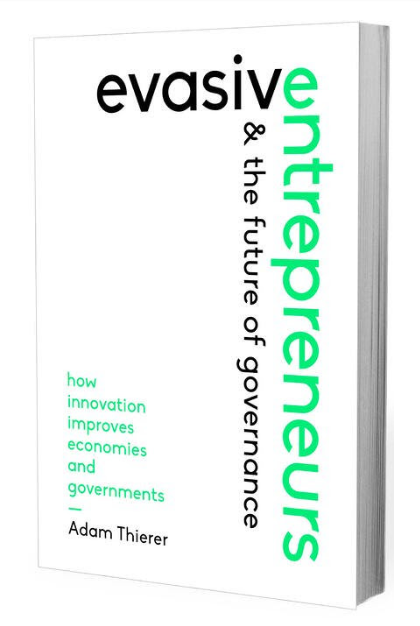

 The Technology Liberation Front is the tech policy blog dedicated to keeping politicians' hands off the 'net and everything else related to technology.