In theory, the Food & Drug Administration (FDA) exists to save lives and improve health outcomes. All too often, however, that goal is hindered by the agency’s highly bureaucratic, top-down, command-and-control orientation toward drug and medical device approval.
Today’s case in point involves families of children with diabetes, many of whom are increasingly frustrated with the FDA’s foot-dragging when it comes to approval of medical devices that could help their kids. Writing today in
The Wall Street Journal, Kate Linebaugh discusses how “Tech-Savvy Families Use Home-Built Diabetes Device” to help their kids when FDA regulations limit the availability of commercial options. She documents how families of diabetic children are taking matters into their own hands and creating their own home-crafted insulin pumps, which can automatically dose the proper amount of proper amount of the hormone in response to their child’s blood-sugar levels. Families are building, calibrating, and troubleshooting these devices on their own. And the movement is growing. Linebaugh reports that:
More than 50 people have soldered, tinkered and written software to make such devices for themselves or their children. The systems—known in the industry as artificial pancreases or closed loop systems—have been studied for decades, but improvements to sensor technology for real-time glucose monitoring have made them possible.
The Food and Drug Administration has made approving such devices a priority and several companies are working on them. But the yearslong process of commercial development and regulatory approval is longer than many patients want, and some are technologically savvy enough to do it on their own.
Linebaugh notes that this particular home-built medical project (known as OpenAPS), was created by Dana Lewis, a 27-year-old with Type 1 diabetes in Seattle. Linebaugh says that: Continue reading →
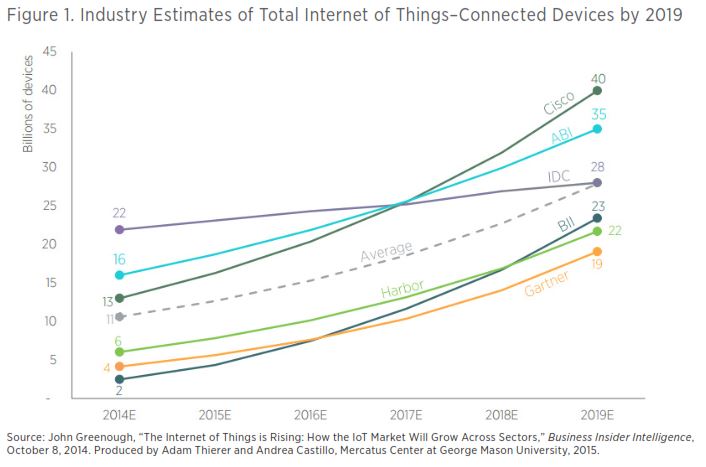
The “Internet of Things” (IoT) is already growing at a breakneck pace and is expected to continue to accelerate rapidly. In a short new paper (“Projecting the Growth and Economic Impact of the Internet of Things“) that I’ve just released with my Mercatus Center colleague Andrea Castillo, we provide a brief explanation of IoT technologies before describing the current projections of the economic and technological impacts that IoT could have on society. In addition to creating massive gains for consumers, IoT is projected to provide dramatic improvements in manufacturing, health care, energy, transportation, retail services, government, and general economic growth. Take a look at our paper if you’re interested, and you might also want to check out my 118-page law review article, “The Internet of Things and Wearable Technology: Addressing Privacy and Security Concerns without Derailing Innovation” as well as my recent congressional testimony on the policy issues surrounding the IoT.)
Over at TechDirt, Mike Masnick has an interesting post asking “Why Did Apple Approve Spotify?” which builds on an AdAge column asking a similar question: “Did Apple Sacrifice ITunes With Latest Apps?” As the title of that AdAge piece suggests, some folks are wondering if Apple shot itself in the foot by approving Spotify, a music streaming app that some regard as a potential iTunes killer. I don’t really have any comment on the business angle here, rather, I wanted to just comment on Mike’s suggestion that one possible explanation for Apple’s approval of the app is that:
As we noted when the app was approved, Apple appears to be somewhat gunshy, following the FCC inquiry into why it “blocked” Google Voice on the iPhone (and, yes, Apple still insists it didn’t actually block the app, but Google says otherwise). Given the scrutiny, Apple probably realized that it was in for some serious political trouble if it blocked an app like Spotify, which would have received a lot of press attention. Oddly, the AdAge article doesn’t mention this at all.
Indeed, it is odd that
AdAge didn’t bother mentioning that fact. But what I find doubly odd here is that nobody is even blinking an eye at the prospect of such political meddling with — or even possible FCC regulation of — Apple, iTunes, or music streaming market in general! Seriously, have we gotten to the point now in our Bold New World of Neutrality Regulation that innovative high-tech companies must live in fear of constant regulatory intervention even when they completely lack any statutory authority to play these games? Moreover, does anyone think that the a bunch of Beltway bureaucrats can micro-manage music and high-tech application markets and give us more options than we have today?
I know the prospect of such meddling makes some academics and regulatory activists groups happy, but I can’t see how this ends well for consumers or high-tech markets more generally. Regardless, for those of you who laugh when we suggest that the slippery slope of regulation is real, consider this case to be Exhibit A. Or perhaps it’s Exhibit B since the Google Voice spat with Apple was already moving the FCC in the direction of becoming a device regulator and applying “handset neutrality” principles that have no basis in law. It’s your anything-goes government at work.
When I was growing up in Illinois and Indiana, my friends and family used to make fun of me for always having my nose in a book. Everywhere I went I carried a book–first comics then novels–and was constantly reading while I walked about the neighborhood. [I still do so today, except it’s more like nerdy law review articles and government filings these days.] My dad used to always say that if I didn’t cut it out that one day I was going fall on my face or, worse yet, get hit by a car.
Luckily that never happened. But I thought of this again today when reading about this new law from my old birth state of Illinois that would ban texting and talking on mobile devices while walking through roadways. The penalty isn’t all that steep (just a $25 misdemeanor) and the law certainly is well-intentioned (trying to deter pedestrian injuries / fatalities or traffic accidents), but one wonders if such a law is really needed or if it will accomplish the goal of improving public safety.
As a general matter, I think it’s unwise for governments to pass laws protecting people from their own stupidity. But proponents might respond that the measure is equally as important in protecting
others from your stupidity. That is, a distracted pedestrian could cause accidents. Therefore, it should be a crime for them to text or talk while crossing a roadway.
Continue reading →

 The Technology Liberation Front is the tech policy blog dedicated to keeping politicians' hands off the 'net and everything else related to technology.