After reading LM Sacasas’ recent piece on moral communities, I couldn’t help but wonder if the piece was written in the esoteric mode.
Let me explain by some meandering.
Now, I am surely going to butcher his argument, so take a read of it yourself, but there is a bit of an interesting call and response structure to the piece. He begins with commentary on “frequent deployment of the rhetorical we,” in discussions over the morality of technology. Then, channeling Langdon Winner, he notes approvingly that “What matters here is that this lovely ‘we’ suggests the presence of a moral community that may not, in fact, exist at all, at least not in any coherent, self-conscious form.” Continue reading →
What are we to make of this peculiar new term “permissionless innovation,” which has gained increasing currency in modern technology policy discussions? And how much relevance has this notion had—or
should it have—on those conversations about the governance of emerging technologies? That’s what I’d like to discuss here today.
Uncertain Origins, Unclear Definitions
I should begin by noting that while I have written a book with the term in the title, I take no credit for coining the phrase “permissionless innovation,” nor have I been able to determine who the first person was to use the term. The phrase is sometimes attributed to Grace M. Hopper, a computer scientist who was a rear admiral in the United States Navy. She once famously noted that, “It’s easier to ask forgiveness than it is to get permission.”
“Hopper’s Law,” as it has come to be known in engineering circles, is probably the most concise articulation of the general notion of “permissionless innovation” that I’ve ever heard, but Hopper does not appear to have ever used the actual phrase anywhere. Moreover, Hopper was not
necessarily applying this notion to the realm of technological governance, but was seemingly speaking more generically about the benefit of trying new things without asking for the blessing of any number of unnamed authorities or overseers—which could include businesses, bosses, teachers, or perhaps even government officials. Continue reading →
Alice Marwick, assistant professor of communication and media studies at Fordham University, discusses her newly-released book, Status Update: Celebrity, Publicity, and Branding in the Social Media Age. Marwick reflects on her interviews with Silicon Valley entrepreneurs, technology journalists, and venture capitalists to show how social media affects social dynamics and digital culture. Marwick answers questions such as: Does “status conscious” take on a new meaning in the age of social media? Is the public using social media the way the platforms’ creators intended? How do you quantify the value of online social interactions? Are social media users becoming more self-censoring or more transparent about what they share? What’s the difference between self-branding and becoming a micro-celebrity? She also shares her advice for how to make Twitter, Tumblr, Instagram and other platforms more beneficial for you.
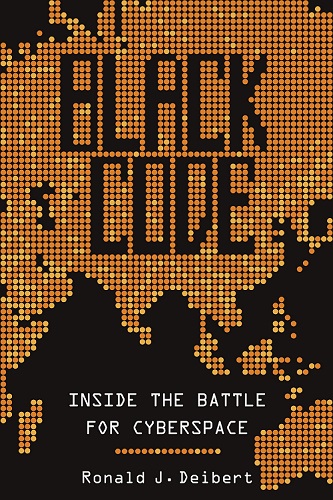
Ronald J. Deibert is the director of The Citizen Lab at the University of Toronto’s Munk School of Global Affairs and the author of an important new book, Black Code: Inside the Battle for Cyberspace, an in-depth look at the growing insecurity of the Internet. Specifically, Deibert’s book is a meticulous examination of the “malicious threats that are growing from the inside out” and which “threaten to destroy the fragile ecosystem we have come to take for granted.” (p. 14) It is also a remarkably timely book in light of the recent revelations about NSA surveillance and how it is being facilitated with the assistance of various tech and telecom giants.
The clear and colloquial tone that Deibert employs in the text helps make arcane Internet security issues interesting and accessible. Indeed, some chapters of the book almost feel like they were pulled from the pages of techno-thriller, complete with villainous characters, unexpected plot twists, and shocking conclusions. “Cyber crime has become one of the world’s largest growth businesses,” Deibert notes (p. 144) and his chapters focus on many prominent recent examples, including cyber-crime syndicates like Koobface, government cyber-spying schemes like GhostNet, state-sanctioned sabotage like Stuxnet, and the vexing issue of zero-day exploit sales.
Deibert is uniquely qualified to narrate this tale not just because he is a gifted story-teller but also because he has had a front row seat in the unfolding play that we might refer to as “How Cyberspace Grew Less Secure.” Continue reading →
For the life of me, I cannot understand how anyone can equate counter-speech with “Twitter Police,” but that’s essentially what Rosenwald does in his essay. The examples he uses in his essay are
exactly the sort of bone-headed and generally offensive comments that I would hope we would call out and challenge robustly in a deliberative democracy. But when average folks did exactly that, Rosenwald jumps to the preposterous conclusion that it somehow chilled speech. Stranger yet is his claim that “the Twitter Police are enforcing laws of their own making, with procedures they have authorized for themselves.” Say what? What laws are you talking about, Mike? This is just silly. These people are SPEAKING not enforcing any “laws.” They are expressing opinions about someone else’s (pretty crazy) opinions. This is what a healthy deliberative democracy is all about, bud!
Moreover, Rosenwald doesn’t really explain what a better world looks like. Is it one in which we all just turn a blind eye to what many regard as offensive or hair-brained commentary? I sure hope not!
I’m all for people vigorously expressing their opinions but I am just as strongly in favor of people pushing back with opinions of their own. You have no right to be free of social sanction if your speech offends large swaths of society. Speech has consequences and the more speech it prompts, the better.
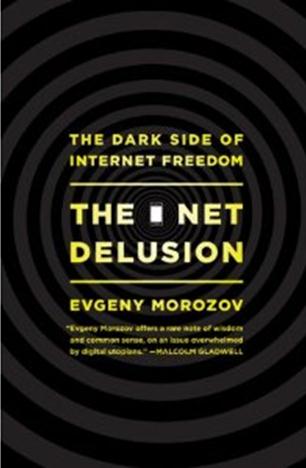
In his new book, The Net Delusion: The Dark Side of Internet Freedom, Evgeny Morozov aims to prick the bubble of hyper-optimism that surrounds debates about the Internet’s role in advancing human freedom or civic causes. Morozov, a native of Belarus, is a tremendously gifted young cyber-policy scholar affiliated with Stanford University and the New America Foundation. He’s an expert on the interaction of digital technology and democracy and writes frequently on that topic for a variety of respected media outlets.
In
Net Delusion, as with many of his previous columns and essays, Morozov positions himself the ultimate Net “realist,” aiming to bring a dose of realpolitik to discussions about how much of a difference the Net and digital technologies make to advancing democracy and freedom. His depressing answer: Not much. Indeed, Morozov’s book is one big wet blanket on the theory that “technologies of freedom” can help liberate humanity from the yoke of repressive government.
Morozov clearly relishes his skunk at the garden party role, missing few opportunities to belittle those who subscribe to such theories. If you’re one of those who tinted your Twitter avatar green as an expression of solidarity with Iranian “Green Movement” dissidents, Morozov’s view is that, at best, you’re wasting your time and, at worst, you’re aiding and abetting tyrants by engaging in a form of “slacktivism” that has little hope of advancing real regime change. The portrait he paints of technology and democracy is a dismal one in which cyber-utopian ideals of information as liberator are not just rejected but inverted. He regards such “cyber-utopian” dreams as counter-productive, even dangerous, to the advance of democracy and human freedom. Continue reading →
Proponents of Net neutrality regulation continue their full-court press to get the Federal Communications Commission (FCC) and its chairman, Julius Genachowski, to unilaterally push through a new industrial policy regime for the Internet. The latest word, according to Politico, is that the agency is pushing back its scheduled December open meeting from Dec. 15 to Dec. 21 to give the agency more time to plot its next move. There’s no word yet what the agency’s regulatory blueprint will look like, so it’s impossible to critique the agency’s plan at this point. I’ve made the case against Net neutrality regulation here before, however, and I’m sure those same concerns and critiques will apply to whatever the agency ends up adopting.
What’s most concerning about the way this process is playing out currently is just how anti-democratic it is. I understand the zeal of the pro-regulatory forces on this issue, but there is simply no good excuse for advocating that 3 unelected officials at an independent regulatory agency rush through a vote to regulate a such a massive and important sector of the American economy.
It used to be the case that a broad and non-partisan coalition of academics and organizations supported the non-delegation principle, which, generally speaking, refers to the notion that only democratically elected officials should be in a position to pass laws and make the really important decisions about the future course of our polity and its economy. Of course, when it comes to the economy, I’d prefer most of those decisions be left to marketplace experimentation. However, to the extent regulation is deemed necessary and that regulation governs such a massively important portion of the American economy, that determination should
definitely be made by elected leaders in Congress and not delegated to bureaucrats who would ram through regulations with 3 votes and sketchy plan for reordering that sector. Continue reading →
As mentioned last week, in a new series of essays, PFF scholars will be examining proposals that would have the government play a greater role in sustaining struggling media enterprises, “saving journalism,” or promoting more “public interest” content. With many traditional media operators struggling, and questions being raised about how journalism in particular will be supported in the future, Washington policymakers are currently considering what role government can and should play in helping media providers reinvent themselves in the face of tumultuous technological change wrought by the Digital Revolution. We will be releasing 6 or 7 essays on this topic leading up to our big filing in the FCC’s “Future of Media” proceeding (deadline is May 7th). And here’s a podcast Berin Szoka and I did providing an overview of the series.
In the first installment of the series, Berin and I critiqued an old idea that’s suddenly gained new currency: taxing media devices or distribution systems to fund media content. In the second installment, “The Wrong Way to Reinvent Media, Part 2: Broadcast Spectrum Taxes to Subsidize Public Media,” I discuss proposals to impose a tax on broadcast spectrum licenses to funnel money to public media projects or other “public interest” content or objectives.Such a tax would be fundamentally unfair to broadcasters, who are struggling for their very survival in the midst of unprecedented marketplace turmoil. Moreover, such a tax is unnecessary in light of the many other sources of “public interest” programming available today. Finally, even if the government creates or subsidizes wonderful, civic- and culturally-enriching content, there’s no way to force people to consume it. Nor should government force such media choices upon the public. There’s no good reason for government to be socially-engineering media choices through taxes.
C-SPAN is really quite incredible when you think about it. When I was growing up in the 70s, there was nothing like it. Like most other Americans, my informational inputs about national news and politics were limited to what a couple of old white dudes in bad suits delivered each night around 6:30 on the three VHF channels I had access to. And no national newspapers were delivered to my small town in rural Illinois, so I had to rely on crummy local papers to fill the void via whatever national reporting they offered, which wasn’t much.
And then came C-SPAN. C-SPAN alone covers more political and civic-minded activity in the course of a week than most of us probably came into contact with in our entire lives just 30 years ago. Consider these data points, which Peter Kiley, Vice President of C-SPAN Networks was kind enough to help me aggregate. In the 2009 calendar year, C-SPAN provided the following amount of first run programming across their three channels:
8,438 overall hours of programming;
2,709 hours of House & Senate floor activity; and,
1,222 hours of House & Senate committee hearings.
Moreover, C-SPAN recently created the C-SPAN Video Library, which archives 23 years worth (1987-on) of fully searchable (and free) video content, including: Continue reading →
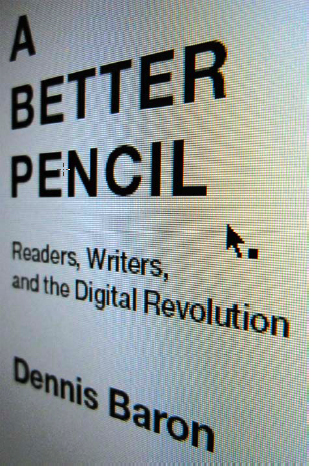
I very much enjoyed Dennis Baron’s new book, A Better Pencil: Readers, Writers, and the Digital Revolution, and highly recommend you pick it up. Baron does a wonderful job exploring the history of techno-pessimism and the endless battles about the impact of new technologies on life and learning, something I have written about here before in my essays on “Internet optimists vs. pessimists” (See: 1, 2, 3).
I have a complete review of Baron’s
A Better Pencil now up on the City Journal‘s website here. I’ve also pasted it down below.
In the beginning, Dennis Baron reminds us in his new book,
A Better Pencil, there was the word—the spoken word, that is. Oral tradition, the passing of knowledge through stories and lectures, was the primary method of instruction and learning throughout early human civilization. But then a few innovative souls decided to start writing everything down on stones and clay. Almost as soon as they did, a great debate began on the impact of new communications technology on culture and education. And it rages on today, with a new generation of optimists and skeptics battling over the impact that computing, the Internet, and digital technologies have on our lives and on how we learn about the world.
The Technology Liberation Front is the tech policy blog dedicated to keeping politicians' hands off the 'net and everything else related to technology. Learn more about TLF →


 The Technology Liberation Front is the tech policy blog dedicated to keeping politicians' hands off the 'net and everything else related to technology.