[first published at The Bridge on August 9, 2018]
What happens when technological innovation outpaces the ability of laws and regulations to keep up?
This phenomenon is known as “the pacing problem,” and it has profound ramifications for the governance of emerging technologies. Indeed, the pacing problem is becoming the great equalizer in debates over technological governance because it forces governments to rethink their approach to the regulation of many sectors and technologies.
The Innovation Cornucopia
Had Rip Van Winkle woken up his famous nap today, he’d be shocked by all the changes around him. At-home genetics tests, personal drones, driverless cars, lab-grown meats, and 3D-printed prosthetic limbs are just some of the amazing innovations that would boggle his mind. New devices and services are flying at us so rapidly that we sometimes forget that most did not even exist a short time ago. Continue reading →
I caught this tidbit today in a Washington Post article about Julius Genachowski’s tenure as Federal Communications Commission chairman:
He wound up presiding over a crucial period in which the powerful companies of Silicon Valley turned into Washington power players. Lobbying the FCC has become a major economic franchise. Each day, hundreds of dark-suited lawyers crowd the antiseptic, midcentury-modern agency building.
Can anyone think this is a good thing? To be clear, I don’t think Genachowski is solely responsible for Silicon Valley innovators getting more aggressive in Washington or for tech lobbying becoming “a major economic franchise” at the FCC. There’s plenty of blame to go around in that regard. Regardless, every legislative and regulatory action that opens the door to greater regulation of the information economy also opens the door a bit wider to unproductive rent-seeking and cronyist activities. Moreover, every minute and every dollar spent focusing on making legislators and regulators happy is another minute and dollar that could have better been spent making consumers happy in the marketplace. It’s a pure deadweight loss to society.
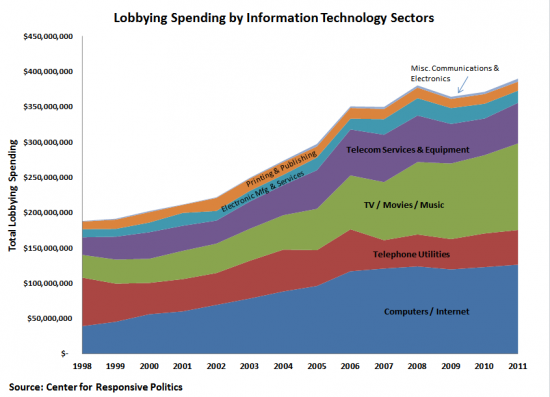
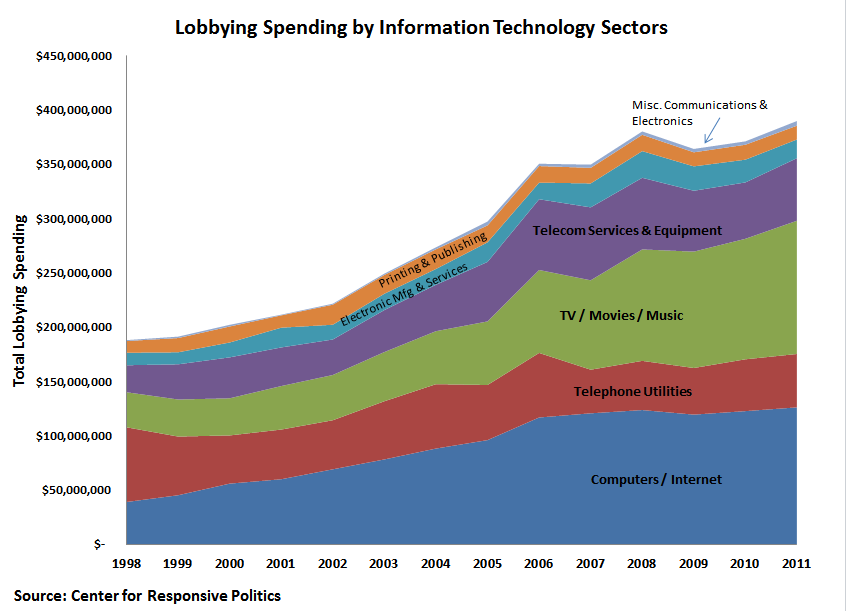
And there has been a remarkable expansion in such tech lobbying activity over the past decade, as the following charts illustrate. The first shows the dramatic growth of lobbying by computer and Internet companies relative to other sectors and the second shows lobbying spending by specific computer and Internet companies. [Click to enlarge.]
Continue reading →
It’s truly amazing how fast mobile broadband demand is expanding. A couple of things caught my eye yesterday that really drove that home. First, I was reading Bernstein Research’s weekly (subscription-only) newsletter and Craig Moffett, one of America’s top media and communications analysts, summarized the growing mobile bandwidth crunch as follows:
To fully grasp the challenge facing wireless providers as we make the transition from wireless voice to wireless data, it is helpful to put some ballpark numbers around current usage levels. Today, the average voice-only customer consumes something like 50 megabytes of data every month. For that, they pay about $40, or about $0.80 per megabyte. That’s 70% of wireless industry revenues. Text messaging generates another $10 per month for a minuscule amount of data (in fact, arguably no throughput at all, since text messaging travels in a signaling band rather than in the carrier band itself). Let’s call it $1,000 per megabyte. That’s another 15% of industry revenues. On a blended basis, then, that’s $1.00 per megabyte for 85% of industry revenues.
And then there’s the iPhone. By some estimates, the average iPhone user consumes as much as 800 megabytes per month. Take out their 50 Mb for voice and you’re looking at 750 Mb of data… for an additional $30. For the mathematically challenged, that’s a princely sum of… wait for it… four cents per megabyte. Worse, we noted that the FCC’s wireless net neutrality policies posed the risk of “bandwidth arbitrage,” where low bandwidth services (at $1.00 per megabyte) would be replaced with free or almost free applications that ride on $0.04 per megabyte data plans, and where carriers’ hands would be tied to prevent it. Taking a business that is currently getting $1.00 per megabyte down to just $0.04 per megabyte is, well, hard. And lest anyone think that this threat is idle fear-mongering, Google’s acquisition last week of Gizmo5, a wireless VoIP specialist, should give one pause.
Those are stunning numbers. And then I saw this new filing by CTIA listing some other statistics about growing mobile broadband demand:
Continue reading →

 The Technology Liberation Front is the tech policy blog dedicated to keeping politicians' hands off the 'net and everything else related to technology.