Alexander Howard has put together this excellent compendium of comments on Mike Rosenwald’s new Washington Post editorial, “Will the Twitter Police make Twitter boring?” I was pleased to see that so many others had the same reaction to Rosenwald’s piece that I did.
For the life of me, I cannot understand how anyone can equate counter-speech with “Twitter Police,” but that’s essentially what Rosenwald does in his essay. The examples he uses in his essay are
exactly the sort of bone-headed and generally offensive comments that I would hope we would call out and challenge robustly in a deliberative democracy. But when average folks did exactly that, Rosenwald jumps to the preposterous conclusion that it somehow chilled speech. Stranger yet is his claim that “the Twitter Police are enforcing laws of their own making, with procedures they have authorized for themselves.” Say what? What laws are you talking about, Mike? This is just silly. These people are SPEAKING not enforcing any “laws.” They are expressing opinions about someone else’s (pretty crazy) opinions. This is what a healthy deliberative democracy is all about, bud!
Moreover, Rosenwald doesn’t really explain what a better world looks like. Is it one in which we all just turn a blind eye to what many regard as offensive or hair-brained commentary? I sure hope not!
I’m all for people vigorously expressing their opinions but I am just as strongly in favor of people pushing back with opinions of their own. You have no right to be free of social sanction if your speech offends large swaths of society. Speech has consequences and the more speech it prompts, the better.
 C-SPAN is really quite incredible when you think about it. When I was growing up in the 70s, there was nothing like it. Like most other Americans, my informational inputs about national news and politics were limited to what a couple of old white dudes in bad suits delivered each night around 6:30 on the three VHF channels I had access to. And no national newspapers were delivered to my small town in rural Illinois, so I had to rely on crummy local papers to fill the void via whatever national reporting they offered, which wasn’t much.
And then came C-SPAN. C-SPAN alone covers more political and civic-minded activity in the course of a week than most of us probably came into contact with in our entire lives just 30 years ago. Consider these data points, which Peter Kiley, Vice President of C-SPAN Networks was kind enough to help me aggregate. In the 2009 calendar year, C-SPAN provided the following amount of first run programming across their three channels:
- 8,438 overall hours of programming;
- 2,709 hours of House & Senate floor activity; and,
- 1,222 hours of House & Senate committee hearings.
Moreover, C-SPAN recently created the C-SPAN Video Library, which archives 23 years worth (1987-on) of fully searchable (and free) video content, including: Continue reading →
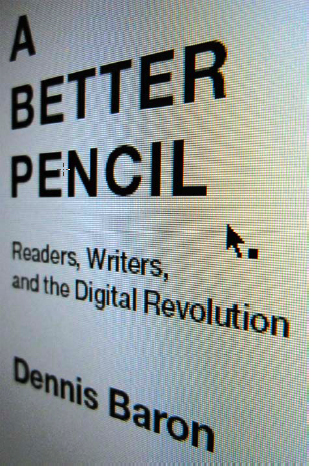 I very much enjoyed Dennis Baron’s new book, A Better Pencil: Readers, Writers, and the Digital Revolution, and highly recommend you pick it up. Baron does a wonderful job exploring the history of techno-pessimism and the endless battles about the impact of new technologies on life and learning, something I have written about here before in my essays on “Internet optimists vs. pessimists” (See: 1, 2, 3).
I have a complete review of Baron’s
A Better Pencil now up on the City Journal‘s website here. I’ve also pasted it down below.
Plato Wrote it Down
by Adam Thierer
a review of A Better Pencil: Readers, Writers, and the Digital Revolution, by Dennis Baron (Oxford University Press, 280 pp., $24.95)
In the beginning, Dennis Baron reminds us in his new book,
A Better Pencil, there was the word—the spoken word, that is. Oral tradition, the passing of knowledge through stories and lectures, was the primary method of instruction and learning throughout early human civilization. But then a few innovative souls decided to start writing everything down on stones and clay. Almost as soon as they did, a great debate began on the impact of new communications technology on culture and education. And it rages on today, with a new generation of optimists and skeptics battling over the impact that computing, the Internet, and digital technologies have on our lives and on how we learn about the world.
Continue reading →

 The Technology Liberation Front is the tech policy blog dedicated to keeping politicians' hands off the 'net and everything else related to technology.