This ongoing series has explored the increasing ability of consumers to “cut the cord” to traditional video distributors (cable, satellite, etc.) and instead receive a mix of “television” programming and other forms of video programming over the Internet. As I’ve argued, this change not only means lower monthly bills for those “early adopter” consumers who actually do “cut the cord”, but, in the coming years, a total revolution in the traditional system of content creation and distribution on which the FCC’s existing media regulatory regime is premised.
This revolution has two key parts:
- Conduits: The growing inventory—and popularity—of sites such as Hulu, Amazon Unboxed and the XBox 360 Marketplace (or software such as Apple’s iTunes store), that allow users to view or download video content. Drawing an analogy to the FCC’s term “Multichannel Video Programming Distibutor” or MVPD (cable, direct broadcast satellite, telco fiber, etc.), I’ve dubbed these sites “Internet Video Programming Distributors” or IVPDs.
- Interface: The hardware and software that allows users to display that content easily on a device of their choice, especially their home televisions.
While much of the conversation about “interface” has focused on special hardware that brings IVPD content to televisions through set-top boxes such as the Roku box or game consoles like the XBox 360, at least one company is making waves with a software solution. From the NYT:
Boxee bills its software as a simple way to access multiple Internet video and music sites, and to bring them to a large monitor or television that one might be watching from a sofa across the room.
Some of Boxee’s fans also think it is much more: a way to euthanize that costly $100-a-month cable or satellite connection.
“Boxee has allowed me to replace cable with no remorse,” said Jef Holbrook, a 27-year-old actor in Columbus, Ga., who recently downloaded the Boxee software to the $600 Mac Mini he has connected to his television. “Most people my age would like to just pay for the channels they want, but cable refuses to give us that option. Services like Boxee, that allow users choice, are the future of television.” ….
Boxee gives users a single interface to access all the photos, video and music on their hard drives, along with a wide range of television shows, movies and songs from sites like Hulu,Netflix, YouTube, CNN.com and CBS.com.
Continue reading →
[This represents a bit of a departure from the traditional format of my ongoing “Media Deconsolidiation Series,” but you will see how it ties in…]
So, some guy from the (Un)Free Press — the activist group that wants to regulate every facet of the media and broadband universe — has created a scary looking chart about “Information Control” [seen below]. It’s based loosely on the Periodic Table of Elements, you know, to give it the aura of science and fact. In reality, it’s just another silly scare tactic that tells us very little about the true nature of our modern media marketplace.
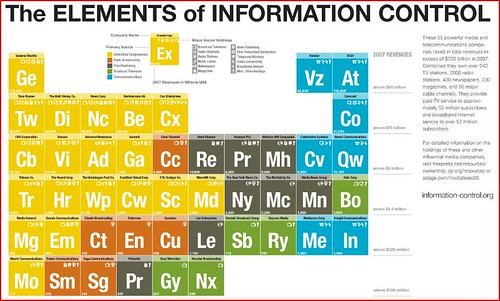
The chart is accompanied by the typical Free Press gloom-and-doom rhetoric about the unfolding media apocalypse. “Nearly everything you see, hear and read that isn’t from a friend — whether on TV, the radio, or even on the Web — comes from a for-profit gatekeeper.” And then comes the obligatory A.J. Liebling quote about how “Freedom of the press belongs to those who own one,” followed quickly by the typical punch line about how just a handful of companies (in this case 55 of ’em) are puppeteering all our thoughts in America today:
Combined, these 55 powerful media and telecommunications companies raked in total revenues in excess of $700 billion in 2007. Together they own over 540 TV stations, 2000 radio stations, 430 newspapers, 230 magazines, and 80 major cable channels in the United States. They provide paid TV service to approximately 52 million subscribers and broadband Internet service to over 57 million subscribers. They’re the bottlenecks through which our news, our entertainment, and our political discourse must travel. What they want to promote becomes prominent; what they suppress stays out of the mainstream. As such, these companies are the elements of information control.
Oh my God! We are all just brainwashed sheep!
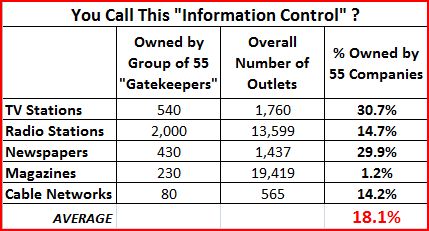
Except we’re not. It amazes me how these “information control” and “media monopoly” myths keep getting widespread circulation. But the first thing to note is how the media reformistas can’t get even their story straight when it comes to how many “monopolists” are supposedly out there today. As I noted in my 2005 book, Media Myths: Making Sense of the Debate over Media Ownership, the critics seem to just pull their numbers out of a hat. Some say as few as 3 companies control everything. Others says 5 or 6. Still others say it might be a few dozen. And now this guy says its 55. Hey, that’s progress that even the Free Press should love!
Regardless of the number, does this really represent the totality of our modern media universe? Do those 55 companies really “own most of the 21st-century presses in America” as the “Info Control” website states? Answer: NOT. EVEN. CLOSE. Here are the facts. [I happened to have compiled them for a PFF special report entitled Media Metrics: The True State of the Modern Media Marketplace to debunk myths just like this.]
Continue reading →
My ongoing media DE-consolidation series represents an effort to set the record straight regarding one of the leading myths about the media marketplace today: the notion that rampant consolidation is taking place and that operators are only growing larger and devouring more and more companies.
Nothing could be further from the truth. Over the past 3 to 5 years, traditional media operators and sectors have been coming apart at the seams in the face of unprecedented innovation and competition. The volume of divestiture activity has been quite intense, and most traditional media operators have been getting smaller, not bigger. “Traditional media’s numbers are shrinking,” argued FCC Commissioner Robert McDowell in a recent speech. “The ironic truth is,” McDowell continued, that “in many cases, media consolidation has actually become media divestiture. Companies… have been shedding properties to raise capital for new ventures.”
And so that trend continues today with the announcement from Cox Enterprises that it will be selling almost all its newspapers. According to the The Atlanta Journal-Constitution:
Continue reading →
 Faithful readers will recall that, several months ago, I penned a 7-part “Media Metrics” series that took a hard look at the health of the media marketplace. Today, the Progress & Freedom Foundation is releasing a greatly expanded version of these essays that I have put together with my PFF colleague Grant Eskelsen. In this 100-page special report, “Media Metrics: The True State of the Modern Media Marketplace,” we begin by noting that heated debates about the state of the media marketplace continue to rage in Washington, and opinions seem to range from grim to outright apocalyptic. As we note on pg. 1:
Many people—including a large number of legislators and regulators—argue that America’s media marketplace is in a miserable state. Some claim that citizens lack choice in media outlets and that options are just as scarce as ever. Others believe that media “localism” is dead or that many groups or niches go underserved because of a lack of true “diversity” in media. Others argue that the market is hopelessly over-concentrated in the hands of a few evil media barons who are hell-bent on force-feeding us corporate propaganda. And still others say that the quality of news and entertainment in our society has deteriorated because of a combination of all of the above. It all sounds quite troubling, but is any of it true?
After taking an objective look at the true state of America’s media marketplace, we conclude that such pessimism is unwarranted. Indeed, a careful review of the facts reveals that—contrary to what those media critics suggest—we have more media choice, more media competition, and more media diversity than ever before. Indeed, to the extent there was ever a “golden age” of media in America, we are living in it today. The media sky has never been brighter and it is getting brighter with each passing year.
Continue reading →

 The Technology Liberation Front is the tech policy blog dedicated to keeping politicians' hands off the 'net and everything else related to technology.