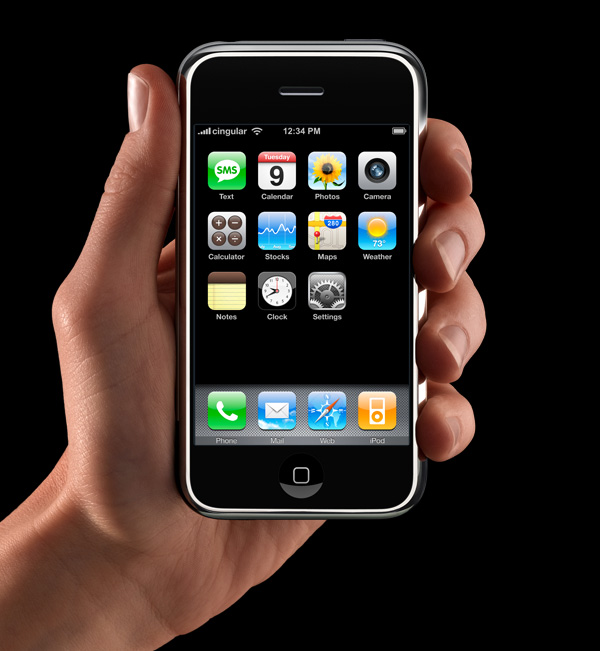
Today marks the 10th anniversary of the launch of the Apple iPhone. With all the headlines being written today about how the device changed the world forever, it is easy to forget that before its launch, plenty of experts scoffed at the idea that Steve Jobs and Apple had any chance of successfully breaking into the seemingly mature mobile phone market.
After all, those were the days when BlackBerry, Palm, Motorola, and Microsoft were on everyone’s minds. Perhaps, then, it wasn’t so surprising to hear predictions like these leading up to and following the launch of the iPhone:
In December 2006, Palm CEO Ed Colligan summarily dismissed the idea that a traditional personal computing company could compete in the smartphone business. “We’ve learned and struggled for a few years here figuring out how to make a decent phone,” he said. “PC guys are not going to just figure this out. They’re not going to just walk in.”
In January 2007, Microsoft CEO Steve Ballmer laughed off the prospect of an expensive smartphone without a keyboard having a chance in the marketplace as follows: “Five hundred dollars? Fully subsidized? With a plan? I said that’s the most expensive phone in the world and it doesn’t appeal to business customers because it doesn’t have a keyboard, which makes it not a very good e-mail machine.”
In March 2007, computing industry pundit John C. Dvorak argued that “Apple should pull the plug on the iPhone” since “There is no likelihood that Apple can be successful in a business this competitive.” Dvorak believed the mobile handset business was already locked up by the era’s major players. “This is not an emerging business. In fact it’s gone so far that it’s in the process of consolidation with probably two players dominating everything, Nokia Corp. and Motorola Inc.”
Over at Silicon Alley Insider, Gregory Galant has a wonderful post about “18 Awesome Tech Things We Didn’t Have 10 Years Ago.” It serves as another great example of the amazing technological progress we have witnessed over the past decade. He’s asking people for suggestions for what else should be on the list, so head over there and let him know. Seems like wi-fi technologies should be on there somehow. FiOS deserves a shout-out, too. And where’s Firefox & Chrome? Also, I’ll put in a special word for some amazing new home theater technologies: high-def flat-screens and projectors; media servers & Windows Media Center; BluRay; and 3 incredible gaming / media consoles (Wii, PS3, & XBox). Anyway, here’s Galant’s list:
Wikipedia
Gmail
Facebook
YouTube
Twitter
AdWords
Amazon AWS
RSS (started in ‘99 but didn’t catch on till the ’00s)
Meetup
iPod
Google Maps
Podcasts
Mint
Skype/VOIP
iPhone
Google Docs
Creative Commons
Flickr
So, did the decade just end or do we have another year to go? Honestly, I’ve never understood when the cut-off is from one decade to the next. (My friend Larry Magid struggles with the same question in his recent column on “The Decade in Technology.”) Nonetheless, I’ve seen a lot of best-of-decade lists published recently, so I thought I would throw my own out there even though it is still a work in progress.
I have been attempting to compile the definitive bibliography for our digital decade—the definitive list of Internet policy books, that is. I started throwing this together two years ago when I was penning my list of “The Most Important Internet Policy Books of 2008” and continued to work on it as I was finishing up my 2009 installment as well. I grabbed every book off my shelf that dealt with the future of the Internet and the impact the Digital Revolution is having on our lives, culture, and economy and threw the title and a link onto this list. (I’m also using the list to help structure my thoughts for a forthcoming book of my own on Internet Optimists vs. Pessimists, something I’ve been writing a lot about here in recent years.)
Below you will find what I’ve got so far. There are around 80 90 books on the list. I’ve divided the list by year, but you may be wondering what determined the order the books appear in. In essence, I’ve listed what I feel are the 1 or 2 most important titles first and then just added others randomly. Eventually, I plan to post a “Most Important Internet Policy Books of the Decade” list outlining which titles I believe have been the most influential. I suspect I’ll name Benkler’s Wealth of Networks to the top slot followed closely by Zittrain’s The Future of the Internet, Lessig’s Free Culture, and Chris Anderson’s The Long Tail. Anyway, that’s for another day.
For now, I would just like to ask for reader suggestions regarding what other titles that should appear on this list. I will add titles as they come in. I want to stress, however, that I am trying to keep this list limited to books that have something to say about
Internet policy (cyber-law, digital economics, information technology politics, etc).
I hope others find this useful. And yes, I have read all most of the books on this list! As I’ve noted here before, I’m a bit of book nerd. (Now that I’ve received so many helpful additions to the list, there are some titles on the list I have not had a chance to read through yet). Continue reading →
My friend Larry Magid, a technology columnist for CBS News.com and others, has a wonderful new column out about “The Decade in Technology.” You have to read it to appreciate just how far we have come in such a short time. Larry notes:
[T]he past 10 years were a momentous period for technology. Not only was there no iPhone a decade ago, there was hardly anything that could be considered a smartphone. The BlackBerry was introduced in 1999, when the well-heeled techno-savvy were carrying around flip phones. That year, 1999, was the height of the dot-com boom. But when you look back at it, the online world was nothing like it is today. There was no Facebook (founded in 2004) or Twitter (2007). Even MySpace wasn’t founded until 2003. The term Web 2.0 hadn’t been coined and most people who were online used the Web mostly to consume information. Those with the skills and resources to post to the Web were called “Webmasters.” Today, everyone with a Facebook account is a master of his or her own Web.
Larry also notes that giants came and went as technology continued to evolve in unexpected ways:
Ten years ago AOL was the most popular Internet service provider and was so successful that it was able to purchase media giant Time Warner in January 2000 for $182 billion in stock. But the marriage didn’t make it through the decade. The two companies formally split up this month, with AOL, once again, being traded on the New York Stock Exchange as a separate company. AOL thrived in the ’90s because people were using the service to go online via phone. Today most American homes have broadband.
That’s something I wrote about at length in my recent paper on “A Brief History of Media Merger Hysteria.” Anyway, read Larry’s entire piece. It really drives home how lucky we are to be living in the midst of such at technological renaissance and information cornucopia.
The Technology Liberation Front is the tech policy blog dedicated to keeping politicians' hands off the 'net and everything else related to technology. Learn more about TLF →


 The Technology Liberation Front is the tech policy blog dedicated to keeping politicians' hands off the 'net and everything else related to technology.