The FCC appears to be dragging the TV industry, which is increasingly app- and Internet-based, into years of rulemakings, unnecessary standards development and oversight, and drawn-out lawsuits. The FCC hasn’t made a final decision but the general outline is pretty clear. T
he FCC wants to use a 20 year-old piece of corporate welfare, calculated to help a now-dead electronics retailer, as authority to regulate today’s TV apps and their licensing terms. Perhaps they’ll succeed in expanding their authority over set top boxes and TV apps. But as TV is being revolutionized by the Internet the legacy providers are trying to stay ahead of the new players (Netflix, Amazon, Layer 3), regulating TV apps and boxes will likely impede the competitive process and distract the FCC from more pressing matters, like spectrum and infrastructure. Continue reading →
The D.C. Circuit has struck down as arbitrary and capricious the FCC’s “cable cap.” The cap prevented a single cable operator from serving more than 30% of U.S. homes—precisely the same percentage limit struck down by the court in 2001. The court ruled that the FCC had failed to demonstrate that “allowing a cable operator to serve more than 30% of all cable subscribers would threaten to reduce either competition or diversity in programming.”
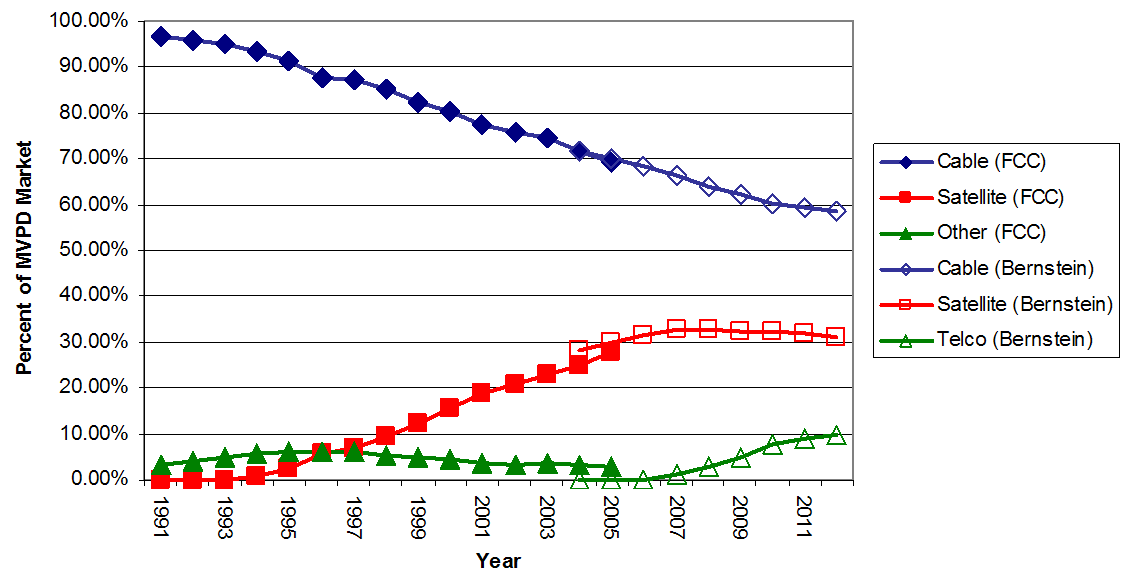
The court’s decision rested on the two critical charts (both generated by my PFF colleague Adam Thierer in his excellent
Media Metrics special report) at the heart of the PFF amicus brief I wrote with our president, Ken Ferree:
First, the record is replete with evidence of ever increasing competition among video providers: Satellite and fiber optic video providers have entered the market and grown in market share since the Congress passed the 1992 Act, and particularly in recent years. Cable operators, therefore, no longer have the bottleneck power over programming that concerned the Congress in 1992.
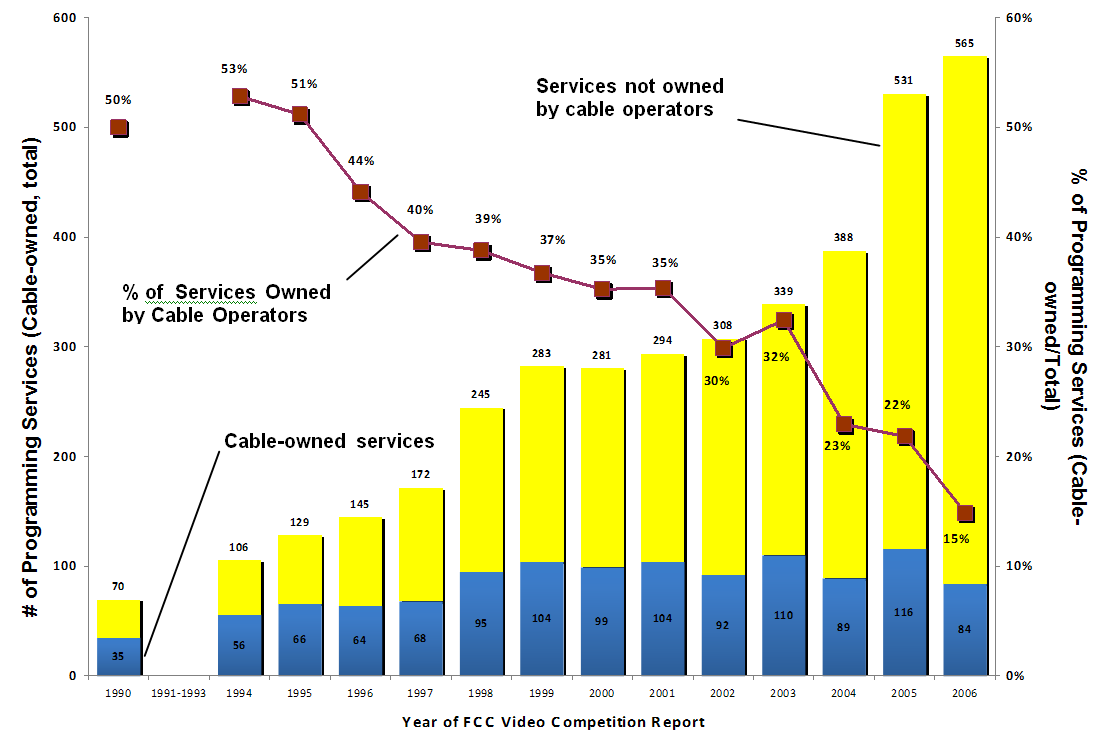
Second, over the same period there has been a dramatic increase both in the number of cable networks and in the programming available to subscribers.
Our chart shows the explosion in the number of programmers (though not the total amount of programming), as well as the falling rate of affiliation between cable operators and programmers, which was among the prime factors motivating Congress when it authorized a cable cap in the 1992 Cable Act:
Continue reading →
There was a hearing today in the House Energy and Commerce Committee on “Reauthorization of the Satellite Home Viewer Extension and Reauthorization Act,” which got into the sticky of issue of whether must carry mandates should be applied to satellite television (DBS) operators. My boss, Ken Ferree, president of the Progress & Freedom Foundation, testified in opposition to that notion. Here’s what he had to say about proposals that would require satellite operators to carry local broadcast TV stations from even the smallest markets:
Because Congress cannot repeal the laws of physics, there are only two ways in which a satellite company might comply with such a mandate: 1) it may add capacity (i.e., launch new satellites and build associated ground equipment), or 2) it may convert capacity currently used for other purposes to local television carriage in the most sparsely populated parts of the country. Neither approach makes economic sense. That is, these proposals, if they were to become law, would impose considerable costs on satellite operators while generating no appreciable revenue.
Continue reading →
Ken Ferree and I just filed an amicus brief with the D.C. Circuit in what could be among the most important First Amendment cases involving economic regulation in years: Comcast’s challenge to the FCC’s cap on the maximum size of a cable operator’s nationwide subscriber-audience. While few may feel righteous indignation at limitations targeted at large corporations such as Comcast or Time Warner, the larger principle at stake here is deeply important: Will the First Amendment provide a meaningful check on what USC law professor Chris Yoo has called “architectural censorship” (i.e., so-called “structural” regulations that “have the unintended consequence of reducing the quantity, quality, and diversity of media content”).
In a nutshell, we argue that that:
- The provisions of the 1992 Cable Act authorizing the FCC to impose a “cable cap” are outdated in world of media abundance and vibrant platform competition.
- Because cable is no longer the unique “bottleneck” or “gatekeeper” that it was in 1992, these statutory provisions (not just the FCC’s 30% rule) must be subject to strict scrutiny under the First Amendment as a limitation on free speech.
- Because there are “less restrictive means” of ensuring cable operators do not impede the flow of video programming to consumers, the court should strike down these provisions.
- Even if the court upholds the statute, it should nonetheless strike down the cap issued by the FCC in December 2007 (30% of all Multichannel Video Programming (MVPD) subscribers as based on an outdated model of the video marketplace.
I encourage you to read our brief (below). I’ve provided a summary below, along with some additional commentary we just couldn’t cover under our 3500 word limit.
Strict Scrutiny. Yoo’s article Architectural Censorship and the FCC is essential reading for anyone who believes that government regulations on the size and shape of the “soapbox” can have huge effects on speech itself. Yoo argues that the First Amendment should check this kind of regulation–however “content-neutral” it might seem–under “strict scrutiny”, which requires that the government show that a regulation is the “least restrictive means” available for advancing a “compelling government interest.” But Yoo ultimately concludes (pp. 713-718, PDF pp. 45-50) that, under existing precedent, most “architectural censorship will be effectively insulated from meaningful judicial review.” Continue reading →

 The Technology Liberation Front is the tech policy blog dedicated to keeping politicians' hands off the 'net and everything else related to technology.