It’s my great pleasure this week to be participating in a 2-day symposium on “Competition in Online Search” that is being hosted by the Antitrust & Competition Policy Blog. Daniel Sokol, Associate Professor of Law at the University of Florida Levin College of Law, was kind enough to invite me to join the fun. Professor Sokol is the editor of the Antitrust & Competition Policy Blog. Others participating in this symposium include: James Grimmelman (NY Law); Eugene Volokh (UCLA); Marvin Ammori (Stanford Law); Mark Jamison (Univ. of Florida); Eric Clemons (Wharton School); Dan Crane (Michigan Law); and both Marina Lao and Frank Pasquale (Seton Hall); and more.
My entry is now live. In it, I focus on how dynamically competitive and innovative the digital economy has been over the past 15 years and question to need for intervention at this time, especially of the “public utility” variety. I’ve re-posted my entry below, but make sure to head over to the Antitrust & Competition Policy Blog to read all the contributions to this excellent symposium. Continue reading →
2009 was not as big of a year for Internet and information technology (“info-tech”) policy books as 2008 was, but there were still some notable titles released that offered interesting perspectives about the future of the Net and the impact the Digital Revolution is having on our lives, culture, and economy. So, like last year, I figured I would throw together my list of the 10 most important info-tech policy books of the year.
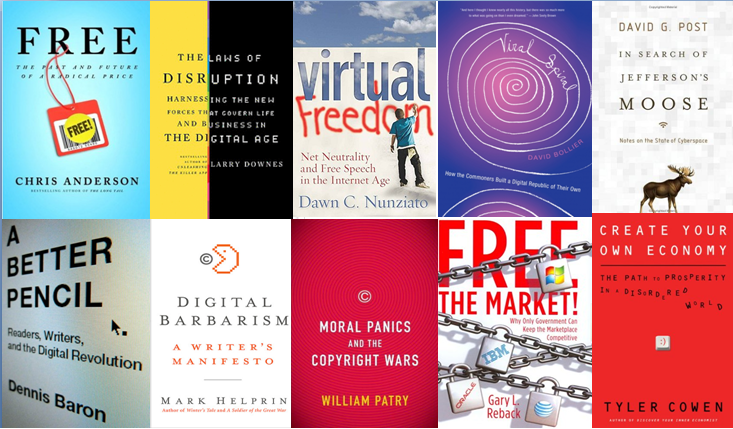 First, let me repeat a few of the same caveats and disclaimers that I set forth last year. What qualifies as an “important” info-tech policy book? Simply put, it’s a title that many people are currently discussing and that we will likely be referencing for many years to come. However, I want to be clear that merely because a book appears on my list it does not necessarily mean I agree with everything said in it. In fact, as was the case in previous years, I found much with which to disagree in my picks for the most important books of 2009 and I find that the cyber-libertarianism I subscribe to has very few fans out there.
Another caveat: Narrowly-focused titles lose a few points on my list. For example, if a book deals mostly with privacy issues, copyright law, or antitrust policy, it does not exactly qualify as the same sort of “tech policy book” as other titles found on this list since it is a narrow exploration of just one set of issues with a bearing on technology policy.
With those caveats in mind, here are my choices for the Most Important Info-Tech Policy Books of 2009. Continue reading →

 The Technology Liberation Front is the tech policy blog dedicated to keeping politicians' hands off the 'net and everything else related to technology.