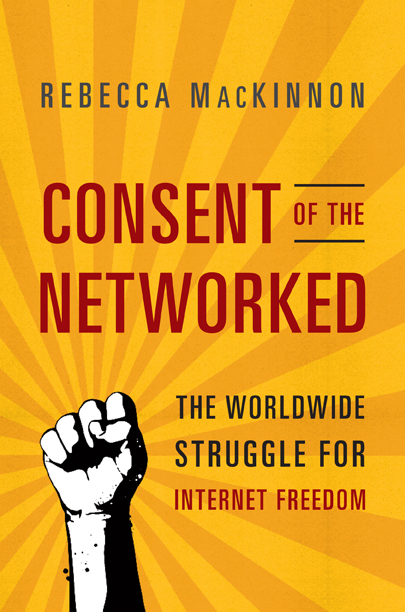
 Rebecca MacKinnon’s new book, Consent of the Networked: The Worldwide Struggle for Internet Freedom, is well-researched exploration of the forces driving Internet developments and policy across the globe today. She serves up an outstanding history of recent global protest movements and social revolutions and explores the role that Internet technologies and digital networks played in those efforts. She also surveys some of the recent policy fights here and abroad over issues such as online privacy, Net neutrality regulation, free speech matters, and the copyright wars. The Consent of the Networked is certainly worth reading and will go down as one of the most important Internet policy books of 2012.
A Call to Action
Of course, it’s not just a history lesson. MacKinnon has also issued a call-to-arms here. As a well-known web activist, MacKinnon has emerged as a leading force in the broad-based, if loosely-defined, “Net freedom” movement. The term “Net freedom,” she notes, means very different things to different people. It’s “like a Rorschach inkblot test: different people look at the same ink splotch and see very different things.” (p. 188) Nonetheless, on the global stage, the Internet freedom movement is fundamentally tied up with efforts to hold both governments and corporate actors more accountable for their actions toward the Netizens, digital networks, and online speech and expression. Continue reading →
2009 was not as big of a year for Internet and information technology (“info-tech”) policy books as 2008 was, but there were still some notable titles released that offered interesting perspectives about the future of the Net and the impact the Digital Revolution is having on our lives, culture, and economy. So, like last year, I figured I would throw together my list of the 10 most important info-tech policy books of the year.
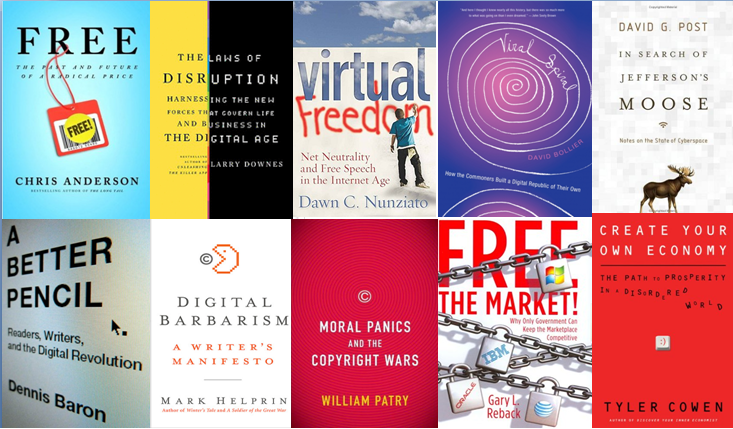 First, let me repeat a few of the same caveats and disclaimers that I set forth last year. What qualifies as an “important” info-tech policy book? Simply put, it’s a title that many people are currently discussing and that we will likely be referencing for many years to come. However, I want to be clear that merely because a book appears on my list it does not necessarily mean I agree with everything said in it. In fact, as was the case in previous years, I found much with which to disagree in my picks for the most important books of 2009 and I find that the cyber-libertarianism I subscribe to has very few fans out there.
Another caveat: Narrowly-focused titles lose a few points on my list. For example, if a book deals mostly with privacy issues, copyright law, or antitrust policy, it does not exactly qualify as the same sort of “tech policy book” as other titles found on this list since it is a narrow exploration of just one set of issues with a bearing on technology policy.
With those caveats in mind, here are my choices for the Most Important Info-Tech Policy Books of 2009. Continue reading →
I’ve been hammering Jonathan Zittrain pretty hard here over the past year for the thesis he sets forth in The Future of the Internet and How to Stop It that digital “generativity” is at risk today. The reason I have been doing so is because all signs point in the exact opposite direction, and more so with each passing day. Contrary to Jonathan’s fear that the Internet and digital technologies are growing more closed, tethered, and sterile, I have argued that the facts on the ground show us how the world is actually becoming far more open, untethered, and innovative. And that’s true even for the technology that Jonathan singles out in the book for special scorn — the iPhone.
Consider David Pogue’s post today on the
New York Times‘ technology blog today entitled “So Many iPhone Apps, So Little Time.” Pogue reports that:
there are now 15,000 programs available on the App Store, and so many more are flooding in that Apple’s army of screeners can’t even keep up. I keep meaning to write a thoughtful, thorough roundup of the very best of these amazing programs, but every day that I don’t do it, the job becomes more daunting.
[…]
Apple, which runs the store, keeps 30 percent of each sale. Even so, Ocarina [an application Pogue discusses in his essay] demonstrates that a programmer can make a staggering amount of money from the iPhone store. It’s a crazy new software model that I don’t remember seeing anywhere else. It’s not a boxed software program for $600, or even a shareware program you download for $25. It’s a buck a copy.
The beauty here is that at these prices, there’s very little risk in trying something out. How many software programs have you bought for your Mac or PC? Two? Four? Well, the average iPhone owner may wind up installing 10, 20 or 30 programs. In all, according to Apple, iPhone owners have downloaded 500 million copies of these programs. Half a billion–since last July.
There’s a lot of gloom in the tech industry (and every industry, for that matter). But even when the economy is crashing down around us, there’s still amazing power in a single good idea. And the one on display here–pricing software so low that millions of people buy it without batting an eye–is turning a few clever programmers into millionaires.
I ask you: Does this sound like a world that is growing less generative, as Zittrain argues? Because it sure doesn’t sound like it to me. Moreover, if you still don’t think the iPhone is open enough, then there’s always a simple solution to that: just buy another phone!
You wouldn’t think that a book called In Search of Jefferson’s Moose could be about the Internet, but it is.
In his book,
In Search of Jefferson’s Moose: Notes on the State of Cyberspace, Temple University Law Professor David Post draws remarkable and entertaining parallels between the Internet and the natural and intellectual landscape that Thomas Jefferson explored, documented, and shaped.
Post will be at the Cato Institute for a lunch-hour book forum on Wednesday, February 4th. Clive Crook and Jeffrey Rosen will comment.
Register here to see just how nicely Thomas Jefferson, cyberspace, and a rather large moose fit between the covers of Post’s new book.

 The Technology Liberation Front is the tech policy blog dedicated to keeping politicians' hands off the 'net and everything else related to technology.