By Adam Thierer & Jennifer Huddleston Skees
“
He’s making a list and checking it twice. Gonna find out who’s naughty and nice
.”
With the Christmas season approaching, apparently it’s not just Santa who is making a list. The Trump Administration has just asked whether a long list of emerging technologies are naughty or nice — as in whether they should be heavily regulated or allowed to be developed and traded freely.
If they land on the naughty list, these technologies could be subjected to complex export control regulations, which would limit research and development efforts in many emerging tech fields and inadvertently undermine U.S. innovation and competitiveness. Worse yet, it isn’t even clear there would be any national security benefit associated with such restrictions.
From Light-Touch to a Long List
Generally speaking, the Trump Administration has adopted a “light-touch” approach to the regulation of emerging technology and relied on more flexible “soft law” approaches to high-tech policy matters. That’s what makes the move to impose restrictions on the trade and usage of these emerging technologies somewhat counter-intuitive. On November 19, the Department of Commerce’s Bureau of Industry and Security launched a “
Review of Controls for Certain Emerging Technologies
.” The notice seeks public comment on “criteria for identifying emerging technologies that are essential to U.S. national security, for example because they have potential conventional weapons, intelligence collection, weapons of mass destruction, or terrorist applications or could provide the United States with a qualitative military or intelligence advantage.” Continue reading →
The future of emerging technology policy will be influenced increasingly by the interplay of three interrelated trends: “innovation arbitrage,” “technological civil disobedience,” and “spontaneous private deregulation.” Those terms can be briefly defined as follows:
- “Innovation arbitrage” refers to the idea that innovators can, and will with increasingly regularity, move to those jurisdictions that provide a legal and regulatory environment more hospitable to entrepreneurial activity. Just as capital now fluidly moves around the globe seeking out more friendly regulatory treatment, the same is increasingly true for innovations. And this will also play out domestically as innovators seek to play state and local governments off each other in search of some sort of competitive advantage.
- “Technological civil disobedience” represents the refusal of innovators (individuals, groups, or even corporations) or consumers to obey technology-specific laws or regulations because they find them offensive, confusing, time-consuming, expensive, or perhaps just annoying and irrelevant. New technological devices and platforms are making it easier than ever for the public to openly defy (or perhaps just ignore) rules that limit their freedom to create or use modern technologies.
- “Spontaneous private deregulation” can be thought of as de facto rather than the de jure elimination of traditional laws and regulations owing to a combination of rapid technological change as well the potential threat of innovation arbitrage and technological civil disobedience. In other words, many laws and regulations aren’t being formally removed from the books, but they are being made largely irrelevant by some combination of those factors. “Benign or otherwise, spontaneous deregulation is happening increasingly rapidly and in ever more industries,” noted Benjamin Edelman and Damien Geradin in a Harvard Business Review article on the phenomenon.[1]
I have previously documented examples of these trends in action for technology sectors as varied as drones, driverless cars, genetic testing, Bitcoin, and the sharing economy. (For example, on the theme of global innovation arbitrage, see all these various essays. And on the growth of technological civil disobedience, see, “DOT’s Driverless Cars Guidance: Will ‘Agency Threats’ Rule the Future?” and “Quick Thoughts on FAA’s Proposed Drone Registration System.” I also discuss some of these issues in the second edition of my Permissionless Innovation book.)
In this essay, I want to briefly highlight how, over the course of just the past month, a single company has offered us a powerful example of how both global innovation arbitrage and technological civil disobedience—
or at least the threat thereof—might become a more prevalent feature of discussions about the governance of emerging technologies. And, in the process, that could lead to at least the partial spontaneous deregulation of certain sectors or technologies. Finally, I will discuss how this might affect technological governance more generally and accelerate the movement toward so-called “soft law” governance mechanisms as an alternative to traditional regulatory approaches. Continue reading →
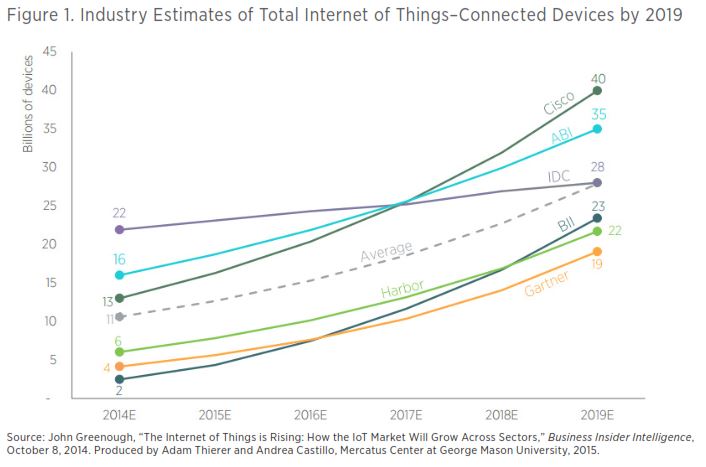
The “Internet of Things” (IoT) is already growing at a breakneck pace and is expected to continue to accelerate rapidly. In a short new paper (“Projecting the Growth and Economic Impact of the Internet of Things“) that I’ve just released with my Mercatus Center colleague Andrea Castillo, we provide a brief explanation of IoT technologies before describing the current projections of the economic and technological impacts that IoT could have on society. In addition to creating massive gains for consumers, IoT is projected to provide dramatic improvements in manufacturing, health care, energy, transportation, retail services, government, and general economic growth. Take a look at our paper if you’re interested, and you might also want to check out my 118-page law review article, “The Internet of Things and Wearable Technology: Addressing Privacy and Security Concerns without Derailing Innovation” as well as my recent congressional testimony on the policy issues surrounding the IoT.)
The Obama Administration has just released a draft “Consumer Privacy Bill of Rights Act of 2015.” Generally speaking, the bill aims to translate fair information practice principles (FIPPs) — which have traditionally been flexible and voluntary guidelines — into a formal set of industry best practices that would be federally enforced on private sector digital innovators. This includes federally-mandated Privacy Review Boards, approved by the Federal Trade Commission, the agency that will be primarily responsible for enforcing the new regulatory regime.
Many of the principles found in the Administration’s draft proposal are quite sensible as best practices, but the danger here is that they could soon be converted into a heavy-handed, bureaucratized regulatory regime for America’s highly innovative, data-driven economy.
No matter how well-intentioned this proposal may be, it is vital to recognize that restrictions on data collection could negatively impact innovation, consumer choice, and the competitiveness of America’s digital economy.
Online privacy and security is vitally important, but we should look to use alternative and less costly approaches to protecting privacy and security that rely on education, empowerment, and targeted enforcement of existing laws. Serious and lasting long-term privacy protection requires a layered, multifaceted approach incorporating many solutions.
That is why flexible data collection and use policies and evolving best practices will ultimately serve consumers better than one-size-fits all, top-down regulatory edicts. Continue reading →
Yesterday, the Federal Trade Commission (FTC) released its long-awaited report on “The Internet of Things: Privacy and Security in a Connected World.” The 55-page report is the result of a lengthy staff exploration of the issue, which kicked off with an FTC workshop on the issue that was held on November 19, 2013.
I’m still digesting all the details in the report, but I thought I’d offer a few quick thoughts on some of the major findings and recommendations from it. As I’ve noted here before, I’ve made the Internet of Things my top priority over the past year and have penned several essays about it here, as well as in a big new white paper (“The Internet of Things and Wearable Technology: Addressing Privacy and Security Concerns without Derailing Innovation”) that will be published in the Richmond Journal of Law & Technology shortly. (Also, here’s a compendium of most of what I’ve done on the issue thus far.)
I’ll begin with a few general thoughts on the FTC’s report and its overall approach to the Internet of Things and then discuss a few specific issues that I believe deserve attention. Continue reading →
What sort of public policy vision should govern the Internet of Things? I’ve spent a lot of time thinking about that question in essays here over the past year, as well as in a new white paper (“The Internet of Things and Wearable Technology: Addressing Privacy and Security Concerns without Derailing Innovation”) that will be published in the Richmond Journal of Law & Technology early next year.
But I recently heard three policymakers articulate their recommended vision for the Internet of Things (IoT) and I found their approach so inspiring that I wanted to discuss it here in the hopes that it will become the foundation for future policy in this arena.
Last Thursday, it was my pleasure to attend a Center for Data Innovation (CDI) event on “How Can Policymakers Help Build the Internet of Things?” As the title implied, the goal of the event was to discuss how to achieve the vision of a more fully-connected world and, more specifically, how public policymakers can help facilitate that objective. It was a terrific event with many excellent panel discussions and keynote addresses.
Two of those keynotes were delivered by Senators Deb Fischer (R-Neb.) and Kelly Ayotte (R-N.H.). Below I will offer some highlights from their remarks and then relate them to the vision set forth by Federal Trade Commission (FTC) Commissioner Maureen K. Ohlhausen in some of her recent speeches. I will conclude by discussing how the Ayotte-Fischer-Ohlhausen vision can be seen as the logical extension of the Clinton Administration’s excellent 1997
Framework for Global Electronic Commerce, which proposed a similar policy paradigm for the Internet more generally. This shows how crafting policy for the IoT can and should be a nonpartisan affair. Continue reading →
 The Mercatus Center at George Mason University has just released my latest working paper, “The Internet of Things and Wearable Technology: Addressing Privacy and Security Concerns without Derailing Innovation.” The “Internet of Things” (IoT) generally refers to “smart” devices that are connected to both the Internet and other devices. Wearable technologies are IoT devices that are worn somewhere on the body and which gather data about us for various purposes. These technologies promise to usher in the next wave of Internet-enabled services and data-driven innovation. Basically, the Internet will be “baked in” to almost everything that consumers own and come into contact with.
Some critics are worried about the privacy and security implications of the Internet of Things and wearable technology, however, and are proposing regulation to address these concerns. In my new 93-page article, I explain why preemptive, top-down regulation would derail the many life-enriching innovations that could come from these new IoT technologies. Building on a recent book of mine, I argue that “permissionless innovation,” which allows new technology to flourish and develop in a relatively unabated fashion, is the superior approach to the Internet of Things.
As I note in the paper and my earlier book, if we spend all our time living in fear of the worst-case scenarios — and basing public policies on them — then best-case scenarios can never come about. As the old saying goes: nothing ventured, nothing gained. Precautionary principle-based regulation paralyzes progress and must be avoided. We instead need to find constructive, “bottom-up” solutions to the privacy and security risks accompanying these new IoT technologies instead of top-down controls that would limit the development of life-enriching IoT innovations. Continue reading →
On Thursday, it was my great pleasure to present a draft of my forthcoming paper, “The Internet of Things & Wearable Technology: Addressing Privacy & Security Concerns without Derailing Innovation,” at a conference that took place at the Federal Communications Commission on “Regulating the Evolving Broadband Ecosystem.” The 3-day event was co-sponsored by the American Enterprise Institute and the University of Nebraska College of Law.
The 65-page working paper I presented is still going through final peer review and copyediting, but I posted a very rough first draft on SSRN for conference participants. I expect the paper to be released as a Mercatus Center working paper in October and then I hope to find a home for it in a law review. I will post the final version once it is released. [UPDATE:The final version of this working paper was released on November 19, 2014.]
In the meantime, however, I thought I would post the 46 slides I presented at the conference, which offer an overview of the nature of the Internet of Things and wearable technology, the potential economic opportunities that exist in this space, and the various privacy and security challenges that could hold this technological revolution back. I also outlined some constructive solutions to those concerns. I plan to be very active on these issues in coming months.
Continue reading →
My latest law review article is entitled, “Privacy Law’s Precautionary Principle Problem,” and it appears in Vol. 66, No. 2 of the Maine Law Review. You can download the article on my Mercatus Center page, on the Maine Law Review website, or via SSRN. Here’s the abstract for the article:
Privacy law today faces two interrelated problems. The first is an
information control problem. Like so many other fields of modern cyberlaw—intellectual property, online safety, cybersecurity, etc.—privacy law is being challenged by intractable Information Age realities. Specifically, it is easier than ever before for information to circulate freely and harder than ever to bottle it up once it is released.
This has not slowed efforts to fashion new rules aimed at bottling up those information flows. If anything, the pace of privacy-related regulatory proposals has been steadily increasing in recent years even as these information control challenges multiply.
This has led to privacy law’s second major problem:
the precautionary principle problem. The precautionary principle generally holds that new innovations should be curbed or even forbidden until they are proven safe. Fashioning privacy rules based on precautionary principle reasoning necessitates prophylactic regulation that makes new forms of digital innovation guilty until proven innocent.
This puts privacy law on a collision course with the general freedom to innovate that has thus far powered the Internet revolution, and privacy law threatens to limit innovations consumers have come to expect or even raise prices for services consumers currently receive free of charge. As a result, even if new regulations are pursued or imposed, there will likely be formidable push-back not just from affected industries but also from their consumers.
In light of both these information control and precautionary principle problems, new approaches to privacy protection are necessary. Continue reading →

 The Technology Liberation Front is the tech policy blog dedicated to keeping politicians' hands off the 'net and everything else related to technology.