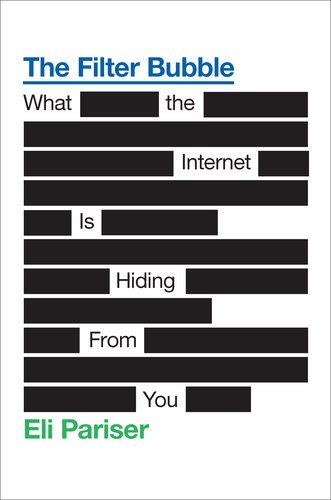
 In my latest weekly Forbes column is entitled “The Internet Isn’t Killing Our Culture or Democracy” and it’s a short review of the new book, The Filter Bubble: What the Internet is Hiding from You, by MoveOn.org board president Eli Pariser. As I note in my essay, Pariser’s book covers some very familiar ground already plowed by others in the burgeoning Internet pessimism movement:
[The Filter Bubble] restates a thesis developed a decade ago in both Cass Sunstein’s Republic.com and Andrew L. Shapiro’s The Control Revolution, that increased personalization is breeding a dangerous new creature—Anti-Democratic Man. “Democracy requires citizens to see things from one another’s point of view,” Pariser notes, “but instead we’re more and more enclosed in our own bubbles.” Pariser worries that personalized digital “filters” like Facebook, Google, Twitter, Pandora, and Netflix are narrowing our horizons about news and culture and leaving “less room for the chance encounters that bring insights and learning.” “Technology designed to give us more control over our lives is actually taking control away,” he fears.
Pariser joins a growing brigade of Internet pessimists. Almost every year for the past decade a new book has been published warning that the Internet is making us stupid, debasing our culture, or destroying social interaction. Many of these Net pessimists—whose ranks include Andrew Keen (The Cult of the Amateur), Lee Siegel (Against the Machine), Jaron Lanier (You Are Not a Gadget) and Nicholas Carr (The Shallows)—lament the rise of “The Daily Me,” or the rise of hyper-personalized news, culture, and information. They claim increased information and media customization will lead to close-mindedness, corporate brainwashing, an online echo-chamber, or even the death of deliberative democracy.
If you’ve read anything I’ve written on this topic in recent years, you will not be surprised to hear that I disagree with Pariser and these other Net pessimists when it comes to fears about hyper-personalization and user customization. As I noted in my recent book chapter, ”
The Case for Internet Optimism, Part 1 – Saving the Net From Its Detractors“:
Continue reading →
 Of the titles I included in a mega-book review about Internet optimists and pessimists that I posted here a few months ago, I mentioned Lee Siegel’s new book, Against the Machine: Being Human in the Age of the Electronic Mob. It is certainly the dourest of the recent books that have adopted a pessimistic view of the impact the Internet is having on our culture, society, and economy. Because Siegel’s book is one of the most important technology policy books of 2008, however, I decided to give it a closer look here.
Siegel’s book essentially picks up where Andrew Keen’s leaves off in
Cult of the Amateur: How Today’s Internet is Killing our Culture (2007). I posted a two-part review of Keen’s book here last year [Part 1, Part 2], but here’s a quick taste of Keen’s take on things. He argues “the moral fabric of our society is being unraveled by Web 2.0” and that “our cultural standards and moral values are not all that are at stake. Gravest of all,” Keen continues, “the very traditional institutions that have helped to foster and create our news, our music, our literature, our television shows, and our movies are under assault as well.”
As I noted in my earlier “Net optimists vs. pessimists” essay, after reading
Cult of the Amateur, I didn’t think anyone else could ever be quite as over-the-top and Chicken Little-ish as Keen. But after working my way through Siegel’s Against the Machine, I realized I was wrong. It made Keen seem downright reasonable and cheery by comparison! Keen and Siegel seem to be in heated competition for the title “High Prophet of Internet Doom,” but Siegel is currently a nose ahead in that race.
Continue reading →
 I’ve been re-reading Nicholas Negroponte’s brilliant and extraordinarily prescient 1995 book Being Digital this week, and I just came to the famous section in Chapter 12 about “The Daily Me.” It’s his visionary discussion of a future of personalized filters for all things digital to perfectly tune news and entertainment to your personal preferences. Here’s the key passage (again, remember that he wrote this in 1995, long before most of the digital things we take for granted today existed):
Imagine a future in which your interface agent can read every newswire and newspaper and catch every TV and radio broadcast on the planet, and then construct a personalized summary. This kind of newspaper is printed in an edition of one. […]
Imagine a computer display of news stories with a knob that, like a volume control, allows you to crank personalization up or down. You could have many of these controls, including a slider that moves both literally and politically from left to right to modify stories about public affairs.
These cotnrols change your window onto the news, both in terms of size and its editorial tone. In the distant future, interface agents will read, listen to, and look at each story in its entirety. In the near future, the filtering process will happen by using headers, those bits about bits.
Well, that future came about sooner than even Negroponte could have predicted. We all have a “Daily Me” now; it’s called our RSS feed. And there are other components to the “Daily Me,” such as iGoogle and Google Alerts, which provide automated search results served up instantaneously. And there are many other digital tools and services out there today that help us personalize our media experience.
You really gotta hand it to Negroponte for being way ahead of the curve in foreseeing all of this at a time when most of us where still using Trumpet Winsock and 14.4 modems. Hell, Al Gore hadn’t even built the Internet yet!

 The Technology Liberation Front is the tech policy blog dedicated to keeping politicians' hands off the 'net and everything else related to technology.
