I didn’t have nearly as much time this year to review the steadily growing stream of information policy books that were released. The end-of-year lists I put together in the past were fairly comprehensive (see 2008, 2009, 2010, 2011 and 2012), but I got sidetracked this year with 7 law review articles and an eBook project and had almost no time for book reviews, or even general blogging for that matter.
So, I’ve just listed some of the more notable titles from 2013 even though I didn’t find the time to describe them all. The first couple are the titles that I believe will have the most lasting influence on information technology policy debates. Needless to say, just because I believe that some of these titles will have an impact on policy going forward does not mean I endorse the perspectives or recommendations in any of them. And that would certainly be the case with my choice for most important Net policy book of the year, Ian Brown and Chris Marsden’s
Regulating Code. Their book does a wonderful job mapping the unfolding universe of Internet “co-regulation” and “multi-stakeholderism,” but their defense of a more politicized information policy future leaves lovers of liberty like me utterly demoralized.
The same could be said of many other titles on the list. As I noted in concluding several reviews over the past year, liberty is increasingly a loser in Internet policy circles these days. And it’s not just neo-Marxist rants like McChesney’s
Digital Disconnect or Lanier’s restatement of the Unibomber Manifesto, Who Owns the Future? The sad reality is that pretty much everybody these days has a pet peeve they want addressed through pure power politics because, you know, something must be done! The very term “Internet freedom” has already been grotesquely contorted into something akin to an open mandate for governments to meticulously plan virtually every facet of economic and social activity in the Information Age.
Anyway, despite that caveat, many interesting books were released in 2013 on an ever-expanding array of specific information policy topics. Here’s the list of everything that landed on my desk over the past year. Continue reading →
Anupam Chander, Director of the California International Law Center and Martin Luther King, Jr. Hall Research Scholar at the UC Davis School of Law, discusses his recent paper with co-author Uyen P. Lee titled The Free Speech Foundations of Cyberlaw. Chander addresses how the first amendment promotes innovation on the Internet; how limitations to free speech vary between the US and Europe; the role of online intermediaries in promoting and protecting the first amendment; the Communications Decency Act; technology, piracy, and copyright protection; and the tension between privacy and free speech.
Download
Related Links
2013 is shaping up to be another big year for Internet and information technology policy books. Here’s a list of what’s coming out or already on the market. As faithful readers know, I put together end-of-year lists of important info-tech policy books, and here are the lists for 2008, 2009, 2010, 2011 and the most recent one for 2012. And here’s my compendium of all the major tech policy books from the 2000s. So I’ll do my best to get through all these books and whatever else follows throughout the year. Consider this my public service to the Internet policy community: I read nerdy Internet policy books so that you don’t have to!
Let me know what else I may have missed and I will add it to the list.
- Ian Brown & Christopher T. Marsden – Regulating Code: Good Governance and Better Regulation in the Information Age
- Robert W. McChesney – Digital Disconnect: How Capitalism Is Turning the Internet Against Democracy
- Jaron Lanier – Who Owns the Future?
- Marvin Ammori – On Internet Freedom
- Abraham H. Foxman and Christopher Wolf – Viral Hate: Containing Its Spread on the Internet
- Giovanni Ziccardi – Resistance, Liberation Technology and Human Rights in the Digital Age
- John O. McGinnis – Accelerating Democracy: Transforming Governance Through Technology
- Scott Shackelford – Managing Cyber Attacks in International Law, Business and Relations: In Search of Cyber Peace
- Viktor Mayer-Schonberger & Kenneth Cukier – Big Data: A Revolution That Will Transform How We Live, Work, and Think
- Evgeny Morozov – To Save Everything, Click Here: The Folly of Technological Solutionism
- Ronald Deibert – Black Code: Inside the Battle for Cyberspace
- Eric Schmidt & Jared Cohen – The New Digital Age: Reshaping the Future of People, Nations and Business
- Dorothea Kleine – Technologies Of Choice? ICTs, Development, and the Capabilities Approach
- Nicco Mele – The End of Big: How the Internet Makes David the New Goliath
- Thomas Rid – Cyber War Will Not Take Place
- Ethan Zuckerman – Rewire: Digital Cosmopolitans in the Age of Connection
- Nate Anderson – The Internet Police: How Crime Went Online, and the Cops Followed
- Paul Rosenzweig – Cyber Warfare: How Conflicts in Cyberspace Are Challenging America and Changing the World
- Alice E. Marwick – Status Update: Celebrity, Publicity, and Branding in the Social Media Age
- Gautam Shroff – The Intelligent Web: Search, Smart Algorithms, and Big Data
- Anupam Chander – The Electronic Silk Road: How the Web Binds the World Together in Commerce
- Laura DeNardis – The Global War for Internet Governance (likely 2014 launch)
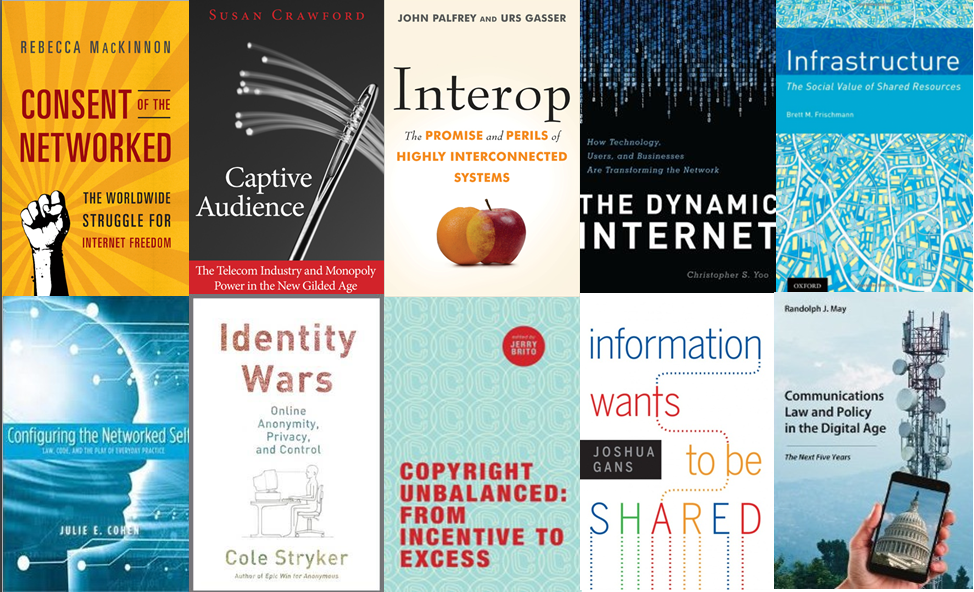
The number of major cyberlaw and information tech policy books being published annually continues to grow at an astonishing pace, so much so that I have lost the ability to read and review all of them. In past years, I put together end-of-year lists of important info-tech policy books (here are the lists for 2008, 2009, 2010, and 2011) and I was fairly confident I had read just about everything of importance that was out there (at least that was available in the U.S.). But last year that became a real struggle for me and this year it became an impossibility. A decade ago, there was merely a trickle of Internet policy books coming out each year. Then the trickle turned into a steady stream. Now it has turned into a flood. Thus, I’ve had to become far more selective about what is on my reading list. (This is also because the volume of journal articles about info-tech policy matters has increased exponentially at the same time.)
So, here’s what I’m going to do. I’m going to discuss what I regard to be the five most important titles of 2012, briefly summarize a half dozen others that I’ve read, and then I’m just going to list the rest of the books out there. I’ve read most of them but I have placed an asterisk next to the ones I haven’t. Please let me know what titles I have missed so that I can add them to the list. (Incidentally, here’s my compendium of all the major tech policy books from the 2000s and here’s the running list of all my book reviews.)
Continue reading →
Scott Shackelford, assistant professor of business law and ethics at Indiana University, and author of the soon-to-be-published book Managing Cyber Attacks in International Law, Business, and Relations: In Search of Cyber Peace, explains how polycentric governance could be the answer to modern cybersecurity concerns.
Shackelford originally began researching collective action problems in physical commons, including Antarctica, the deep sea bed, and outer space, where he discovered the efficacy of polycentric governance in addressing these issues. Noting the similarities between these communally owned resources and the Internet, Shackelford was drawn to the idea of polycentric governance as a solution to the collective action problems he identified in the online realm, particularly when it came to cybersecurity.
Shackelford contrasts the bottom-up form of governance characterized by self-organization and networking regulations at multiple levels to the increasingly state-centric approach prevailing in forums like the International Telecommunication Union (ITU). Analyzing the debate between Internet sovereignty and Internet freedom through the lens of polycentric regulation, Shackelford reconceptualizes both cybersecurity and the future of Internet governance.
Download
Related Links
Last month, it was my great privilege to be invited to deliver some remarks at the University of Maine’s Center for Law and Innovation (CLI) as part of their annual “Privacy in Practice” conference. Rita Heimes and Andrew Clearwater of the CLI put together a terrific program that also featured privacy gurus Harriet Pearson, Chris Wolf, Omer Tene, Kris Klein and Trevor Hughes. [Click on their names to watch their presentations.] In my remarks, I presented a wide-ranging (sometimes rambling) overview of how privacy policy is unfolding here in the U.S. as compared to the European Union, and also offered a full-throated defense of America’s approach to privacy as compared to the model from the other side of the Atlantic that many now want us to adopt here in the U.S. I also identified the many interesting parallels between online child safety policy and privacy policy here in the U.S. and discussed how we can apply a similar toolbox of solutions to problems that arise in both contexts. If you’re interested, I’ve embedded my entire 20-minute speech below, but I encourage you to also check out the other speakers videos that the folks at the CLI have posted on their site here. And keep an eye on the Maine Center for Law and Innovation; it is an up and coming powerhouse in the field of cyberlaw and Internet policy.
[UPDATE: 2/14/2013: As noted here, this paper was published by the Minnesota Journal of Law, Science & Technology in their Winter 2013 edition. Please refer to that post for more details and cite this final version of the paper going forward.]
I’m pleased to report that the Mercatus Center at George Mason University has just released my huge new white paper, “Technopanics, Threat Inflation, and the Danger of an Information Technology Precautionary Principle.” I’ve been working on this paper for a long time and look forward to finding it a home in a law journal some time soon. Here’s the summary of this 80-page paper:
Fear is an extremely powerful motivating force, especially in public policy debates where it is used in an attempt to sway opinion or bolster the case for action. Often, this action involves preemptive regulation based on false assumptions and evidence. Such fears are frequently on display in the Internet policy arena and take the form of full-blown “technopanic,” or real-world manifestations of this illogical fear. While it’s true that cyberspace has its fair share of troublemakers, there is no evidence that the Internet is leading to greater problems for society.
This paper considers the structure of fear appeal arguments in technology policy debates and then outlines how those arguments can be deconstructed and refuted in both cultural and economic contexts. Several examples of fear appeal arguments are offered with a particular focus on online child safety, digital privacy, and cybersecurity. The various factors contributing to “fear cycles” in these policy areas are documented.
To the extent that these concerns are valid, they are best addressed by ongoing societal learning, experimentation, resiliency, and coping strategies rather than by regulation. If steps must be taken to address these concerns, education and empowerment-based solutions represent superior approaches to dealing with them compared to a precautionary principle approach, which would limit beneficial learning opportunities and retard technological progress.
The complete paper can be found on the Mercatus site here, on SSRN, or on Scribd. I’ve also embedded it below in a Scribd reader. Continue reading →
This week I will again be attending the Family Online Safety Institute’s excellent annual summit. The 2-day affair brings together some of the world’s leading experts on online safety and privacy issues. It’s a great chance to learn about major developments in the field. As I was preparing for the session I am moderating on Thursday, I thought back to the first FOSI annual conference, which took place back in 2007. What is remarkable about that period compared to now is that there was a flurry of legislative and regulatory activity related to online child safety then that we simply do not see today.
In fact, just 3 1/2 years ago, John Morris of the Center for Democracy and Technology and I compile a legislative index [summary here] that cataloged the more than 30 legislative proposals that had been introduced in the the 110th session of Congress. There was also a great deal of interest in these issues within the regulatory community. Finally, countless state and local measures related to online safety and speech issues had been floated. Today, by contrast, it is hard for me to find any legislative measures focused on online safety regulation at the federal level, and I don’t see much activity at the agency level either. I haven’t surveyed state and local activity, but it seems like it has also died down.
Generally speaking, I think this is a good development since I am opposed to most proposals to regulate online speech, expression, or conduct. But let’s ignore the particular wisdom of such measures and ask a simple question:
What explains the decline in Internet safety legislation and online content regulation? I believe there are three possible explanations: Continue reading →
This is the second of two essays making “The Case for Internet Optimism.” This essay was included in the book, The Next Digital Decade: Essays on the Future of the Internet (2011), which was edited by Berin Szoka and Adam Marcus of TechFreedom. In my previous essay, which I discussed here yesterday, I examined the first variant of Internet pessimism: “Net Skeptics,” who are pessimistic about the Internet improving the lot of mankind. In this second essay, I take on a very different breed of Net pessimists: “Net Lovers” who, though they embrace the Net and digital technologies, argue that they are “dying” due to a lack of sufficient care or collective oversight. In particular, they fear that the “open” Internet and “generative” digital systems are giving way to closed, proprietary systems, typically run by villainous corporations out to erect walled gardens and quash our digital liberties. Thus, they are pessimistic about the long-term survival of the Internet that we currently know and love.
Leading exponents of this theory include noted cyberlaw scholars Lawrence Lessig, Jonathan Zittrain, and Tim Wu. I argue that these scholars tend to significantly overstate the severity of this problem (the supposed decline of openness or generativity, that is) and seem to have very little faith in the ability of such systems to win out in a free market. Moreover, there’s nothing wrong with a hybrid world in which some “closed” devices and platforms remain (or even thrive) alongside “open” ones. Importantly, “openness” is a highly subjective term, and a constantly evolving one. And many “open” systems or devices are as perfectly open as these advocates suggest.
Finally, I argue that it’s likely that the “openness” advocated by these advocates will devolve into expanded government control of cyberspace and digital systems than that unregulated systems will become subject to “perfect control” by the private sector, as they fear. Indeed, the implicit message in the work of all these hyper-pessimistic critics is that markets must be steered in a more sensible direction by those technocratic philosopher kings (although the details of their blueprint for digital salvation are often scarce). Thus, I conclude that the dour, depressing “the-Net-is-about-to-die” fear that seems to fuel this worldview is almost completely unfounded and should be rejected before serious damage is done to the evolutionary Internet through misguided government action.
I’ve embedded the entire essay down below in Scribd reader, but it can also be found on TechFreedom’s Next Digital Decade book website and SSRN.
Continue reading →

 The Technology Liberation Front is the tech policy blog dedicated to keeping politicians' hands off the 'net and everything else related to technology.