2009 was not as big of a year for Internet and information technology (“info-tech”) policy books as 2008 was, but there were still some notable titles released that offered interesting perspectives about the future of the Net and the impact the Digital Revolution is having on our lives, culture, and economy. So, like last year, I figured I would throw together my list of the 10 most important info-tech policy books of the year.
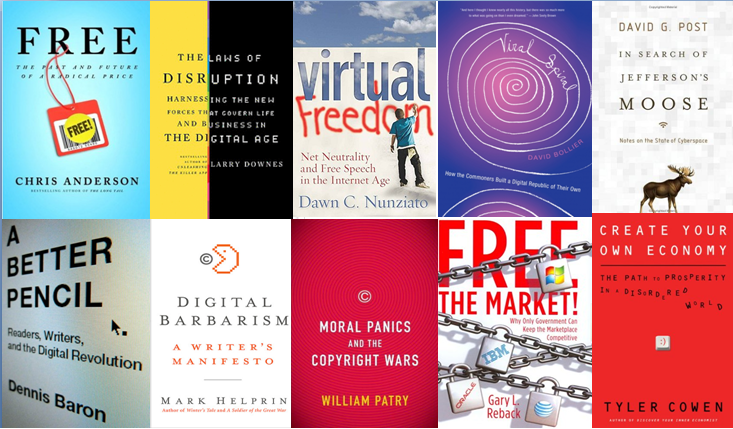 First, let me repeat a few of the same caveats and disclaimers that I set forth last year. What qualifies as an “important” info-tech policy book? Simply put, it’s a title that many people are currently discussing and that we will likely be referencing for many years to come. However, I want to be clear that merely because a book appears on my list it does not necessarily mean I agree with everything said in it. In fact, as was the case in previous years, I found much with which to disagree in my picks for the most important books of 2009 and I find that the cyber-libertarianism I subscribe to has very few fans out there.
Another caveat: Narrowly-focused titles lose a few points on my list. For example, if a book deals mostly with privacy issues, copyright law, or antitrust policy, it does not exactly qualify as the same sort of “tech policy book” as other titles found on this list since it is a narrow exploration of just one set of issues with a bearing on technology policy.
With those caveats in mind, here are my choices for the Most Important Info-Tech Policy Books of 2009. Continue reading →
 Five years ago today the Technology Liberation Front (the “TLF”) got underway with this post. The idea for the TLF came about after I asked some tech policy wonks whether it was worth put together a blog dedicated to covering Internet-related issues from a cyber-libertarian perspective. The model I had in mind was a “Volokh Conspiracy
for Tech Issues,” if you will. I wanted to bring together a collection of sharp, liberty-loving wonks (most of whom worked in the think tank world) to talk about their research on this front and to give them a place to post their views on breaking tech policy developments. It was to be a sort of central clearinghouse for libertarian-oriented tech policy analysis and advocacy.
Five years ago today the Technology Liberation Front (the “TLF”) got underway with this post. The idea for the TLF came about after I asked some tech policy wonks whether it was worth put together a blog dedicated to covering Internet-related issues from a cyber-libertarian perspective. The model I had in mind was a “Volokh Conspiracy
for Tech Issues,” if you will. I wanted to bring together a collection of sharp, liberty-loving wonks (most of whom worked in the think tank world) to talk about their research on this front and to give them a place to post their views on breaking tech policy developments. It was to be a sort of central clearinghouse for libertarian-oriented tech policy analysis and advocacy.
At first, Tim Lee and I debated whether it even made sense to have that sort of narrow focus, but I think the passage of time and the rise of plenty of competition on this front shows that it was worthwhile. And I’ve been very pleased with the tag-team effort of all our TLF contributors and the way—without anyone planning it, in true libertarian fashion—we’ve sort of developed a nice division of labor on various tech policy issues.
Perhaps a few stats are in order on this occasion to mark our progress 5 years in. The best indication of our success is the fact that our Pagerank (Google’s logarithmic scale of website importance based on links to that site) has reached 7/10—the same score shared by the Volokh Conspiracy (our model), as well as Techmeme (the leading tech news aggregator), the Cato Institute, CDT, etc. (For comparison: ArsTechnica and EFF are 8s.) Unfortunately, we’ve only been using Google Analytics for three of the past five years, so it’s impossible to get a authoritative accounting of traffic growth since Day 1. But here are few markers:
- 4,450+ posts
- 29,000+ comments
- 2,698 RSS subscribers
- 15,763 unique visitors per month
- 1,000,000 pageviews since Nov. 2006 when we started using Google Analytics
- Besides organic search and direct links, we get the bulk of our traffic from other tech-oriented sites (in order of hits) TechDirt, Freedom to Tinker, Ars Technica, GamePolitics.com, TechMeme, Slate, etc., and aggregators such as reddit, Fark, and StumbleUpon
So, what’s our #1 post of all-time? Continue reading →
 by Adam Thierer & Berin Szoka — (Ver. 1.0 — Summer 2009)
We are attempting to articulate the core principles of cyber-libertarianism to provide the public and policymakers with a better understanding of this alternative vision for ordering the affairs of cyberspace. We invite comments and suggestions regarding how we should refine and build-out this outline. We hope this outline serves as the foundation of a book we eventually want to pen defending what we regard as “Real Internet Freedom.” [Note: Here’s a printer-friendly version, which we also have embedded down below as a Scribd document.]
I. What is Cyber-Libertarianism?
Cyber-libertarianism refers to the belief that individuals—acting in whatever capacity they choose (as citizens, consumers, companies, or collectives)—should be at liberty to pursue their own tastes and interests online.
Generally speaking, the cyber-libertarian’s motto is “Live & Let Live” and “Hands Off the Internet!” The cyber-libertarian aims to minimize the scope of state coercion in solving social and economic problems and looks instead to voluntary solutions and mutual consent-based arrangements.
Cyber-libertarians believe true “Internet freedom” is freedom
from state action; not freedom for the State to reorder our affairs to supposedly make certain people or groups better off or to improve some amorphous “public interest”—an all-to convenient facade behind which unaccountable elites can impose their will on the rest of us.
Continue reading →

 The Technology Liberation Front is the tech policy blog dedicated to keeping politicians' hands off the 'net and everything else related to technology.