It was my pleasure to recently join Matthew Lesh, Director of Public Policy and Communications for the London-based Institute of Economic Affairs (IEA), for the IEA podcast discussion, “Should We Regulate AI?” In our wide-ranging 30-minute conversation, we discuss how artificial intelligence policy is playing out across nations and I explained why I feel the UK has positioned itself smartly relative to the US & EU on AI policy. I argued that the UK approach encourages a better ‘innovation culture’ than the new US model being formulated by the Biden Administration.
We also went through some of the many concerns driving calls to regulate AI today, including: fears about job dislocations, privacy and security issues, national security and existential risks, and much more.
In an earlier essay, I explored “Why the Future of AI Will Not Be Invented in Europe” and argued that, “there is no doubt that European competitiveness is suffering today and that excessive regulation plays a fairly significant role in causing it.” This essay summarizes some of the major academic literature that leads to that conclusion.
Since the mid-1990s, the European Union has been layering on highly restrictive policies governing online data collection and use. The most significant of the E.U.’s recent mandates is the 2018 General Data Protection Regulation (GDPR). This regulation established even more stringent rules related to the protection of personal data, the movement thereof, and limits what organizations can do with data. Data minimization is the major priority of this system, but there are many different types of restrictions and reporting requirements involved in the regulatory scheme. This policy framework also has ramifications for the future of next-generation technologies, especially artificial intelligence and machine learning systems, which rely on high-quality data sets to improve their efficacy.
Whether or not the E.U.’s complicated regulatory regime has actually resulted in truly meaningful privacy protections for European citizens relative to people in other countries remains open to debate. It is very difficult to measure and compare highly subjective values like privacy across countries and cultures. This makes benefit-cost analysis for privacy regulation extremely challenging — especially on the benefits side of the equation.
What is no longer up for debate, however, is the cost side of the equation and the question of what sort of consequences the GDPR has had on business formation, competition, investment, and so on. On these matters, standardized metrics exist and the economic evidence is abundantly clear: the GDPR has been a disaster for Europe. Continue reading →
I spent much of 2022 writing about the growing policy debate over artificial intelligence, machine learning, robotics, and the Computational Revolution more generally. Here are some of the major highlights of my work on this front.
POLICY DEFAULTS: “The Proper Governance Default for AI” – Which policy default should we choose for algorithmic technologies: The Precautionary Principle or The Proactionary Principle? This is the single most important issue in AI policy today.
It was my pleasure this week to participate in a panel discussion about the future of innovation policy at the James Madison Institute’s 2022 Tech and Innovation Summit in Coral Gables, FL. Our conversation focused on the future of Progress Studies, which is one of my favorite topics. We were asked to discuss five major questions and below I have summarized some of my answers to them, plus some other thoughts I had about what I heard at the conference from others.
What is progress studies and why is it so needed today?
In a sense, Progress Studies is nothing new. Progress studies goes back at least to the days of Adam Smith and plenty of important scholars have been thinking about it ever since. Those scholars and policy advocates have long been engaged in trying to figure out what’s the secret sauce that powers economic growth and human prosperity. It’s just that we didn’t call that Progress Studies in the old days.
The reason Progress Studies is important is because technological innovation has been shown to be the fundamental driver in improvements in human well-being over time. When we can move the needle on progress, it helps individuals extend and improve their lives, incomes, and happiness. By extension, progress helps us live lives of our choosing. As Hans Rosling brilliantly argued, the goal of expanding innovation opportunities and raising incomes “is not just bigger piles of money” or more leisure time. “The ultimate goal is to have the freedom to do what we want.” Continue reading →
This a running list of all the essays and reports I’ve already rolled out on the governance of artificial intelligence (AI), machine learning (ML), and robotics. Why have I decided to spend so much time on this issue? Because this will become the most important technological revolution of our lifetimes. Every segment of the economy will be touched in some fashion by AI, ML, robotics, and the power of computational science. It should be equally clear that public policy will be radically transformed along the way.
Eventually, all policy will involve AI policy and computational considerations. As AI “eats the world,” it eats the world of public policy along with it. The stakes here are profound for individuals, economies, and nations. As a result, AI policy will be the most important technology policy fight of the next decade, and perhaps next quarter century. Those who are passionate about the freedom to innovate need to prepare to meet the challenge as proposals to regulate AI proliferate.
There are many socio-technical concerns surrounding algorithmic systems that deserve serious consideration and appropriate governance steps to ensure that these systems are beneficial to society. However,
there is an equally compelling public interest in ensuring that AI innovations are developed and made widely available to help improve human well-being across many dimensions. And that’s the case that I’ll be dedicating my life to making in coming years.
Here’s the list of what I’ve done so far. I will continue to update this as new material is released: Continue reading →
Profectus is an excellent new online magazine featuring essays and interviews on the intersection of academic literature, public policy, civilizational progress, and human flourishing. The Spring 2022 edition of the magazine features a “Progress Roundtable” in which six different scholars were asked to contribute their thoughts on three general questions:
What is progress?
What are the most significant barriers holding back further progress?
If those challenges can be overcome, what does the world look like in 50 years?
I was honored to be asked by Clay Routledge to contribute answers to those questions alongside others, including: Steven Pinker (Harvard University), Jason Crawford (Roots of Progress), Matt Clancy (Institute for Progress), Marian Tupy (HumanProgress.org), James Pethokoukis (AEI). I encourage you to jump over the roundtable and read all their excellent responses. I’ve included my answers down below:
Almost every argument against technological innovation and progress that we hear today was identified and debunked by Samuel C. Florman a half century ago. Few others since him have mounted a more powerful case for the importance of innovation to human flourishing than Florman did throughout his lifetime.
Chances are you’ve never heard of him, however. As prolific as he was, Florman did not command as much attention as the endless parade of tech critics whose apocalyptic predictions grabbed all the headlines. An engineer by training, Florman became concerned about the growing criticism of his profession throughout the 1960s and 70s. He pushed back against that impulse in a series of books over the next two decades, including most notably:
The Existential Pleasures of Engineering (1976), Blaming Technology: The Irrational Search for Scapegoats (1981), and The Civilized Engineer (1987). He was also a prolific essayist, penning hundreds of articles for a wide variety of journals, magazines, and newspapers beginning in 1959. He was also a regular columnist for MIT Technology Review for sixteen years.
Florman’s primary mission in his books and many of those essays was to defend the engineering profession against attacks emanating from various corners. More broadly, as he noted in a short autobiography on his personal website, Florman was interested in discussing, “the relationship of technology to the general culture.”
Florman could be considered a “rational optimist,” to borrow Matt Ridley’s notable term[1] for those of us who believe, as I have summarized elsewhere, that there is a symbiotic relationship between innovation, economic growth, pluralism, and human betterment.[2] Rational optimists are highly pragmatic and base their optimism on facts and historical analysis, not on dogmatism or blind faith in any particular viewpoint, ideology, or gut feeling. But they are unified in the belief that technological change is a crucial component of moving the needle on progress and prosperity.
Florman’s unique contribution to advancing rational optimism came in the way he itemized the various claims made by tech critics and then powerfully debunked each one of them. Continue reading →
The White House has announced a new effort to help prepare workers for the challenges they will face in the future. While it’s a well-intentioned effort, and one that I hope succeeds, I’m skeptical about it for a simple reason: It’s just really hard to plan for the workforce needs of the future and train people for jobs that we cannot possibly envision today.
Writing in the Wall Street Journal today, Ivanka Trump, senior adviser to the president, outlines the elements of new Executive Order that President Trump is issuing “to prioritize and expand workforce development so that we can create and fill American jobs with American workers.” Toward that end, the Administration plans on:
establishing a National Council for the American Worker, “composed of senior administration officials, who will develop a national strategy for training and retraining workers for high-demand industries.” This is meant to bring more efficiency and effectiveness to the “more than 40 workforce-training programs in more than a dozen agencies, and too many have produced meager results.”
“facilitat[ing] the use of data to connect American businesses, workers and educational institutions.” This is meant to help workers find “what jobs are available, where they are, what skills are required to fill them, and where the best training is available.”
launching a nationwide campaign “to highlight the growing vocational crisis and promote careers in the skilled trades, technology and manufacturing.”
The Administration also plans on creating a new advisory board of experts to address these issues, and the administration is also “asking companies and trade groups throughout the country to sign our new Pledge to America’s Workers—a commitment to invest in the current and future workforce.” They hope to encourage companies to take additional steps “to educate, train and reskill American students and workers.”
Perhaps some of these steps make sense, and perhaps a few will even help workers deal with the challenges of our more complex, fast-evolving, global economy. But I doubt it.
Continue reading →
The National Academies of Sciences, Engineering, and Medicine has released an amazing new report focused on, “Assessing the Risks of Integrating Unmanned Aircraft Systems (UAS) into the National Airspace System.” In what the Wall Street Journal rightly refers to as an “unusually strongly worded report,” the group of experts assembled by the National Academies call for a sea change in regulatory attitudes and policies toward regulation of Unmanned Aircraft Systems (or “drones”) and the nation’s airspace more generally.
The report uses the term “conservative” or “overly conservative” more than a dozen times to describe the Federal Aviation Administration’s (FAA) problematic current approach toward drones. They point out that the agency has “a culture with a near-zero tolerance for risk,” and that the agency needs to adjust that culture to take into account “the various ways in which this new technology may reduce risk and save lives.” (Ch. S, p.2) The report continues on to say that:
The committee concluded that “fear of making a mistake” drives a risk culture at the FAA that is too often overly conservative, particularly with regard to UAS technologies, which do not pose a direct threat to human life in the same way as technologies used in manned aircraft. An overly conservative attitude can take many forms. For example, FAA risk avoidance behavior is often rewarded, even when it is excessively risk averse, and rewarded behavior is repeated behavior. Balanced risk decisions can be discounted, and FAA staff may conclude that allowing new risk could endanger their careers even when that risk is so minimal that it does not exceed established safety standards. The committee concluded that a better measure for the FAA to apply is to ask the question, “Can we make UAS as safe as other background risks that people experience daily?” As the committee notes, we do not ground airplanes because birds fly in the airspace, although we know birds can and do bring down aircraft.
[. . . ]
In many cases, the focus has been on “What might go wrong?” instead of a holistic risk picture: “What is the net risk/benefit?” Closely related to this is what the committee considers to be paralysis wherein ever more data are often requested to address every element of uncertainty in a new technology. Flight experience cannot be gained to generate these data due to overconservatism that limits approvals of these flights.
Ultimately, the status quo is seen as safe. There is too little recognition that new technologies brought into the airspace by UAS could improve the safety of manned aircraft operations, or may mitigate, if not eliminate, some nonaviation risks. (p. S-2)
Importantly, the report makes it clear that the problem here is not just that “an overly conservative risk culture that overestimates the severity and the likelihood of UAS risk can be a significant barrier to introduction and development of these technologies,” but, more profoundly, the report highlights how, “Avoiding risk entirely by setting the safety target too high creates imbalanced risk decisions and can degrade overall safety and quality of life.” (p. 3-6,7) In other words, we should want a more open and common sense-oriented approach to drones, not only to encourage more life-enriching innovation, but also because it could actually make us safer as a result.
No Reward without Some Risk
What the National Academies report is really saying here is that
there can be no reward without some risk. This is something I have spent a great deal of time writing about in my last book, a recent book chapter, and various other essays and journal articles over the past 25 years. As I noted in my last book, “living in constant fear of worst-case scenarios—and premising public policy on them—means that best-case scenarios will never come about.” If we want a wealthier, healthier, and safer society, we must embrace change and risk-taking to get us there.
This is exactly what that National Academies report is getting at when they note that the FAA”s “overly conservative culture prevents safety beneficial operations from entering the airspace. The focus is on what might go wrong. More dialogue on potential benefits is needed to develop a holistic risk picture that addresses the question, What is the net risk/benefit?” (p. 3-10)
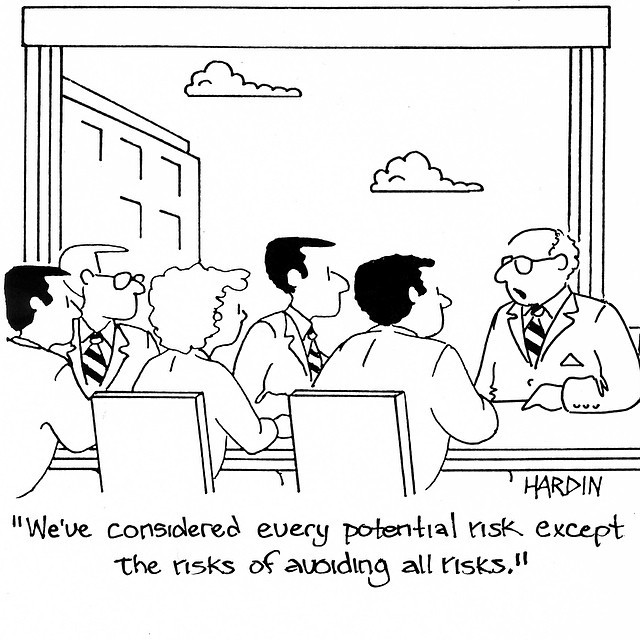
In other words, all safety regulation involves trade-offs, and if (to paraphrase a classic Hardin cartoon you’ll see to your right) we consider every potential risk except the risk of avoiding all risks, the result will be not only a decline in short-term innovation, but also a corresponding decline in safety and overall living standards over time.
Countless risk scholars have studied this process and come to the same conclusion. “We could virtually end all risk of failure by simply declaring a moratorium on innovation, change, and progress,” notes engineering historian Henry Petroski. But the costs to society of doing so would be catastrophic, of course. “The history of the human race would be dreary indeed if none of our forebears had ever been willing to accept risk in return for potential achievement,” observed H.L. Lewis, an expert on technological risk trade-offs.
The most important book ever written on this topic was Aaron Wildavsky’s 1988 masterpiece, Searching for Safety. Wildavsky warned of the dangers of “trial without error” reasoning and contrasted it with the trial-and-error method of evaluating risk and seeking wise solutions to it. Wildavsky argued that real wisdom is born of experience and that we can learn how to be wealthier and healthier as individuals and a society only by first being willing to embrace uncertainty and even occasional failure. As he put it:
The direct implication of trial without error is obvious: If you can do nothing without knowing first how it will turn out, you cannot do anything at all. An indirect implication of trial without error is that if trying new things is made more costly, there will be fewer departures from past practice; this very lack of change may itself be dangerous in forgoing chances to reduce existing hazards. . . . Existing hazards will continue to cause harm if we fail to reduce them by taking advantage of the opportunity to benefit from repeated trials.
When this logic takes the form of public policy prescriptions, it is referred to as the “precautionary principle,” which generally holds that, because new ideas or technologies could pose some theoretical danger or risk in the future, public policies should control or limit the development of such innovations until their creators can prove that they won’t cause any harms.
Again, if we adopt that attitude, human safety actually suffers because it holds back beneficial experiments aimed at improving the human condition. As the great economic historian Joel Mokyr argues, “technological progress requires above all tolerance toward the unfamiliar and the eccentric.” But the regulatory status quo all too often rejects “the unfamiliar and the eccentric” out of an abundance of caution. While usually well-intentioned, that sort of status quo thinking holds back new and better was of doing old things better, or doing all new things. The end result is that real health and safety advances are ignored or forgone.
How Status Quo Thinking at the FAA Results in Less Safety
This is equally true for air safety and FAA regulation of drones. “Ultimately, the status quo is seen as safe,” the National Acadamies report notes. “There is too little recognition that new technologies brought into the airspace by UAS could improve the safety of manned aircraft operations, or may mitigate, if not eliminate, some nonaviation risks.” The example of the life-saving potential of drones have already been well-documented.
Drones have already been used to monitor fires, help with search-and-rescue missions for missing people or animals, assist life guards by dropping life vests to drowning people, deliver medicines to remote areas, and help with disaster monitoring and recovery efforts. But that really just scratches the surface in terms of their potential.
Some people scoff at the idea of drones being used to deliver small packages to our offices or homes. But consider how many of those packages are delivered by human-operated vehicles that are far more likely to be involved in dangerous traffic accidents on our over-crowded roadways. If drones were used to make some of those deliveries, we might be able to save a lot of lives. Or how about an elderly person stuck at home during storm, only to realize they are out of some essential good or medicine that is a long drive away. Are we better off having them (or someone else) get behind the wheel to drive and get it, or might a drone be able to deliver it more safely?
The authors of the National Academies report understand this, as they made clear when they concluded that, “operation of UAS has many advantages and may improve the quality of life for people around the world. Avoiding risk entirely by setting the safety target too high creates imbalanced risk decisions and can degrade overall safety and quality of life.” (Ch. 3, p. 5-6)
Reform Ideas: Use the “Innovator’s Presumption” & “Sunsetting Imperative”
Given that reality, the National Academies report makes several sensible reform recommendations aimed at countering the FAA’s hyper-conservatism and bias for the broken regulatory status quo. I won’t go through them all, but I think they are an excellent set of reforms that deserve to be taken seriously.
I do, however, want to highly recommend everyone take a close look at this one outstanding recommendation in Chapter 3, which is aimed at keep things moving and making sure that status quo thinking doesn’t freeze beneficial new forms of airspace innovation. Specifically, the National Academies report recommends that:
The FAA should meet requests for certifications or operations approvals with an initial response of “How can we approve this?” Where the FAA employs internal boards of executives throughout the agency to provide input on decisions, final responsibility and authority and accountability for the decision should rest with the executive overseeing such boards. A time limit should be placed on responses from each member of the board, and any “No” vote should be accompanied with a clearly articulated rationale and suggestion for how that “No” vote could be made a “Yes.” (Ch. 3, p. 8)
I absolutely love this reform idea because it essentially combines elements of two general innovation policy reform ideas that I discussed in my recent essay, “Converting Permissionless Innovation into Public Policy: 3 Reforms.” In that piece, I proposed the idea of instituting an “Innovator’s Presumption” that would read: “Any person or party (including a regulatory authority) who opposes a new technology or service shall have the burden to demonstrate that such proposal is inconsistent with the public interest.” I also proposed a so-called “Sunsetting Imperative” that would read: “Any existing or newly imposed technology regulation should include a provision sunsetting the law or regulation within two years.”
The National Academies report recommendation above basically embodies the spirit of both the Innovator’s Presumption and the Sunsetting Imperative. It puts the burden of proof on opponents of change and then creates a sort of shot clock to keep things moving.
These are the kind of reforms we need to make sure status quo thinking at regulatory agencies doesn’t hold back life-enriching and life-saving innovations. It’s time for a change in the ways business is done at the FAA to make sure that regulations are timely, effective, and in line with common sense. Sadly, as the new National Academies report makes clear, today’s illogical policies governing airspace innovation are having counter-productive results that hurt society.
Writing last week in The Wall Street Journal, Matt Moffett noted how many European countries continue to struggle with chronic unemployment and general economic malaise. (“New Entrepreneurs Find Pain in Spain“) It’s a dismal but highly instructive tale about how much policy incentives matter when it comes to innovation and job creation–especially the sort of entrepreneurial activity from small start-ups that is so essential for economic growth. Here’s the key takeaway:
Scarce capital, dense bureaucracy, a culture deeply averse to risk and a cratered consumer market all suppress startups in Europe. The Global Entrepreneurship Monitor, a survey of startup activity, found the percentage of the adult population involved in early stage entrepreneurial activity last year was just 5% in Germany, 4.6% in France and 3.4% in Italy. That compares with 12.7% in the U.S. Even once they are established, European businesses are, on average, smaller and slower growing than those in the U.S. The problems of entrepreneurs are one reason Europe’s economy continues to struggle after six years of crisis. The European Union this month cut its growth forecasts for the region for this year and next, citing weaker than expected performance in the eurozone’s biggest economies, Germany, France and Italy. This week, the Organization for Economic Cooperation and Development delivered its own pessimistic appraisal, with chief economist Catherine Mann saying, “The eurozone is the locus of the weakness in the global economy.”
[…]
Europe’s unemployment crisis may be eroding a deeply ingrained fear of failure that is a bigger impediment to entrepreneurship on the Continent than in other regions, according to academic surveys. “Fear of failure is less of an issue because the whole country is a failure, and most of us are out of business or have a hard time paying our bills,” said Nick Drandakis of Athens, who in 2011 founded Taxibeat, an app that provides passenger ratings on taxi drivers.
The Technology Liberation Front is the tech policy blog dedicated to keeping politicians' hands off the 'net and everything else related to technology. Learn more about TLF →


 The Technology Liberation Front is the tech policy blog dedicated to keeping politicians' hands off the 'net and everything else related to technology.
Running List of My Research on AI, ML & Robotics Policy
by Adam Thierer on July 29, 2022 · 0 comments
[last updated 4/3/2025 – Check my Medium page for latest posts]
This a running list of all the essays and reports I’ve already rolled out on the governance of artificial intelligence (AI), machine learning (ML), and robotics. Why have I decided to spend so much time on this issue? Because this will become the most important technological revolution of our lifetimes. Every segment of the economy will be touched in some fashion by AI, ML, robotics, and the power of computational science. It should be equally clear that public policy will be radically transformed along the way.
Eventually, all policy will involve AI policy and computational considerations. As AI “eats the world,” it eats the world of public policy along with it. The stakes here are profound for individuals, economies, and nations. As a result, AI policy will be the most important technology policy fight of the next decade, and perhaps next quarter century. Those who are passionate about the freedom to innovate need to prepare to meet the challenge as proposals to regulate AI proliferate.
There are many socio-technical concerns surrounding algorithmic systems that deserve serious consideration and appropriate governance steps to ensure that these systems are beneficial to society. However, there is an equally compelling public interest in ensuring that AI innovations are developed and made widely available to help improve human well-being across many dimensions. And that’s the case that I’ll be dedicating my life to making in coming years.
Here’s the list of what I’ve done so far. I will continue to update this as new material is released: Continue reading →