Over the weekend, the always-terrific Lenore Skenazy published a provocative editorial in Forbes entitled, “Shred Your Sex Offender Map.” (For more on Skenazy, see my review of her amazing book Free-Range Kids here last year). In her Forbes essay, Skenazy argues that, as currently constructed, America’s sex offender registries “are making our kids LESS safe.” How can that possibly be? I explained why in a lengthy essay on this topic I penned last summer entitled, “
Rethinking ‘Sex Crimes’ and Sex Offender Registries.” In it, I made an argument similar to Lenore’s. In a nutshell, if we really want to keep kids safe from real sex offenders, we need to completely rethink the way we define and punish sex offenses in this country because a significant percentage of the people listed on sex offender registries pose almost no threat to children, making it difficult for us to know who really does pose a threat to our kids and what we should do about them.
Consider two groups of people. Let’s call Group #1 the “petty sex crime crowd.” This would include anyone convicted of indecent exposure (streaking / public nudity / public urination); a 19-year-old teen who gets caught having sex with a 17-year-old girlfriend; two gay men who had consensual sex in a state where sodomy was previously illegal; etc, etc. The crucial distinction for this group is that their actions were consensual and non-violent. No serious harm came from their actions, even if
some of these activities are less than socially desirable. Now, let’s talk about Group #2: violent rapists, child molesters, child pornographers, and other creeps who sexually abused people (or even animals!) These people are the wretched scum of the Earth.
Anyway, here’s the first problem with the current sex offender registries: Group 1 and Group 2 are all mixed together! There’s a word for this:
Insanity. How in the hell did it ever come to pass that non-violent, consensual sex “offenders” got stuck on the same list as sadists, pedophiles, rapists, and other violent, evil scum? Honestly, I don’t know and I don’t care. I just want that nonsense to end and end right now because as I noted in my earlier essay and Lenore argues in her’s, this means current sex offender lists / maps are largely worthless to parents like me unless I take the time to drill down into the details of who was guilty of what. (Even when you do, it can still be confusing since some crimes aren’t made clear). But the public is basically being subjected to a panic attack when they hear sex offender registry numbers or see maps of sex offenders in their neighborhood because the overall number of “offenders on the lists,” or dots on the offender maps, is being artificially raised by the presence of Group 1 “offenders.”
Continue reading →
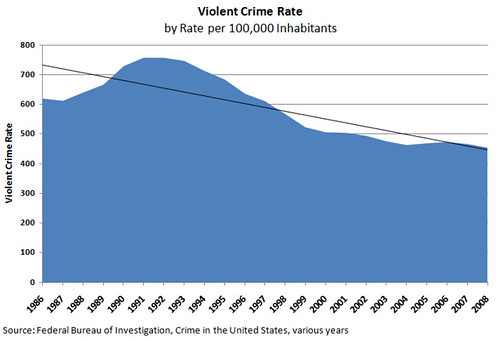
 David Leonhardt of The New York Times penned an interesting essay a few days ago entitled, “Do Video Games Equal Less Crime?” reflecting upon the same FBI crime data I wrote about earlier this week, which showed rapid drops in violent crime last year (on top of years of steady declines). Crimes of all sorts plummeted last year despite the serious economic recession we find ourselves in. Downturns in the economy are typically followed by upticks in crime. Not so this time. Which leads Leonhardt to wonder if perhaps exposure to violent media (especially violent video games) could have played a positive role in tempering criminal activity in some fashion:
Video games can not only provide hours of entertainment. They can also give people — especially young men, who play more than their fair share of video games and commit more than their fair share of crimes — an outlet for frustration that doesn’t involve actual violence. Video games obviously have many unfortunate side effects. They can promote obsessive, antisocial behavior and can make violent situations seem ordinary. But might video games also have an upside? I’m willing to consider the idea.
Go Back to the Greeks
What Leonhardt is suggesting here goes by the name “cathartic effect hypothesis” and debates have raged over it for centuries. Seriously, the fight goes all the way back to the great Greek philosophers Plato and Aristotle. And, as with everything else, Aristotle had it right! Well, at least in my opinion he did, but I am a rabid Aristotealian. While Plato thought the media of his day (poetry, plays & music) had a deleterious impact on culture and humanity, Aristotle took a very different view. Indeed, most historians believe it was Aristotle who first used the term
katharsis when discussing the importance of Greek tragedies, which often contained violent overtones and action. He suggested that these tragedies helped the audience, “through pity and fear effecting the proper purgation of these emotions.” (See Part IV of Aristotle’s Poetics,) Aristotle spoke highly of tragedies that used provocative or titillating storytelling to its fullest effect:
Continue reading →
The Parents Television Council (PTC) released a new report today entitled Women in Peril: A Look at TV’s Disturbing New Storyline Trend. The report argues that “by depicting violence against women with increasing frequency, or as a trivial, even humorous matter, the broadcast networks may ultimately be contributing to a desensitized atmosphere in which people view aggression and violence directed at women as normative, even acceptable,” said PTC President Tim Winter. As evidence the report cites… Nicole Kidman. OK, it cites more than Nicole Kidman, but the 7-page report and accompanying press release does seem to place a lot of stock in the fact that, while being questioning by a House Foreign Affairs subcommittee hearing about violence against women overseas, “Ms. Kidman conceded that Hollywood has probably contributed to violence against women by portraying them as weak sex objects, according to the Associated Press.” I’m not sure what Ms. Kidman was doing testifying before Congress on the matter of violence against women overseas — dare I suggest some congressmen were out for another photo-op with a Hollywood celeb? — but the better question is whether Ms. Kidman’s opinion has any bearing on the question of what relationship, if any, there is between televised violence and real-world violence against women. (Incidentally, if she really feels passionately about all this, is she prepared to go back and recut some of her old scenes in “Dead Calm,” “To Die For,” and “Eyes Wide Shut“?)
But let’s not nitpick about the credentials Ms. Kidman brings to the table or whether it makes any sense for PTC to elevate her opinions to proof of theory when it comes to a supposed connection between depictions of violence against women in film or television and real world acts of violence against women. PTC, however, suggests that’s exactly what is going on today. They allude to a few lab studies which are of the “monkey see, monkey do” variety — where the results of artificial lab experiments are used to claim that watching depictions of violence will turn us all into killing machines, rapists, robbers, or just plain ol’ desensitized thugs.
There’s just one problem with such studies, and the PTC report: Reality. Continue reading →
Fascinating article in the WSJ today: “To Sketch a Thief: Genes Draw Likeness of Suspects In the Field of DNA Forensics, Scientists Identify Genetic Markers for Traits Revealing Appearance and Ethnicity.”
Forensic experts are increasingly relying on DNA as “a genetic eyewitness,” says Jack Ballantyne, associate director for research at the National Center for Forensic Science at the University of Central Florida in Orlando, who is studying whether a DNA sample can reveal a person’s age. “We’d like to say if the DNA found on a bomb fragment comes from the young man who carried the bomb or from the wizened old mastermind who built it.”
The push to predict physical features from genetic material is known as DNA forensic phenotyping, and it’s already helped crack some difficult investigations. In 2004, police caught a Louisiana serial killer who eyewitnesses had suggested was white, but whose crime-scene DNA suggested — correctly — that he was black. Britain’s forensic service uses a similar “ethnic inference” test to trace murderers and rapists.
It goes almost without saying that the first impulse of many is to ban this evolving area of technology:
Worried about the ethical and social challenges, Germany doesn’t permit the forensic use of DNA to infer ethnicity or physical traits. Nor do a handful of U.S. states, including Indiana, Wyoming and Rhode Island. The U.K. and the Netherlands allow it.
The main downside I can see to the use of this technology in crime-fighting is that it would be disastrous for the genre of crime fiction. While it certainly
sounds like something out of GATTACA (my favorite movie of all time), it would have killed the plot: The genetic-GESTAPO probably would have known that our genetically-defective hero Vincent Freeman (Ethan Hawke) was not in fact, the genetically-engineered-but-crippled superman Jerome Morrow (Jude Law) he claimed to be—and the whole plot would have gone up in smoke. How much fun would that have been?
Interestingly, it seems Hulu once made the entire film available online but no longer does so. Fie on them and their conspiracy to suppress the future! Damn it, Hulu, don’t you know that “There Is No Gene For The Human Spirit?”
Forget net neutrality and the growing Googleplex. The real threat to Internet freedom comes from plain old criminal law.
In three weeks time, Missouri housewife Lori Drew will face trial for entering false personal details when she signed up for a MySpace account. Her indictment alone, whether or not she is convicted, should frighten anyone who’s ever filled out a form online.
The case, which captured the tabloid media when it broke last year, turns on unusual facts. Drew, posting as a teenage boy, created the MySpace account to probe why a neighbor’s daughter, Megan Meier, had broken off a friendship with her own daughter. She gave a few others access to the account, and things quickly spiraled out of control. Before long, “Josh Evans” (the fictional teen) and Meier were an online couple, and soon after that, they were hurling insults at one another on public message boards.
Meier, already suffering from depression, was devastated by Josh’s turnabout. A final private message from the Evans account–“The world would be a better place without you”–pushed her over the edge. Twenty minutes after receiving it, Meier hung herself in her closet.
Even though she was not responsible for the worst of the messages (according to a prosecutor who investigated the case but declined to file charged), Lori Drew mislead an emotionally troubled youth, and that was surely wrong.
But it’s more problematic to say that it’s a crime.
The theory of the prosecutor behind this case would make all Internet users criminals. Continue reading →

 The Technology Liberation Front is the tech policy blog dedicated to keeping politicians' hands off the 'net and everything else related to technology.