2009 was not as big of a year for Internet and information technology (“info-tech”) policy books as 2008 was, but there were still some notable titles released that offered interesting perspectives about the future of the Net and the impact the Digital Revolution is having on our lives, culture, and economy. So, like last year, I figured I would throw together my list of the 10 most important info-tech policy books of the year.
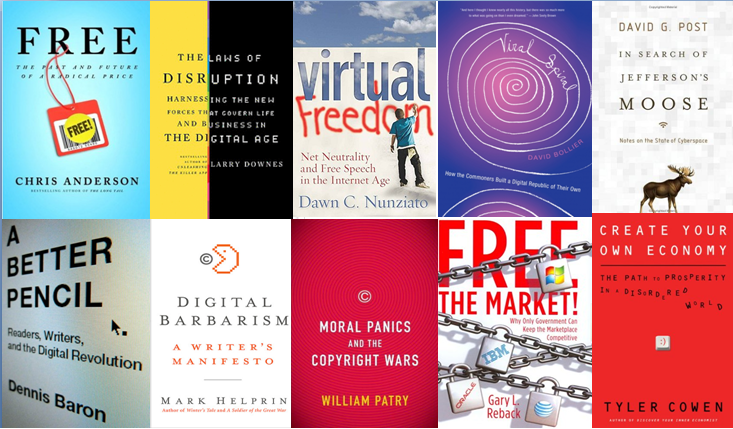 First, let me repeat a few of the same caveats and disclaimers that I set forth last year. What qualifies as an “important” info-tech policy book? Simply put, it’s a title that many people are currently discussing and that we will likely be referencing for many years to come. However, I want to be clear that merely because a book appears on my list it does not necessarily mean I agree with everything said in it. In fact, as was the case in previous years, I found much with which to disagree in my picks for the most important books of 2009 and I find that the cyber-libertarianism I subscribe to has very few fans out there.
Another caveat: Narrowly-focused titles lose a few points on my list. For example, if a book deals mostly with privacy issues, copyright law, or antitrust policy, it does not exactly qualify as the same sort of “tech policy book” as other titles found on this list since it is a narrow exploration of just one set of issues with a bearing on technology policy.
With those caveats in mind, here are my choices for the Most Important Info-Tech Policy Books of 2009. Continue reading →
 I recently finished Tyler Cowen’s latest book, Create Your Own Economy: The Path to Prosperity in a Disordered World. Like everything he writes, this book is worth reading and it will be of interest to those who follow technology policy debates since Cowen makes a passionate case for “Internet optimism” in the face of recent criticisms of the Internet and the Information Age in general.
Cowen is a Professor of Economics at George Mason University and the co-author, along with Alex Tabarrok, of the wonderful MarginalRevolution.com blog. And if you haven’t read Cowen’s
In Praise of Commercial Culture, stop what you’re doing and go get yourself a copy right now. Brilliant book. Compared to that book, Create Your Own Economy is a difficult book to summarize. Seriously, this book is all over the place… but in a good way. Even though it sometimes feels like “Tyler’s Miscellaneous Ramblings,” those ramblings will keep you engaged and entertained. Cord Blomquist did a pretty good job of summarizing the general themes of the book in this post two months ago when he noted that, “despite cultural reflexes that would have us do otherwise, we should embrace… new technologies as means to be more selective about what information we absorb and therefore welcome the increased volume of bytes into our lives. In his new book, [Cowen] explores technology as a vehicle to help you determine what you really value, not a series of a email-powered torture devices.” That’s a pretty good summation, but the book is about much more than that.
Instead of a full-blown review, I want to focus on some of passages from Cowen’s book about coping with information overload, which I think readers here might find of interest. In doing so, I will contrast Cowen’s views with those of John Freeman, who just penned “A Manifesto for Slow Communication” in The Wall Street Journal. As we will see, Cowen and Freeman’s differences exemplify the heated ongoing debate taking place among “Internet optimists & pessimists,” which I have discussed here many times before. Continue reading →
In April 2008, L. Gordon Crovitz, the former publisher of the Wall Street Journal, launched his “Information Age” column with a brilliant piece entitled “Optimism and the Digital World” (which Adam lauded here). Crovitz noted the problem of “information overload,” then creeping into the public consciousness, but was unabashed in his optimism:
My own bias is that as information becomes more accessible, individuals gain choice, control and freedom. Established institutions – governments, large companies and special-interest groups – need to work harder to justify their authority. As information and knowledge spread, financial and human capital become more global and more competitive. The uncertainties and dislocations from new technology can be wrenching, but genies don’t go back into bottles.
The First Law of Technology says that “with every change in technology that affects consumer behavior, we always overestimate the impact in the short term, but then underestimate the full impact over the long term.”
Crovitz picks up where he left off in today’s column: “Information Overload? Relax: We survived copy machines. We’ll survive Twitter.”
Our era in the information age is a transition period of learning how to navigate information abundance. Rather than pitch our BlackBerrys and iPhones into the sea, imagine the benefits once we have figured out how to manage the chaos of endless data and routine multitasking, a process that will help refine our judgment about information and refocus our attention on what’s truly important….
Humans adapt, so we’ll learn how to live with information overabundance. Young people growing up multitasking are already less anxious about using technology and may well cope better than those of us in older generations. They have no choice but to get more sophisticated at separating the important from the unimportant and the authoritative from the unreliable, even while sampling from among many new kinds of information tools…
Young people will cope first as we all evolve to become more sophisticated, less anxious users of information.
Crovitz also notes, with approval, GMU economist Tyler Cowen’s new book, “Create Your Own Economy,” which Cord blogged about here. I recently heard Cowen talk about the book and thoroughly enjoyed the talk.

 The Technology Liberation Front is the tech policy blog dedicated to keeping politicians' hands off the 'net and everything else related to technology.