Posts tagged as:

For decades Congress has gradually deregulated communications and media. This poses a significant threat to the FCC’s jurisdiction because it is the primary regulator of communications and media. The current FCC, exhibiting alarming mission creep, has started importing its legacy regulations to the online world, like Title II common carrier regulations for Internet providers. The FCC’s recent proposal to “open up” TV set top boxes is consistent with the FCC’s reinvention as the US Internet regulator, and now the White House has supported that push.

There are a lot of issues with the set top box proposal but I’ll highlight a few. I really don’t even like referring to it as “the set top box proposal” because the proposal is really aimed at the future of TV–video viewing via apps and connected devices. STBs are a sideshow and mostly just provide the FCC a statutory hook to regulate TV apps. Even that “hook” is dubious–the FCC arbitrarily classifies apps and software as “navigation devices” but concludes that actual TV devices like Chromecast, Roku, smartphones, and tablets aren’t navigation devices. And, despite what activists say, this isn’t about “cable” either but all TV distributors (“MVPDs”) like satellite and telephone companies and Google Fiber, most of whom are small TV players. Continue reading →

At the same time FilmOn, an Aereo look-alike, is seeking a compulsory license to broadcast TV content, free market advocates in Congress and officials at the Copyright Office are trying to remove this compulsory license. A compulsory license to copyrighted content gives parties like FilmOn the use of copyrighted material at a regulated rate without the consent of the copyright holder. There may be sensible objections to repealing the TV compulsory license, but transaction costs–the ostensible inability to acquire the numerous permissions to retransmit TV content–should not be one of them. Continue reading →

Last week, the Mercatus Center and the R Street Institute co-hosted a video discussion about copyright law. I participated in the Google Hangout, along with co-liberator Tom Bell of Chapman Law School (and author of the new book Intellectual Privilege), Mitch Stoltz of the Electronic Frontier Foundation, Derek Khanna, and Zach Graves of the R Street Institute. We discussed the Aereo litigation, compulsory licensing, statutory damages, the constitutional origins of copyright, and many more hot copyright topics.

You can watch the discussion here:


Adam and I recently published a Mercatus research paper titled Video Marketplace Regulation: A Primer on the History of Television Regulation And Current Legislative Proposals, now available on SSRN. I presented the paper at a Silicon Flatirons academic conference last week.

We wrote the paper for a policy audience and students who want succinct information and history about the complex world of television regulation. Television programming is delivered to consumers in several ways, including via cable, satellite, broadcast, IPTV (like Verizon FiOS), and, increasingly, over-the-top broadband services (like Netflix and Amazon Instant Video). Despite their obvious similarities–transmitting movies and shows to a screen–each distribution platform is regulated differently.

The television industry is in the news frequently because of problems exacerbated by the disparate regulatory treatment. The Time Warner Cable-CBS dispute last fall (and TWC’s ensuing loss of customers), the Aereo lawsuit, and the Comcast-TWC proposed merger were each caused at least indirectly by some of the ill-conceived and antiquated TV regulations we describe. Further, TV regulation is a “thicket of regulations,” as the Copyright Office has said, which benefits industry insiders at the expense of most everyone else.

We contend that overregulation of television resulted primarily because past FCCs, and Congress to a lesser extent, wanted to promote several social objectives through a nationwide system of local broadcasters:

1) Localism 2) Universal Service 3) Free (that is, ad-based) television; and 4) Competition

These objectives can’t be accomplished simultaneously without substantial regulatory mandates. Further, these social goals may even contradict each other in some respects.

For decades, public policies constrained TV competitors to accomplish those goals. We recommend instead a reliance on markets and consumer choice through comprehensive reform of television laws, including repeal of compulsory copyright laws, must-carry, retransmission consent, and media concentration rules.

At the very least, our historical review of TV regulations provides an illustrative case study of how regulations accumulate haphazardly over time, demand additional “correction,” and damage dynamic industries. Congress and the FCC focused on attaining particular competitive outcomes through industrial policy, unfortunately. Our paper provides support for market-based competition and regulations that put consumer choice at the forefront.

It appears that Federal Communications Commission (FCC) Chairman Tom Wheeler is returning to a competition-based approach to communications regulation. Chairman Wheeler’s emphasis on “competition, competition, competition” indicates his intent to intervene in communications markets only when it is necessary to correct a market failure.

I expect most on both sides of the political spectrum would welcome a return to rigorous market analysis at the FCC, but you can’t please all of the people all of the time. The American Television Alliance (ATVA), whose FCC petition wouldn’t withstand even a cursory market power analysis, is sure to be among the displeased.

The ATVA petition asks the FCC to regulate prices for retransmission consent (the prices video service providers (VSPs) pay for the rights to provide broadcast television programming to pay-TV subscribers) because retransmission fees and competition among VSPs are increasing. Though true, this data doesn’t indicate that TV stations or broadcast television networks have market power — it indicates that legislative and policy efforts to increase competition among VSPs are working. Continue reading →

Anupam Chander, Director of the California International Law Center and Martin Luther King, Jr. Hall Research Scholar at the UC Davis School of Law, discusses his recent paper with co-author Uyen P. Lee titled The Free Speech Foundations of Cyberlaw. Chander addresses how the first amendment promotes innovation on the Internet; how limitations to free speech vary between the US and Europe; the role of online intermediaries in promoting and protecting the first amendment; the Communications Decency Act; technology, piracy, and copyright protection; and the tension between privacy and free speech.

Download

Related Links

It’s been over five years since Congress passed major legislation addressing copyright protection, but this hasn’t stopped copyright owners from achieving real progress in securing their expressive works. In cooperation with private-sector stakeholders, rights holders have made several deals aimed at combating copyright infringement and channeling consumer demand for original content toward legitimate outlets. These voluntary agreements will be the subject of a hearing this afternoon (9/18) before the House Judiciary Committee’s Subcommittee on Courts, Intellectual Property and the Internet. This panel marks the latest in a series of hearings the committee launched earlier this year to review the Copyright Act, much of which dates back to 1976 or earlier.

Copyright consensus may sound like an oxymoron, especially in the wake of last year’s bruising legislative battle over SOPA and PIPA. But in reality, there’s no shortage of common ground when it comes to copyright protection. Despite all the controversy that surrounds the issue, copyright isn’t so much a “conflict of visions”, to borrow from Thomas Sowell, but a conflict of tactics, as I argued earlier this year on Cato Unbound.

Indeed, with some notable exceptions, most scholars, business leaders, and policymakers accept that government has a legitimate and important role in securing to inventors and creators the fruits of their labors“. Unsurprisingly, the devil is in the details, where genuinely tough questions arise regarding the government’s proper role in policing the Internet for copyright violations. Should the law hold online intermediaries accountable for their users’ infringing acts? What remedies should the law afford rights holders whose works are unlawfully distributed all over the Internet, often by profit-generating foreign actors?

Continue reading →

Sherwin Siy, Vice President of Legal Affairs at Public Knowledge, discusses emerging issues in digital copyright policy. He addresses the Department of Commerce’s recent green paper on digital copyright, including the need to reform copyright laws in light of new technologies. This podcast also covers the DMCA, online streaming, piracy, cell phone unlocking, fair use recognition, digital ownership, and what we’ve learned about copyright policy from the SOPA debate.

Download

Related Links

Adam Thierer, Senior Research Fellow at the Mercatus Center discusses his recent working paper with coauthor Brent Skorup, A History of Cronyism and Capture in the Information Technology Sector. Thierer takes a look at how cronyism has manifested itself in technology and media markets — whether it be in the form of regulatory favoritism or tax privileges. Which tech companies are the worst offenders? What are the consequences for consumers? And, how does cronyism affect entrepreneurship over the long term?

Download

Related Links

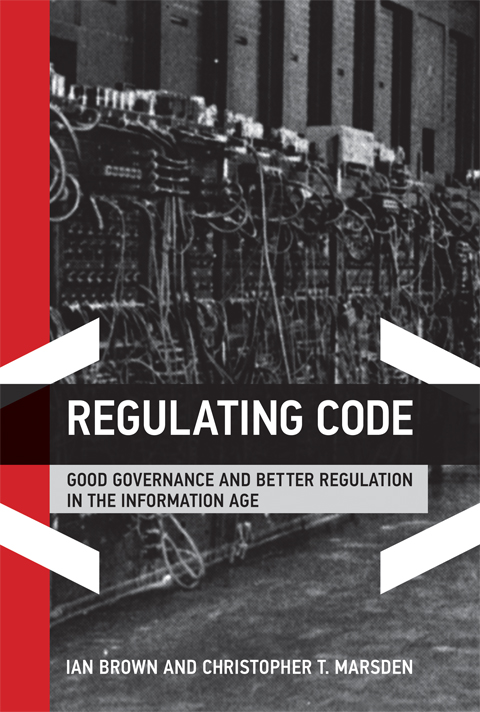
Regulating Code book coverIan Brown and Christopher T. Marsden’s new book, Regulating Code: Good Governance and Better Regulation in the Information Age, will go down as one of the most important Internet policy books of 2013 for two reasons. First, their book offers an excellent overview of how Internet regulation has unfolded on five different fronts: privacy and data protection; copyright; content censorship; social networks and user-generated content issues; and net neutrality regulation. They craft detailed case studies that incorporate important insights about how countries across the globe are dealing with these issues. Second, the authors endorse a specific normative approach to Net governance that they argue is taking hold across these policy arenas. They call their preferred policy paradigm “prosumer law” and it envisions an active role for governments, which they think should pursue “smarter regulation” of code.

In terms of organization, Brown and Marsden’s book follows the same format found in Milton Mueller’s important 2010 book Networks and States: The Global Politics of Internet Governance; both books feature meaty case studies in the middle bookended by chapters that endorse a specific approach to Internet policymaking. (Incidentally, both books were published by MIT Press.) And, also like Mueller’s book, Brown and Marsden’s Regulating Code does a somewhat better job using case studies to explore the forces shaping Internet policy across the globe than it does making the normative case for their preferred approach to these issues. Continue reading →