FCC Commissioners Michael Copps and Meredith Attwell Baker kicked off the 2010 Congressional Internet Caucus “State of the Net” conference this afternoon with two brief keynote addresses. Below I’ve summarized the highlights here from my live Tweeting at the event (@AdamThierer):
Commissioner Copps
• “every great challenge this country faces… has a broadband component at its core if it’s going to be successfully dealt with”
• Broadband is the great enabler; Private sector will lead, but national objectives and visionary public policy also have to be at core
• “sins of recent public policy past” got in way of us doing things that needed to get done
• Worries about wider new “divides between us”; have opportunity to close them
• Praises Hillary Clinton’s Internet freedom speech from last week
• Hard to conceptualize the changes that next 5-10 years hold in light of the developments of past 5-10
• Worried about open Internet; “unreasonable discrimination”… doesn’t want to allow “too much latitude” to private operators… says it is threat to “openness” (he never really defines the term, however)
• Passionate views on both sides of Net neutrality debate
• Need big pipes and more spectrum to grow capacity (I certainly agree on that one! But Net neutrality isn’t going to help us much in that regard)
• He fears consolidation
• Says minority and women voices are not getting heard online (he says we should measure it by audience measurements & ad $$ but doesn’t bothering mentioning how much wider the gap was in the old mass media era when none of those voices could get heard at all)
• How do we assure what we’re doing “actually works for democracy” and the “public interest” (but never defines what that means)
• Says media is failing us today; victims are public; investigative journalism is dying (but never discusses how current FCC regulation affects the equation)
• cites Founders (Jefferson, Madison) re importance of media … and then favorably cites McChesney & Nichols new book (ugh, someone needs to tell Commissioner Copps that McChesney is a neo-Marxist who wants to destroy all private media providers!)
Continue reading →
Bidding has begun on Comcast’s acquisition of a majority stake in NBC Universal. No, not the bidding between GE and Comcast over the terms of the sale. That was the comparatively easy part. The real bidding is over at the FCC, as various interests work to get concessions and pledges from Comcast as a condition of FCC approval of the deal. The jostling may put post-Thanksgiving Black Friday sales to shame. Everything from more kid’s shows to broadband open access mandates are potentially on the table.
And that’s if the sale is approved by the FCC at all. Groups such as Free Press called for its rejection as soon as it was announced. Commissioner Michael Copps underscored the alpine nature of the approval process, stating bluntly that the deal “faces a very steep climb with me.”
Amidst the din, however, one question has been drowned out: Why is the FCC involved in this at all? Continue reading →
Acting FCC Chairman Michael Copps declared yesterday in a speech celebrating the 75th anniversary of the FCC and the Communications Act, that it was time to think “more rigorously” about the impact of the migration of communications to the Internet and “how to ensure that as the Internet becomes our primary vehicle for communicating with one another, it protects the public interest and informs the civic dialogue that America depends on.”
“In the beginning was the Word,” said John Something-or-other. Well, the word here is “public interest” and—make no mistake about it—this is the beginning of a wholesale attempt to impose the regulatory regime of the broadcast era onto the Internet.
As Adam Thierer has pointed out, the “public interest” is really no standard at all—just so much hot air.
Speaking of transparency… My colleague Barbara Esbin has a great piece on the PFF blog about changes being implemented by Acting Chairman Copps to make the agency less dysfunctional and more open to the public:
the new Acting Chairman has confirmed what FCC insiders, outside practitioners, and the House staff investigating former Chairman Kevin Martin’s management practices have long known: Commission staffers were not permitted to freely communicate either with one another, or with the other Commissioners. The liberation of the staff, together with changes concerning how the Bureaus and Offices work with each other and how the Commission communications with the public, certainly falls under the category of “change we can believe in…”
Acting Chairman Copps has outlined other important changes in how the FCC does business, including establishing a calendar for regular open meetings in advance, and updating the FCC’s website to be more user-friendly, particularly its Digital TV Transition pages. These and other changes and commitments together constitute an extremely promising start for Acting Chairman Copps, and his commitment to transparency and order bode very well for the FCC, its staff, the companies the agency regulates, and the American public.
Great news. Let’s hope the FCC also gets to work
soon on updating its painfully antique website, with its proliferation of databases.
In a City Journal article earlier this year, I wondered “how long some local papers have left when they are barred from restructuring their businesses or partnering with other local media operators to stem the bleeding and reinvent their business models.” I was responding to the Senate’s smack-down of a half-hearted reform effort that FCC chairman Kevin Martin pushed through in November 2007, which proposed relaxing the FCC’s newspaper/broadcast cross-ownership rule. That rule, unrevised since going into effect in 1975, prohibits a newspaper operator from also owning a radio or television station in the same media market. However, waivers were granted to grandfather in some combined newspaper and broadcast operations that had existed long before the ban took effect. Martin’s proposal was to simply tweak the rule to permit similar combinations in just the nation’s 20 largest media markets.
Martin’s limited liberalization proposal, however, led to howls of disapproval from FCC democrats like Michael Copps and many folks on both side of the aisle in Congress. Supposedly, this was nothing more than a “giveaway” to the newspaper industry, which critics said was doing just fine. It really makes you wonder if any of those critics even both reading the news about newspapers today.
As I have documented here on many occasions, as well as in my big Media Metrics report, the newspaper industry is in huge trouble with every financial variable of importance rapidly heading south. Alan Mutter does a good job here of summarizing “the secular forces dragging down newspapers: Declining readership, shrinking advertising, high fixed costs and growing online competition that makes it increasingly difficult to charge the premium ad rates that were possible prior to the Internet.” As a result of these forces, everyday brings another headline like this one today in the New York Times: “The Star-Ledger of Newark Plans 40% Cut,” or this one in the Wall Street Journal: “Some Newspapers Shed Unprofitable Readers.” The numbers are just miserable, and they just get worse and worse.
Continue reading →
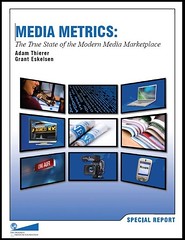 Faithful readers will recall that, several months ago, I penned a 7-part “Media Metrics” series that took a hard look at the health of the media marketplace. Today, the Progress & Freedom Foundation is releasing a greatly expanded version of these essays that I have put together with my PFF colleague Grant Eskelsen. In this 100-page special report, “Media Metrics: The True State of the Modern Media Marketplace,” we begin by noting that heated debates about the state of the media marketplace continue to rage in Washington, and opinions seem to range from grim to outright apocalyptic. As we note on pg. 1:
Many people—including a large number of legislators and regulators—argue that America’s media marketplace is in a miserable state. Some claim that citizens lack choice in media outlets and that options are just as scarce as ever. Others believe that media “localism” is dead or that many groups or niches go underserved because of a lack of true “diversity” in media. Others argue that the market is hopelessly over-concentrated in the hands of a few evil media barons who are hell-bent on force-feeding us corporate propaganda. And still others say that the quality of news and entertainment in our society has deteriorated because of a combination of all of the above. It all sounds quite troubling, but is any of it true?
After taking an objective look at the true state of America’s media marketplace, we conclude that such pessimism is unwarranted. Indeed, a careful review of the facts reveals that—contrary to what those media critics suggest—we have more media choice, more media competition, and more media diversity than ever before. Indeed, to the extent there was ever a “golden age” of media in America, we are living in it today. The media sky has never been brighter and it is getting brighter with each passing year.
Continue reading →
In Part 1 of this series, I argued that the Democratic Party seems to be gradually abandoning whatever claim it once had to being the party of the First Amendment. Regrettably, examples of Democrats selling out the First Amendment are becoming more prevalent and the few champions of freedom of speech and expression left in the party are getting more difficult to find.
For example, in my previous essay, I documented how Democratic politicians were leading the charge to reinstitute the so-called Fairness Doctrine. In today’s entry I will discuss how Democrats are now working hand-in-hand with Republicans to orchestrate what would constitute the most significant expansion of content regulation in decades–the regulation of “excessive violence” on television.
Continue reading →
The idea that the Democrats are the party of free speech and the great protectors of our nation’s First Amendment heritage has always been a bit of a myth. In reality, when you study battles over freedom of speech and expression throughout American history you quickly come to realize that there are plenty of people in both parties would like to serve as the den mothers of the American citizenry. That being said, it is generally true that there have been a few more voices in the Democratic party willing to stand in opposition to governmental attempts to regulate speech in the past.
But I’m starting to wonder where even that handful of First Amendment champions has gone. Sadly, examples of Democrats selling out the First Amendment are becoming so common that I’ve decided to start a new series to highlight recent examples of Dems actually leading the charge for increased government regulation of speech and expression. I want to stress that I’m not trying to pick on Democrats here, rather, I’m just trying to point out that–unless there is a sea change in their approach to these issues by Democrats in coming months and years–both parties now appear to be singing out of the same pro-regulatory hymnal. This constitutes an ominous threat to the future of free expression.
Today, as part of this new series, I’ll be focusing on the Democratic-led efforts to revive the hideously misnamed “Fairness Doctrine.”
Continue reading →

 The Technology Liberation Front is the tech policy blog dedicated to keeping politicians' hands off the 'net and everything else related to technology.