I’ve been floating around in conservative policy circles for 30 years and I have spent much of that time covering media policy and child safety issues. My time in conservative circles began in 1992 with a 9-year stint at the Heritage Foundation, where I launched the organization’s policy efforts on media regulation, the Internet, and digital technology. Meanwhile, my work on child safety has spanned 4 think tanks, multiple blue ribbon child safety commissions, countless essays, dozens of filings and testimonies, and even a multi-edition book.
During this three-decade run, I’ve tried my hardest to find balanced ways of addressing some of the legitimate concerns that many conservatives have about kids, media content, and online safety issues. Raising kids is the hardest job in the world. My daughter and son are now off at college, but the last twenty years of helping them figure out how to navigate the world and all the challenges it poses was filled with difficulties. This was especially true because my daughter and son faced completely different challenges when it came to media content and online interactions. Simply put, there is no one-size-fits-all playbook when it comes to raising kids or addressing concerns about healthy media interactions. Continue reading →
Last week, it was my great pleasure to be invited on NPR’s “On Point with Tom Ashbrook,” to debate Jeffrey Rosen, a leading privacy scholar and the president and chief executive of the National Constitution Center. In an editorial in the previous Sunday’s New York Times (“Madison’s Privacy Blind Spot”), Rosen proposed “constitutional amendment to prohibit unreasonable searches and seizures of our persons and electronic effects, whether by the government or by private corporations like Google and AT&T.” He said his proposed amendment would limit “outrageous and unreasonable” collection practices and would even disallow consumers from sharing their personal information with private actors even if they saw an advantage in doing so.
I responded to Rosen’s proposal in an essay posted on the IAPP
Privacy Perspectives blog, “Do We Need A Constitutional Amendment Restricting Private-Sector Data Collection?” In my essay, I argued that there are several legal, economic, and practical problems with Rosen’s proposal. You can head over to the IAPP blog to read my entire response but the gist of it is that “a constitutional amendment [governing private data collection] would be too sweeping in effect and that better alternatives exist to deal with the privacy concerns he identifies.” There are very good reasons we treat public and private actors differently under the law and there “are all far more practical and less-restrictive steps that can be taken without resorting to the sort of constitutional sledgehammer that Jeff Rosen favors. We can protect privacy without rewriting the Constitution or upending the information economy,” I concluded.
But I wanted to elaborate on one particular thing I found particularly interesting about Rosen’s comments when we were on NPR together. During the show, Rosen kept stressing how we needed to adopt a more European construction of privacy as “dignity rights” and he even said his proposed privacy amendment would even disallow individuals from surrendering their private data or their privacy because he viewed these rights as “unalienable.” In other words, from Rosen’s perspective, privacy pretty much trumps
everything, even if you want to trade it off against other values. Continue reading →
The Mercatus Center at George Mason University has just released my new white paper, “The Perils of Classifying Social Media Platforms as Public Utilities.” [PDF] I first presented a draft of this paper last November at a Michigan State University conference on “The Governance of Social Media.” [Video of my panel here.]
In this paper, I note that to the extent public utility-style regulation has been debated within the Internet policy arena over the past decade, the focus has been almost entirely on the physical layer of the Internet. The question has been whether Internet service providers should be considered “essential facilities” or “natural monopolies” and regulated as public utilities. The debate over “net neutrality” regulation has been animated by such concerns.
While that debate still rages, the rhetoric of public utilities and essential facilities is increasingly creeping into policy discussions about other layers of the Internet, such as the search layer. More recently, there have been rumblings within academic and public policy circles regarding whether social media platforms, especially social networking sites, might also possess public utility characteristics. Presumably, such a classification would entail greater regulation of those sites’ structures and business practices.
Proponents of treating social media platforms as public utilities offer a variety of justifications for regulation. Amorphous “fairness” concerns animate many of these calls, but privacy and reputational concerns are also frequently mentioned as rationales for regulation. Proponents of regulation also sometimes invoke “social utility” or “social commons” arguments in defense of increased government oversight, even though these notions lack clear definition.
Social media platforms do not resemble traditional public utilities, however, and there are good reasons why policymakers should avoid a rush to regulate them as such. Continue reading →
This week I will again be attending the Family Online Safety Institute’s excellent annual summit. The 2-day affair brings together some of the world’s leading experts on online safety and privacy issues. It’s a great chance to learn about major developments in the field. As I was preparing for the session I am moderating on Thursday, I thought back to the first FOSI annual conference, which took place back in 2007. What is remarkable about that period compared to now is that there was a flurry of legislative and regulatory activity related to online child safety then that we simply do not see today.
In fact, just 3 1/2 years ago, John Morris of the Center for Democracy and Technology and I compile a legislative index [summary here] that cataloged the more than 30 legislative proposals that had been introduced in the the 110th session of Congress. There was also a great deal of interest in these issues within the regulatory community. Finally, countless state and local measures related to online safety and speech issues had been floated. Today, by contrast, it is hard for me to find any legislative measures focused on online safety regulation at the federal level, and I don’t see much activity at the agency level either. I haven’t surveyed state and local activity, but it seems like it has also died down.
Generally speaking, I think this is a good development since I am opposed to most proposals to regulate online speech, expression, or conduct. But let’s ignore the particular wisdom of such measures and ask a simple question:
What explains the decline in Internet safety legislation and online content regulation? I believe there are three possible explanations: Continue reading →
Yesterday’s 7-2 decision in Brown v. EMA [summaries here from me + Berin Szoka] was one of those historic First Amendment rulings that tends to bring out passions in people. You either loved it or hated it. But it’s sad to see some critics on the losing end of the case declaring that only greed could have possibly motivated the Court’s decision.
For example, California Senator Leland Yee, the author of the law that the Supreme Court struck down yesterday, obviously wasn’t happy about the outcome of the case. Neither was James Steyer, CEO of the advocacy group Common Sense Media, who has been a vociferous advocate of the California law and measures like it. What they had to say in response to the decision, however, was outlandish and juvenile. In essence, they both claimed that the Supreme Court only struck down the law to make video game developers and retailers happy.
“Unfortunately, the majority of the Supreme Court once again put the interests of corporate America before the interests of our children,” Leland Yee said in a post on his website yesterday. “As a result of their decision, Wal-Mart and the video game industry will continue to make billions of dollars at the expense of our kids’ mental health and the safety of our community. It is simply wrong that the video game industry can be allowed to put their profit margins over the rights of parents and the well-being of children.” Jim Steyer reached a similar conclusion: “Today’s decision is a disappointing one for parents, educators, and all who care about kids,” he said. “Today, the multi-billion dollar video game industry is celebrating the fact that their profits have been protected, but we will continue to fight for the best interests of kids and families.”
Mr. Yee and Mr. Steyer seem to be under the impression that the Court and supporters of its ruling in
Brown cannot possibly care about children and that something sinister motivates our passion about the victory. Apparently we’re all just apparently in it to make video game industry fat cats and retailing giants happy! That’s a truly insulting position for Mr. Yee and Mr. Steyer to adopt. Perhaps it is just because they are sore about the outcome in the case that are adopting such rhetorical tactics. Regardless, I think they do themselves, their constituencies, and the public a great injustice by suggesting that only greed could possibly be motivating the outcome in this case. Continue reading →
PFF has just released the transcript of an excellent panel discussion I moderated last week entitled, “Let’s Make a Deal: Broadcasters, Mobile Broadband, and a Market in Spectrum.” As I’ve mentioned here before, one of the hottest issues in DC right now is the question of broadcast TV spectrum reallocation. Blair Levin, who serves as the Executive Director of the Omnibus Broadband Initiative at the Federal Communications Commission, recently raised the possibility of reallocating a portion of broadcast television spectrum for alternative purposes, namely, mobile broadband. Such a “cash-for-spectrum” swap would give mobile broadband providers to spectrum they need to roll out next generation wireless broadband networks while making sure broadcaster receive compensation for any spectrum they hand over. The FCC just recently released a public notice on “Data Sought on Users of Spectrum,” (NBP Public Notice # 26) that looks into the matter. “This inquiry,” the agency says,” takes into account the value that the United States puts on free, over-the-air television, while also exploring market-based mechanisms for television broadcasters to contribute to the broadband effort any spectrum in excess of that which they need to meet their public interest obligations and remain financially viable.” Meanwhile, the House Energy and Commerce Communications Subcommittee is set to hold a hearing on the issue next Tuesday.
PFF’s panel discussion on this issue featured an all-star cast of characters, including opening remarks by Blair Levin, and a terrific discussion ensued. [You can hear the full audio from the event here.] Down below I have highlighted some of the major points each speaker made during the discussion and also embedded the complete transcript in a Scribd reader. Also, just a reminder that my PFF colleague Barbara Esbin and I authored a short paper on this issue recently: “An Offer They Can’t Refuse: Spectrum Reallocation That Can Benefit Consumers, Broadcasters & the Mobile Broadband Sector.”
Continue reading →
Along with my colleague Barbara Esbin, the Director of PFF’s Center for Communications and Competition Policy, I have just released a new paper on discussing the possibility of reallocating a portion of broadcast television spectrum for alternative purposes, namely, mobile broadband. As I discussed here before, Blair Levin, the Executive Director of the FCC’s Omnibus Broadband Initiative, has been suggesting that it might be possible to craft a grand bargain whereby broadcasters get cash for some (or all) of their current spectrum allocations if they return spectrum to the FCC for reallocation and re-auction, likely to mobile broadband services.
In our paper, “An Offer They Can’t Refuse: Spectrum Reallocation That Can Benefit Consumers, Broadcasters & the Mobile Broadband Sector,” [PDF] Barbara and I argue that:
the benefits of such a deal could be enormous for wireless broadband providers, developers of digital technologies, and consumers. Expanding the pool of spectrum available for next-generation wireless broadband offerings will ensure that innovative new networks, devices, and services are made available to the public on a timely basis. Ultimately, that will mean more high-speed choices for consumers, especially those in rural areas harder to reach with high-speed wireline networks. Finally, more generally, anything that moves us in the direction of a freer market in spectrum is a good thing.
But fairness to broadcasters lies at the heart of this spectrum reallocation plan. If a deal can’t be structured that broadcasters would find acceptable, they should not be forced to come to the table. When we speak of an offer they can’t refuse, we mean one so attractive that no rational businessperson or investor would pass it up. It is essential broadcasters be willing partners in the deal, and be full participants in the process of shaping its contours.
Read the entire thing here, or below the fold as a Scribd document. Continue reading →
With today’s historic Supreme Court decision in FCC v. Fox, I have been commenting on the logic and implications of the decision. Part 3 dealt with the majority’s decision in the case, which was driven solely by procedural / admin law considerations. This installment will discuss the very interesting concurring opinion penned by Justice Thomas, which is the only one that takes a serious look at the constitutional foundations of the FCC’s current regulatory regime. While I was sad to see Justice Thomas join the majority’s decision upholding the FCC’s radical expansion of speech regulation in recent years, he joined that majority only on straightforward procedural grounds. On the underlying constitutional issues at stake here, it is clear from his concurring statement that he is ready for the Court to hear a challenge to the previous court precedents and traditional regulatory doctrines that have long supported FCC speech and media controls.
“I write separately,” Justice Thomas says “to note the questionable viability of the two precedents that support the FCC’s assertion of constitutional authority to regulate the programming at issue in this case.” Specifically, he addresses the two key cases upon which almost all FCC speech regulation rests: Red Lion Broadcasting Co. v. FCC, 395 U. S. 367 (1969) and FCC v. Pacifica Foundation, 438 U. S. 726 (1978). Thomas continues: “Red Lion and Pacifica were unconvincing when they were issued, and the passage of time has only increased doubt regarding their continued validity.”
BOOM! With those words, Justice Thomas has dropped the hammer and taken what will hopefully be the first swing at toppling the house of cards that is modern FCC speech regulation. Justice Thomas goes on to itemize the many problems with what I have referred to as “America’s Jurisprudential Twilight Zone” when it comes to how we apply the First Amendment to media platforms in this country. He states:
Continue reading →
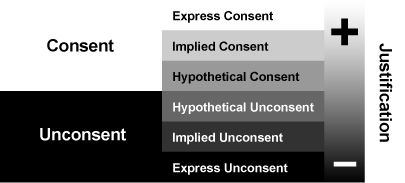
Theories constitute the technology of academia. They give us eggheads the tools we need to get our work done, just as computers serve programmers and DNA sequencing serves bioengineers. I trust that TLF’s readers won’t think me too far off-topic, then, if I cite a new approach to consent theory, something that should interest anyone who cares about the fundamental reasons for valuing of liberty. Here’s a snapshot of the theory:
This week, I have been up at Harvard University participating in another meeting of the Internet Safety Technical Task Force (ISTTF), of which I am a member. The ISTTF was organized earlier this year pursuant to an agreement between 49 state attorneys general (AGs) and social networking giant MySpace.com. A group of experts from academia, non-profit organizations, and industry were appointed to the Task Force, which is charged with evaluating the market for online child safety tools and methods and issuing a report on the matter to the AGs at the end of this year. ISTTF members have been meeting privately and publicly in both Cambridge, MA and Washington, D.C. The Task Force has been very ably chaired by John Palfrey, co-director of Harvard’s Berkman Center for Internet & Society.
Although the ISTTF is looking at a wide variety of tools and methods associated with online child protection (ex: filters, monitoring tools, educational campaigns, etc.), many of the AGs who crafted the agreement with MySpace that led to the Task Force’s formation have made it clear that they are
most interested in having the ISTTF evaluate age verification / online verification technologies. In fact, at the start of this week’s session at Harvard Law School, AGs Martha Coakely of Massachusetts and Richard Blumenthal of Connecticut both spoke and made it abundantly clear they expect the Task Force to develop age and identify-verification tools for social networking sites (SNS). AG Blumenthal said we need to deal with “the dangers of anonymity” and repeated his standard line about online age verification: “If we can put a man on the moon, we can make the Internet safe.” [Of course, putting a man on the moon took hundreds of billions of dollars and a decade to accomplish, but never mind that fact! Moreover, one could also argue that if we can put a man on the moon we can cure hunger, AIDS, and the common cold, but some things are obviously easier said than done. Finally, putting a man on the moon didn’t require all Americans or their kids to give up their anonymity or privacy rights in order to accomplish the feat!]
On many occasions here before, I have outlined various questions and reservations about proposals to mandate online age verification. Last year, I also published a lengthy white paper on the issue and hosted a lively debate on Capitol Hill [transcript here] about this. I also have discussed age verification in my book on parental controls and online child safety. [Braden Cox also talked about his experiences up at Harvard this week here, and CNet’s Chris Soghoian had a brutal assessment of this week’s proposals on his “Surveillance State” blog.]
In this essay, I will discuss the new fault lines in the debate over online age verification and outline where I think we are heading next on this front. I will argue:
- There is now widespread understanding that it is extraordinarily difficult to verify the ages and identities of minors online using the methods we typically use to verify adults. Because of this, age verification proponents are increasingly proposing two alternative models of verifying kids before they go online or visit SNS…
- First, for those who continue to believe that we must do whatever we can to verify kids themselves, schools and school records are increasingly being viewed as the primary mechanism to facilitate that. This raises two serious questions: Do we want schools to serve as DMVs for our children? And, do we want more school records or information about our kids being accessed or put online?
- Second, for those who are uncomfortable with the idea of verifying kids or using schools, or school records, to accomplish that task, parental permission-based forms of authentication are becoming the preferred regulatory approach. Under this scheme, which might build upon the regulatory model found in the Children’s Online Privacy Protection Act of 1998 (COPPA), parents or guardians would be verified somehow and then would vouch for their children before they were allowed on a SNS, however defined. But how do we establish a clear link between parents and kids? And will parents be willing to surrender a great deal more information (about themselves and their kids) before their kids can go online? And, is it sensible to use a law that was meant to protect the privacy and personal information of children to potentially gather a great deal more information about them, and their parents?
- It remains very unclear how either of those two verification methods would make children safer online. Indeed, that could actually make kids less safe by compromising their personal information and creating a false sense of security online for them and their parents.
- It is highly unlikely the Internet Safety Technical Task Force will be able to reach consensus on this complicated, controversial issue. A small camp will likely flock to the sort of proposals mentioned above. Another, larger camp (including me) will flock to education-based approaches to child safety as well increased reliance on other parental empowerment tools and strategies, industry self-regulatory efforts, social norms, and better intervention strategies for troubled youth. But the age verification debate will go on and, as was the case over the past two years, the legal battleground will be state capitals across America, with AGs likely pushing for age verification mandates regardless of what the Task Force concludes.
Continue reading if you are interested in the details.
Continue reading →

 The Technology Liberation Front is the tech policy blog dedicated to keeping politicians' hands off the 'net and everything else related to technology.