Posts tagged as:

My latest dispatch from the frontlines of the artificial intelligence policy wars in Washington looks at the major proposals to regulate AI. In my new essay, “Artificial Intelligence Legislative Outlook: Fall 2023 Update,” I argue that there are 3 major impediments to getting major AI legislation over the finish line in Congress: (1) Breadth and complexity of the issue; (2) Multiplicity of concerns & special interests; & (3) Extreme rhetoric / proposals are dominating the discussion.

If Congress wants to get something done in this session, they’ll need to do two things: (1) set aside the most radical regulatory proposals (like big new AI agencies or licensing schemes); and (2) break AI policy down into its smaller subcomponents and then prioritize among them where policy gaps might exist.

Prediction: Congress will not pass any AI-related legislation this session due to the factors identified in my essay. The temptation to “go big” with everything-and-the-kitchen-sink approaches to AI regulation will (especially with extreme ideas like new agencies & licenses) will doom AI legislation. It’s also worth noting that Washington’s swelling interest in AI policy is having a crowding-out effect on other important legislative proposals that might have advanced otherwise, such as the baseline privacy bill (ADPPA) and other things like driverless car legislation. Many want to advance those efforts first, but the AI focus makes that hard.

Read the entire essay here.

[last updated 4/3/2025 – Check my Medium page for latest posts]

This a running list of all the essays and reports I’ve already rolled out on the governance of artificial intelligence (AI), machine learning (ML), and robotics. Why have I decided to spend so much time on this issue? Because this will become the most important technological revolution of our lifetimes. Every segment of the economy will be touched in some fashion by AI, ML, robotics, and the power of computational science. It should be equally clear that public policy will be radically transformed along the way.

Eventually, all policy will involve AI policy and computational considerations. As AI “eats the world,” it eats the world of public policy along with it. The stakes here are profound for individuals, economies, and nations. As a result, AI policy will be the most important technology policy fight of the next decade, and perhaps next quarter century. Those who are passionate about the freedom to innovate need to prepare to meet the challenge as proposals to regulate AI proliferate.

There are many socio-technical concerns surrounding algorithmic systems that deserve serious consideration and appropriate governance steps to ensure that these systems are beneficial to society. However, there is an equally compelling public interest in ensuring that AI innovations are developed and made widely available to help improve human well-being across many dimensions. And that’s the case that I’ll be dedicating my life to making in coming years.

Here’s the list of what I’ve done so far. I will continue to update this as new material is released: Continue reading →

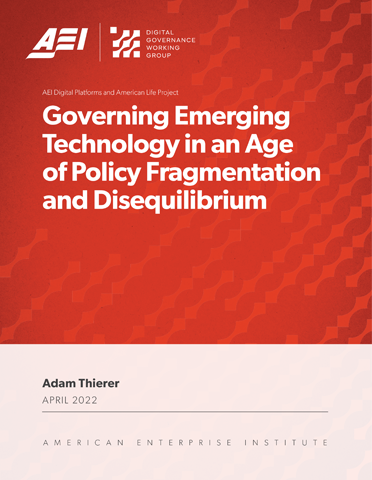
The American Enterprise Institute (AEI) has kicked off a new project called “Digital Platforms and American Life,” which will bring together a variety of scholars to answer the question: How should policymakers think about the digital platforms that have become embedded in our social and civic life? The series, which is being edited by AEI Senior Fellow Adam J. White, highlights how the democratization of knowledge and influence in the Internet age comes with incredible opportunities but also immense challenges. The contributors to this series will approach these issues from various perspectives and also address different aspects of policy as it pertains to the future of technological governance.

It is my honor to have the lead paper in this new series. My 19-page essay is entitled, Governing Emerging Technology in an Age of Policy Fragmentation and Disequilibrium, and it represents my effort to concisely tie together all my writing over the past 30 years on governance trends for the Internet and related technologies. The key takeaways from my essay are:

  • Traditional governance mechanisms are being strained by modern technological and political realities. Newer technologies, especially digital ones, are developing at an ever-faster rate and building on top of each other, blurring lines between sectors.
  • Congress has failed to keep up with the quickening pace of technological change. It also continues to delegate most of its constitutional authority to agencies to deal with most policy concerns. But agencies are overwhelmed too. This situation is unlikely to change, creating a governance gap.
  • Decentralized governance techniques are filling the gap. Soft law—informal, iterative, experimental, and collaborative solutions—represents the new normal for technological governance. This is particularly true for information sectors, including social media platforms, for which the First Amendment acts as a major constraint on formal regulation anyway.
  • No one-size-fits-all tool can address the many governance issues related to fast-paced science and technology developments; therefore, decentralized governance mechanisms may be better suited to address newer policy concerns.

My arguments will frustrate many people of varying political dispositions because I adopt a highly pragmatic approach to technological governance. Continue reading →

On December 13th, I will be participating in an Atlas Network panel on, “Big Tech, Free Speech, and Censorship: The Classical Liberal Approach.” In anticipation of that event, I have also just published a new op-ed for The Hill entitled, “Left and right take aim at Big Tech — and the First Amendment.” In this essay, I expand upon that op-ed and discuss the growing calls from both the Left and the Right for a variety of new content regulations. I then outline the classical liberal approach to concerns about free speech platforms more generally, which ultimately comes down to the proposition that innovation and competition are always superior to government regulation when it comes to content policy.

In the current debates, I am particularly concerned with calls by many conservatives for more comprehensive governmental controls on speech policies enforced by various private platforms, so I will zero in on those efforts in this essay. First, here’s what both the Left and the Right share in common in these debates: Many on both sides of the aisle desire more government control over the editorial decisions made by private platforms. They both advocate more political meddling with the way private firms make decisions about what types of content and communications are allowed on their platforms. In today’s hyper-partisan world,” I argue in my Hill column, “tech platforms have become just another plaything to be dominated by politics and regulation. When the ends justify the means, principles that transcend the battles of the day — like property rights, free speech and editorial independence — become disposable. These are things we take for granted until they’ve been chipped away at and lost.”

Despite a shared objective for greater politicization of media markets, the Left and the Right part ways quickly when it comes to the underlying objectives of expanded government control. As I noted in my Hill op-ed:

there is considerable confusion in the complaints both parties make about “Big Tech.” Democrats want tech companies doing more to limit content they claim is hate speech, misinformation, or that incites violence. Republicans want online operators to do less, because many conservatives believe tech platforms already take down too much of their content.

This makes life very lonely for free speech defenders and classical liberals. Usually in the past, we could count on the Left to be with us in some free speech battles (such as putting an end to “indecency” regulations for broadcast radio and television), while the Right would be with us on others (such as opposition to the “Fairness Doctrine,” or similar mandates). Today, however, it is more common for classical liberals to be fighting with both sides about free speech issues.

My focus is primarily on the Right because, with the rise of Donald Trump and “national conservatism,” there seems to be a lot of soul-searching going on among conservatives about their stance toward private media platforms, and the editorial rights of digital platforms in particular. Continue reading →

I wanted to bring to your attention this Federalist Society podcast discussion I hosted a few weeks ago on, “Tech Policy Under the Biden Administration and 117th Congress.” I was joined by Jennifer Huddleston, Director of Technology & Innovation Policy at the American Action Forum, and Blake Reid, Clinical Professor at the University of Colorado Law School.

We discussed key policy debates – such as antitrust and “Big Tech,” online speech and Section 230, and the race to 5G – and considered how the new presidential administration and Congress might approach innovation and the tech industry in 2021 and beyond. Note: You might also want to check out this earlier essay by Jennifer on, “5 Tech Policy Topics to Follow in the Biden Administration and 117th Congress.”

Time magazine recently declared 2020 “The Worst Year Ever.” By historical standards that may be a bit of hyperbole. For America’s digital technology sector, however, that headline rings true. After a remarkable 25-year run that saw an explosion of innovation and the rapid ascent of a group of U.S. companies that became household names across the globe, politicians and pundits in 2020 declared the party over. “We now are on the cusp of a new era of tech policy, one in which the policy catches up with the technology,” says Darrell M. West of the Brookings Institution in a recent essay, “The End of Permissionless Innovation.” West cites the House Judiciary Antitrust Subcommittee’s October report on competition in digital markets—where it equates large tech firms with the “oil barons and railroad tycoons” of the Gilded Age—as the clearest sign that politicization of the internet and digital technology is accelerating. It is hardly the only indication that America is set to abandon permissionless innovation and revisit the era of heavy-handed regulation for information and communication technology (ICT) markets. Equally significant is the growing bipartisan crusade against Section 230, the provision of the 1996 Telecommunications Act that shields “interactive computer services” from liability for information posted or published on their systems by users. No single policy has been more important to the flourishing of online speech or commerce than Sec. 230 because, without it, online platforms would be overwhelmed by regulation and lawsuits. But now, long knives are coming out for the law, with plenty of politicians and academics calling for it to be gutted. Calls to reform or repeal Sec. 230 were once exclusively the province of left-leaning academics or policymakers, but this year it was conservatives in the White Houseon Capitol Hill and at the Federal Communications Commission (FCC) who became the leading cheerleaders for scaling back or eliminating the law. President Trump railed against Sec. 230 repeatedly on Twitter, and most recently vetoed the annual National Defense Authorization Act in part because Congress did not include a repeal of the law in the measure. Meanwhile, conservative lawmakers in Congress such as Sens. Josh Hawley and Ted Cruz have used subpoenasangry letters and heated hearings to hammer digital tech executives about their content moderation practices. Allegations of anti-conservative bias have motivated many of these efforts. Even Supreme Court Justice Clarence Thomas questioned the law in a recent opinion. Other proposed regulatory interventions include calls for new national privacy laws, an “Algorithmic Accountability Act” to regulate artificial intelligence technologies, and a growing variety of industrial policy measures that would open the door to widespread meddling with various tech sectors. Some officials in the Trump administration even pushed for a nationalized 5G communications network in the name of competing with China. This growing “techlash” signals a bipartisan “Back to the Future” moment, with the possibility of the U.S. reviving a regulatory playbook that many believed had been discarded in history’s dustbin. Although plenty of politicians and pundits are taking victory laps and giving each other high-fives over the impending end of the permissionless innovation era, it is worth considering what America will be losing if we once again apply old top-down, permission slip-oriented policies to the technology sector. Continue reading →

ImageCongress has become a less important player in the field of technology policy. Why did that happen, and what are the ramifications for technological governance efforts going forward?

I’ve spent almost 30 years covering technology policy. There was a time in my life when I spent almost all my time as a policy analyst preoccupied with developments in the federal legislative arena. I lived in the trenches of Capitol Hill and interacted with lawmakers and their staff morning, noon, and night.

In recent years, however, I have spent very little time focused on the Legislative Branch because it has effectively become a non-actor on technology policy. It is not that congressional lawmakers stopped caring about tech policy. Interest actually remains quite high—perhaps higher than ever before. Congress also continues to introduce lots of bills, host plenty of hearings, and issue mountains of press releases related to tech policy issues.

Nonetheless, all that interest and activity has not really translated into much important legislation. Continue reading →

This essay originally appeared on The Bridge under the title “Confessions of a Vidiot” on July 16, 2019.


I have a confession: I’m 50 years old and still completely in love with video games.

Image result for Time magazine video games coverI feel silly saying that, even though I really shouldn’t. Video games are now fully intertwined with the fabric of modern life and, by this point, there have been a couple of generations of adults who, like me, have played them actively over the past few decades. Somehow, despite the seemingly endless moral panics about video games, we came out alright. But that likely will not stop some critics from finding new things to panic over.


As a child of the 1970s, I straddled the divide between the old and new worlds of gaming. I was (and remain) obsessed with board and card games, which my family played avidly. But then Atari’s home version of “Pong” landed in 1976. The console had rudimentary graphics and controls, and just one game to play, but it was a revelation. After my uncle bought Pong for my cousins, our families and neighbors would gather round his tiny 20-inch television to watch two electronic paddles and a little dot move around the screen.

Every kid in the world immediately began lobbying their parents for a Pong game of their own, but then a year later something even more magical hit the market: Atari’s 2600 gaming platform. It was followed by Mattel’s “Intellivision” and Coleco’s “ColecoVision.” The platform wars had begun, and home video games had gone mainstream.

My grandmother, who lived with us at the time, started calling my brother and me “vidiots,” which was short for “video game idiots.” My grandmother raised me and was an absolute treasure to my existence, but when it came to video games (as well as rock music), the generational tensions between us were omnipresent. She was constantly haranguing my brother and me about how we were never going to amount to much in life if we didn’t get away from those damn video games!

I used to ask her why she never gave us as much grief about playing board or card games. She thought those were mostly fine. There was just something about the electronic or more interactive nature of video games that set her and the older generation off.

And, of course, there was the violence. There is no doubt that video games contained violent themes and images that were new to the gaming experience. In the analog gaming era, violent action was left mostly to the imagination. With electronic games, it was right there for us to see in all its (very bloody) glory. Continue reading →

DroneIf you want a devastating portrait of how well-intentioned regulation sometimes has profoundly deleterious unintended consequences, look no further than the Federal Aviation Administration’s (FAA) current ban on commercial drones in domestic airspace. As Jack Nicas reports in a story in today’s Wall Street Journal (“Regulation Clips Wings of U.S. Drone Makers“), the FAA’s heavy-handed regulatory regime is stifling America’s ability to innovate in this space and remain competitive internationally. As Nicas notes:

as unmanned aircraft enter private industry—for purposes as varied as filming movies, inspecting wind farms and herding cattle—many U.S. drone entrepreneurs are finding it hard to get off the ground, even as rivals in Europe, Canada, Australia and China are taking off. The reason, according to interviews with two-dozen drone makers, sellers and users across the world: regulation. The FAA has banned all but a handful of private-sector drones in the U.S. while it completes rules for them, expected in the next several years. That policy has stifled the U.S. drone market and driven operators underground, where it is difficult to find funding, insurance and customers. Outside the U.S., relatively accommodating policies have fueled a commercial-drone boom. Foreign drone makers have fed those markets, while U.S. export rules have generally kept many American manufacturers from serving them.

Of course, the FAA simply responds that they are looking out for the safety of the skies and that we shouldn’t blame them. Continue reading →

Aereo LogoThere are few things more likely to get constituents to call their representative than TV programming blackouts, and the increase in broadcasting disruptions arising from licensing disputes in recent years means Congress may be forced to once again fix television and copyright laws. As Jerry Brito explains at Reason, the current standoff between CBS and Time Warner Cable is the result of bad regulations, which contribute to more frequent broadcaster blackouts. While each type of TV distributor (cable, satellite, broadcasters, telcos) is both disadvantaged and advantaged through regulation, broadcasters are particularly favored. As the US Copyright Office has said, the rule at issue in CBS-TWC is “part of a thicket of communications law requirements aimed at protecting and supporting the broadcast industry.”

But as we approach a damaging tipping point of rising programming costs and blackouts, Congress’ potential rescuer–Aereo–appears on the horizon, possibly buying more time before a major regulatory rewrite. Aereo, for the uninitiated, is a small online company that sets up tiny antennas in certain cities to capture broadcast television station signals–like CBS, NBC, ABC, Fox, the CW, and Univision–and streams those signals online to paying customers, who can watch live or record the local signals captured by their own “rented” Aereo antenna. Broadcasters hate this because the service deprives them of lucrative retransmission fees and unsuccessfully sued to get Aereo to cease operations. Continue reading →