There is a war going on in the conservative movement over free speech issues and FCC Commissioner Mike O’Reilly just became a causality of that skirmish. Neil Chilson and I just posted a new essay about this over on the Federalist Society blog. As we note there:
Plenty of people claim to favor freedom of expression, but increasingly the First Amendment has more fair-weather friends than die-hard defenders. Michael O’Rielly, a Commissioner at the Federal Communications Commission (FCC), found that out the hard way this week.
Last week, O’Rielly delivered an important speech before the Media Institute highlighting a variety of problematic myths about the First Amendment, as well as “a particularly ominous development in this space.” In a previous political era, O’Rielly’s remarks would have been mainstream conservative fare. But his well-worded warnings are timely with many Democrats and Republicans – including some in the White House – looking to resurrect analog-era speech mandates and let Big Government reassert control over speech decisions in the United States.
Shortly after delivering his remarks, the White House yanked O’Rielly’s nomination to be reappointed to the agency. It was a shocking development that was likely motivated by growing animosities between Republicans on the question of how much control the federal government–and the FCC in particular–should exercise over speech platforms, including platforms that the FCC has no authority to regulate.
For the 30 years that I have been covering media and technology policy, I’ve heard conservatives rail against the Fairness Doctrine, Net Neutrality and arbitrary Big Government only to see many of them now reverse suit and become the biggest defenders of these things as it pertains to speech controls and FCC regulation. It will certainly be interesting to see what a potential future Biden Administration does with the various new regulations that some in the GOP are seeking to impose. Continue reading →
by Andrea O’Sullivan & Adam Thierer
This essay originally appeared on The Bridge on September 25, 2019.
It is quickly becoming one of the iron laws of technology policy that by attempting to address one problem (like privacy, security, safety, or competition), policymakers often open up a different problem on another front. Trying to regulate to protect online safety, for example, might give rise to privacy concerns, or vice versa. Or taking steps to address online privacy through new regulations might create barriers to new entry, thus hurting online competition.
In a sense, this is simply a restatement of the law of unintended consequences. But it seems to be occurring with greater regularity in the technology policy today, and it serves as another good reminder why humility is essential when considering new regulations for fast-moving sectors.
Consider a few examples.
Privacy vs security & competition
Many US states and the federal government are considering data privacy regulations in the vein of the European Union’s wide-reaching General Data Privacy Regulation (GDPR). But as early experiences with the GDPR and various state efforts can attest, regulations aimed at boosting consumer privacy can often butt against other security and competition concerns. Continue reading →
 This week I will be traveling to Montreal to participate in the 2018 G7 Multistakeholder Conference on Artificial Intelligence. This conference follows the G7’s recent Ministerial Meeting on “Preparing for the Jobs of the Future” and will also build upon the
G7 Innovation Ministers’ Statement on Artificial Intelligence
. The goal of Thursday’s conference is to, “focus on how to enable environments that foster societal trust and the responsible adoption of AI, and build upon a common vision of human-centric AI.” About 150 participants selected by G7 partners are expected to participate, and I was invited to attend as a U.S. expert, which is a great honor.
This week I will be traveling to Montreal to participate in the 2018 G7 Multistakeholder Conference on Artificial Intelligence. This conference follows the G7’s recent Ministerial Meeting on “Preparing for the Jobs of the Future” and will also build upon the
G7 Innovation Ministers’ Statement on Artificial Intelligence
. The goal of Thursday’s conference is to, “focus on how to enable environments that foster societal trust and the responsible adoption of AI, and build upon a common vision of human-centric AI.” About 150 participants selected by G7 partners are expected to participate, and I was invited to attend as a U.S. expert, which is a great honor.
I look forward to hearing and learning from other experts and policymakers who are attending this week’s conference. I’ve been spending a lot of time thinking about the future of AI policy in recent books, working papers, essays, and debates. My most recent essay concerning a vision for the future of AI policy was co-authored with Andrea O’Sullivan and it appeared as part of a point/counterpoint debate in the latest edition of the Communications of the ACM. The ACM is the Association for Computing Machinery, the world’s largest computing society, which “brings together computing educators, researchers, and professionals to inspire dialogue, share resources, and address the field’s challenges.” The latest edition of the magazine features about a dozen different essays on “Designing Emotionally Sentient Agents” and the future of AI and machine-learning more generally.
In our portion of the debate in the new issue, Andrea and I argue that “Regulators Should Allow the Greatest Space for AI Innovation.” “While AI-enabled technologies can pose some risks that should be taken seriously,” we note, “it is important that public policy not freeze the development of life-enriching innovations in this space based on speculative fears of an uncertain future.” We contrast two different policy worldviews — the precautionary principle versus permissionless innovation — and argue that:
artificial intelligence technologies should largely be governed by a policy regime of permissionless innovation so that humanity can best extract all of the opportunities and benefits they promise. A precautionary approach could, alternatively, rob us of these life-saving benefits and leave us all much worse off.
That’s not to say that AI won’t pose some serious policy challenges for us going forward that deserve serious attention. Rather, we are warning against the dangers of allowing worst-case thinking to be the default position in these discussions. Continue reading →
With Facebook CEO Mark Zuckerberg in town this week for a political flogging, you might think that this is darkest hour for the social networking giant. Facebook stands at a regulatory crossroads, to be sure. But allow me to offer a cynical take, and one based on history: Facebook is potentially poised to score its greatest victory ever as it begins the transition to regulated monopoly status, solidifying its market power, and limiting threats from new rivals.
By slowly capitulating to critics (both here and abroad) who are thirsty for massive regulation of the data-driven economy, Facebook is setting itself up as a servant of the state. In the name of satisfying some amorphous political “public interest” standard and fulfilling a variety of corporate responsibility objectives, Facebook will gradually allow itself to be converted into a sort of digital public utility or electronic essential facility.
That sounds like trouble for the firm until you realize that Facebook is one of the few companies who will be able to sacrifice a pound of flesh like that and remain alive. As layers of new regulatory obligations are applied, barriers to new innovations will become formidable obstacles to the very competitors that the public so desperately needs right now to offer us better alternatives. Gradually, Facebook will recognize this and go along with the regulatory schemes. And then eventually they will become the biggest defender of all of it.
Welcome to Facebook’s broadcast industry moment. The firm is essentially in the same position the broadcast sector was about a century ago when it started cozying up to federal lawmakers. Over time, broadcasters would warmly embrace an expansive licensing regime that would allow all parties—regulatory advocates, academics, lawmakers, bureaucrats, and even the broadcasters themselves—to play out the fairy tale that broadcasters would be good “public stewards” of the “public airwaves” to serve the “public interest.”
Alas, the actual listening and viewing public got royally shafted in this deal. Continue reading →
Jerry Ellig, senior research fellow at the Mercatus Center at George Mason University, discusses the the FCC’s lifeline assistance benefit funded through the Universal Service Fund (USF). The program, created in 1997, subsidizes phone services for low-income households. The USF is not funded through the federal budget, rather via a fee from monthly phone bills — reaching an all-time high of 17% of telecomm companies’ revenues last year. Ellig discusses the similarities between the USF fee and a tax, how the fee fluctuates, how subsidies to the telecomm industry have boomed in recent years, and how to curb the waste, fraud and abuse that comes as a result of the lifeline assistance benefit.
Download
Related Links
 The Mercatus Center at George Mason University has just released a new paper by Brent Skorup and me entitled, “A History of Cronyism and Capture in the Information Technology Sector.” In this 73-page working paper, which we hope to place in a law review or political science journal shortly, we document the evolution of government-granted privileges, or “cronyism,” in the information and communications technology marketplace and in the media-producing sectors. Specifically, we offer detailed histories of rent-seeking and regulatory capture in: the early history of the telephony and spectrum licensing in the United States; local cable TV franchising; the universal service system; the digital TV transition in the 1990s; and modern video marketplace regulation (i.e., must-carry and retransmission consent rules, among others.
Our paper also shows how cronyism is slowly creeping into new high-technology sectors.We document how Internet companies and other high-tech giants are among the fastest-growing lobbying shops in Washington these days. According to the Center for Responsive Politics, lobbying spending by information technology sectors has almost doubled since the turn of the century, from roughly $200 million in 2000 to $390 million in 2012. The computing and Internet sector has been responsible for most of that growth in recent years. Worse yet, we document how many of these high-tech firms are increasingly seeking and receiving government favors, mostly in the form of targeted tax breaks or incentives. Continue reading →
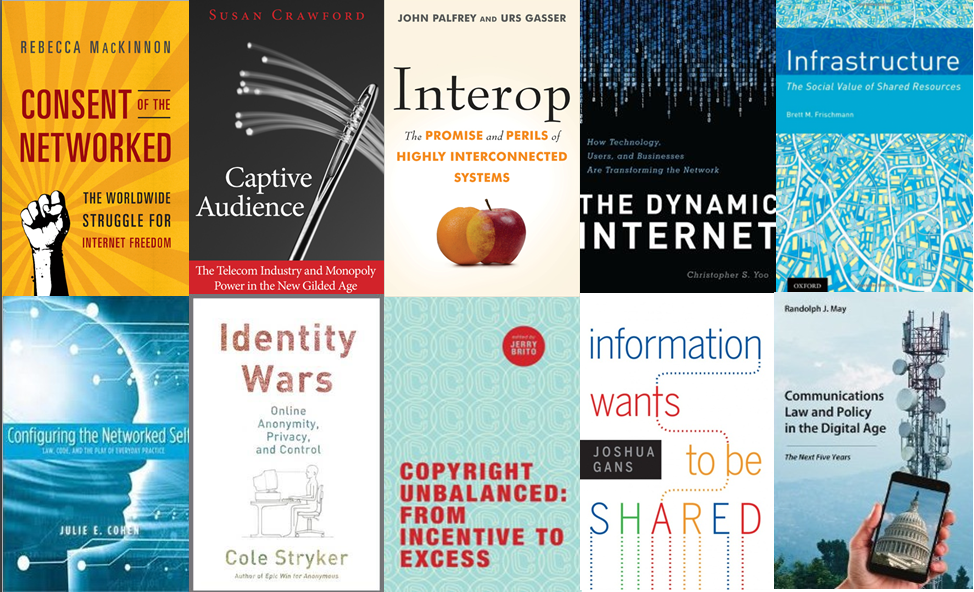
The number of major cyberlaw and information tech policy books being published annually continues to grow at an astonishing pace, so much so that I have lost the ability to read and review all of them. In past years, I put together end-of-year lists of important info-tech policy books (here are the lists for 2008, 2009, 2010, and 2011) and I was fairly confident I had read just about everything of importance that was out there (at least that was available in the U.S.). But last year that became a real struggle for me and this year it became an impossibility. A decade ago, there was merely a trickle of Internet policy books coming out each year. Then the trickle turned into a steady stream. Now it has turned into a flood. Thus, I’ve had to become far more selective about what is on my reading list. (This is also because the volume of journal articles about info-tech policy matters has increased exponentially at the same time.)
So, here’s what I’m going to do. I’m going to discuss what I regard to be the five most important titles of 2012, briefly summarize a half dozen others that I’ve read, and then I’m just going to list the rest of the books out there. I’ve read most of them but I have placed an asterisk next to the ones I haven’t. Please let me know what titles I have missed so that I can add them to the list. (Incidentally, here’s my compendium of all the major tech policy books from the 2000s and here’s the running list of all my book reviews.)
Continue reading →
Yesterday it was my privilege to speak at a Free State Foundation (FSF) event on “Ideas for Communications Law and Policy Reform in 2013.” It was moderated by my friend and former colleague Randy May, who is president of FSF, and the event featured opening remarks from the always-excellent FCC Commissioner Robert McDowell.
During the panel discussing that followed, I offered my thoughts about the problem America continues to face in cleaning up communications and media law and proposed a few ideas to get reform done right once and for all. I don’t have time to formally write-up my remarks, but I thought I would just post the speech notes that I used yesterday and include links to the relevant supporting materials. (I’ve been using a canned version of this same speech at countless events over the past 15 years. Hopefully lawmakers will take up some of these reforms some time soon so I’m not using this same set of remarks in 2027!)
Continue reading →
In previous posts about the battle for control of the Cato Institute, I’ve noted (Part I) that the “Koch side” is a variety of different actors with different motivations who collectively seem not to apprehend the Cato Institute’s value. Next (Part II), I looked at why the Koch side is fairly the object of the greater scrutiny: their precipitous filing of the original lawsuit.
My premise has been that the Koch side cares. That is, I’ve assumed that they want to preserve Cato and see its role in the libertarian movement continue. Some evidence to undercut that assumption has come around, namely, their filing of a second lawsuit—and now a third! [Update: Mea culpa—there hasn’t been a third lawsuit. Just a new report of the second one. I had assumed the second was filed in state court and thus thought this was distinct. I’m not following the legal issues, obviously, which matter very little.]
The Koch side may be “on tilt.” Lawsuit-happy, win-at-any-cost. We will just have to wait and see.
For the time being, I will continue to assume that the Koch side has the best interests of liberty in mind and explore the dispute from that perspective. I owe the world some discussion of Cato-side miscalculation—of course, there is some—but before I get to that in my next post, I think it’s worth talking about the burden of proof in the Kochs’ campaign to take control of Cato.
Only fringies will deny that the Cato Institute adds some value to the liberty movement. It does. The question—if preservation of liberty is the goal—is how well it will do so in the future. The central
substantive issue in the case—there are many side issues—is how Cato will operate in the future.
Now, here’s a quick primer on public campaigns and the difference between the “yes” side and the “no” side. Continue reading →
Last week, I posted about the conflict between the Koch brothers and the Cato Institute, threatening to make that post first in a series. Never let it be said that I don’t follow through on my threats, sometimes.
Recapping: I believe the Koch brothers want what’s best for liberty, but the actions of the “Koch side”—an array of actors with differing motivations and strategies—may not be serving that goal. This seems due to miscalculation: the Koch side seems not to recognize how much of the Cato Institute’s value is in its reputational capital, capital which would be despoiled by a Koch takeover. I basically fleshed out an early point of Jonathan Adler’s on the Volokh Conspiracy.
But why is it the Koch side that gets the attention and not the Cato side? Continue reading →

 The Technology Liberation Front is the tech policy blog dedicated to keeping politicians' hands off the 'net and everything else related to technology.