Posts tagged as:

Interoperability is a topic that has long been of interest to me. How networks, platforms, and devices work with each other–or sometimes fail to–is an important engineering, business, and policy issue. Back in 2012, I spilled out over 5,000 words on the topic when reviewing John Palfrey and Urs Gasser’s excellent book, Interop: The Promise and Perils of Highly Interconnected Systems.

I’ve always struggled with the interoperability issues, however, and often avoided them became of the sheer complexity of it all. Some interesting recent essays by sci-fi author and digital activist Cory Doctorow remind me that I need to get back on top of the issue. His latest essay is a call-to-arms in favor of what he calls “adversarial interoperability.” “[T]hat’s when you create a new product or service that plugs into the existing ones without the permission of the companies that make them,” he says. “Think of third-party printer ink, alternative app stores, or independent repair shops that use compatible parts from rival manufacturers to fix your car or your phone or your tractor.”

Doctorow is a vociferous defender of expanded digital access rights of many flavors and his latest essays on interoperability expand upon his previous advocacy for open access and a general freedom to tinker. He does much of this work with the Electronic Frontier Foundation (EFF), which shares his commitment to expanded digital access and interoperability rights in various contexts.

I’m in league with Doctorow and EFF on some of these things, but also find myself thinking they go much too far in other ways. At root, their work and advocacy raise a profound question: should there be any general right to exclude on digital platforms? Although he doesn’t always come right out and say it, Doctorow’s work often seems like an outright rejection of any sort of property rights in networks or platforms. Generally speaking, he does not want the law to recognize any right for tech platforms to exclude using digital fences of any sort. Continue reading →

Those of us with deep reservations about the push for ever more unlicensed spectrum are having many of our fears realized with the new resistance to novel technologies using unlicensed spectrum. By law unlicensed spectrum users have no rights to their spectrum; unlicensed spectrum is a managed commons. In practice, however, existing users frequently act as if they own their spectrum and they can exclude others. By entertaining these complaints, the FCC simply encourages NIMBYism in unlicensed spectrum.

The general idea behind unlicensed spectrum is that by providing a free spectrum commons to any device maker who complies with certain simple rules (namely, Part 15’s low power operation requirement), device makers will develop wireless services that would never have developed if the device makers had to shell out millions for licensed spectrum. For decades, unlicensed spectrum has stimulated development and sale of millions of consumer devices, including cordless phones, Bluetooth devices, wifi access points, RC cars, and microwave ovens.

Now, however, many device makers are getting nervous about new entrants. For instance, Globalstar is developing a technology, TLPS, based on wifi standards that will use some unlicensed spectrum at 2.4 GHz and mobile carriers would like to market an unlicensed spectrum technology, LTE-U, based on 4G LTE standards that will use spectrum at 5 GHz.

This resistance from various groups and spectrum incumbents, who fear interference in “their” spectrum if these new technologies catch on, was foreseeable, which makes these intractable conflicts even more regrettable. As Prof. Tom Hazlett wrote in a 2001 essay, long before today’s conflicts, when it comes to unlicensed devices, “economic success spells its own demise.” Hazlett noted, “Where an unlicensed firm successfully innovates, open access guarantees imitation. This not only results in competition…but may degrade wireless emissions — perhaps severely.”

On the other hand, the many technical filings about potential interference to existing unlicensed devices are red herrings. Prospective device makers in these unlicensed bands have no duty to protect existing users. Part 15 rules say that unlicensed users like wifi and Bluetooth “shall not be deemed to have any vested or recognizable right to continued use of any given frequency by virtue of prior registration or certification of equipment” and that “interference must be accepted.” These rules, however, put the FCC in a self-created double bind: the agency provides no interference protection to existing users but its open access policy makes interference conflicts likely. Continue reading →

The FCC is being dragged–reluctantly, it appears–into disputes that resemble the infamous beauty contests of bygone years, where the agency takes on the impossible task of deciding which wireless services deliver more benefits to the public. Two novel technologies used for wireless broadband–TLPS and LTE-U–reveal the growing tensions in unlicensed spectrum. The two technologies are different and pose slightly different regulatory issues but each is an attempt to bring wireless Internet to consumers. Their advocates believe these technologies will provide better service than existing wifi technology and will also improve wifi performance. Their major similarity is that others, namely wifi advocates, object that the unlicensed bands are already too crowded and these new technologies will cause interference to existing users.

The LTE-U issue is new and developing. The TLPS proceeding, on the other hand, has been pending for a few years and there are warning signs the FCC may enter into beauty contests–choosing which technologies are entitled to free spectrum–once again.

What are FCC beauty contests and why does the FCC want to avoid them? Continue reading →

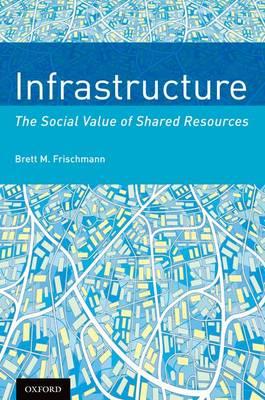
The folks at the Concurring Opinions blog were kind enough to invite me to participate in a 2-day symposium they are holding about Brett Frischmann’s new book, Infrastructure: The Social Value of Shared Resources. In my review, I noted that it’s an important book that offers a comprehensive and highly accessible survey of the key issues and concepts, and outlines much of the relevant literature in the field of infrastructure policy.  Frischmann’s book deserves a spot on your shelf whether you are just beginning your investigation of these issues or if you have covered them your entire life. Importantly, readers of this blog will also be interested in the separate chapters Frischmann devotes to communications policy and Net neutrality regulation, as well as his chapter on intellectual property issues.

However, my review focused on a different matter: the book’s almost complete absence of “public choice” insights and Frischmann’s general disregard for thorny “supply-side” questions.  Frischmann is so focused on making the “demand-side” case for better appreciating how open infrastructures “generate spillovers that benefit society as a whole” and facilitate various “downstream productive activities,” that he short-changes the supply-side considerations regarding how infrastructure gets funded and managed. I argue that: Continue reading →

The Mercatus Center at George Mason University has just released my new white paper, “The Perils of Classifying Social Media Platforms as Public Utilities.” [PDF] I first presented a draft of this paper last November at a Michigan State University conference on “The Governance of Social Media.” [Video of my panel here.]

In this paper, I note that to the extent public utility-style regulation has been debated within the Internet policy arena over the past decade, the focus has been almost entirely on the physical layer of the Internet. The question has been whether Internet service providers should be considered “essential facilities” or “natural monopolies” and regulated as public utilities. The debate over “net neutrality” regulation has been animated by such concerns.

While that debate still rages, the rhetoric of public utilities and essential facilities is increasingly creeping into policy discussions about other layers of the Internet, such as the search layer. More recently, there have been rumblings within academic and public policy circles regarding whether social media platforms, especially social networking sites, might also possess public utility characteristics. Presumably, such a classification would entail greater regulation of those sites’ structures and business practices.

Proponents of treating social media platforms as public utilities offer a variety of justifications for regulation. Amorphous “fairness” concerns animate many of these calls, but privacy and reputational concerns are also frequently mentioned as rationales for regulation. Proponents of regulation also sometimes invoke “social utility” or “social commons” arguments in defense of increased government oversight, even though these notions lack clear definition.

Social media platforms do not resemble traditional public utilities, however, and there are good reasons why policymakers should avoid a rush to regulate them as such. Continue reading →

Earlier this year I read Scott Cleland’s new book, Search & Destroy: Why You Can’t Trust Google, Inc., after he was kind enough to send me an advance copy. I didn’t have time to review it at the time and just jotted down a few notes for use later. Because the year is winding down, I figured I should get my thoughts on it out now before I publish my end of year compendium of important tech policy books.

Cleland is President of Precursor LLC and a noted Beltway commentator on information policy issues, especially Net neutrality regulation, which he has vociferously railed against for many years. On a personal note, I’ve known Scott for many years and always enjoyed his analysis and wit, even when I disagree with the thrust of some of it.

And I’m sad to report that I disagree with most of it in Search & Destroy, a book that is nominally about Google but which is really a profoundly skeptical look at the modern information economy as we know it. Indeed, Cleland’s book might have been more appropriately titled, “Second Thoughts about Cyberspace.” In a sense, it represents an outline for an emerging “cyber-conservative” vision that aims to counter both “cyber-progressive” and “cyber-libertarian” schools of thinking.

After years of having Scott’s patented bullet-point mini-manifestos land in my mailbox, I think it’s only appropriate I write this review in the form of a bulleted list! So, here it goes.. Continue reading →

Tom HazlettNow that the broadband plan is out, and the FCC has its sights set on 500 MHz of broadcast spectrum, come listen to what it all means. In the latest episode of the Surprisingly Free Conversation podcast, Thomas Hazlett, Professor of Law & Economics and Director of the Information Economy Project at George Mason University School of Law, discusses the economics of spectrum. The discussion also turns to the history of spectrum regulation, ongoing inefficiencies in the current system, and suggestions for possible improvements.

Listen to other episodes and remember to subscribe to the podcast using RSS or iTunes.

This looks like a good one to me. An ITIF event tomorrow called “Info-Communism:” A Progressive Path Forward or a Political and Intellectual Dead End?

Overheated rhetoric around information policy and intellectual property damages the quality of the debate. In this paper, featured speaker and Syracuse University information studies professor Milton Mueller warns against pouring these debates into old ideological molds. Doing so preserves controversy rather than fostering the discovery of common ground. (Or “commons” ground—couldn’t help it!)

I don’t know that this forum will solve the problem, but I know it will be interesting. The sign-up page indicates that the event will be streamed.

2009 was not as big of a year for Internet and information technology (“info-tech”) policy books as 2008 was, but there were still some notable titles released that offered interesting perspectives about the future of the Net and the impact the Digital Revolution is having on our lives, culture, and economy.  So, like last year, I figured I would throw together my list of the 10 most important info-tech policy books of the year.

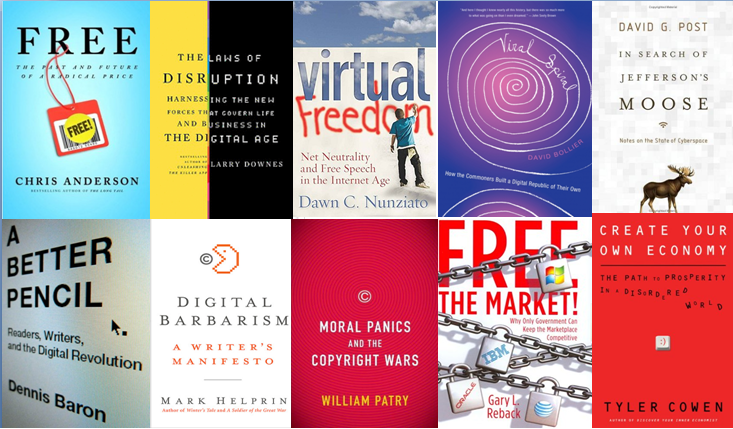
book covers collage 2009First, let me repeat a few of the same caveats and disclaimers that I set forth last year.  What qualifies as an “important” info-tech policy book? Simply put, it’s a title that many people are currently discussing and that we will likely be referencing for many years to come.  However, I want to be clear that merely because a book appears on my list it does not necessarily mean I agree with everything said in it. In fact, as was the case in previous years, I found much with which to disagree in my picks for the most important books of 2009 and I find that the cyber-libertarianism I subscribe to has very few fans out there.

Another caveat: Narrowly-focused titles lose a few points on my list. For example, if a book deals mostly with privacy issues, copyright law, or antitrust policy, it does not exactly qualify as the same sort of “tech policy book” as other titles found on this list since it is a narrow exploration of just one set of issues with a bearing on technology policy.

With those caveats in mind, here are my choices for the Most Important Info-Tech Policy Books of 2009. Continue reading →

libertyby Adam Thierer & Berin Szoka — (Ver. 1.0 — Summer 2009)

We are attempting to articulate the core principles of cyber-libertarianism to provide the public and policymakers with a better understanding of this alternative vision for ordering the affairs of cyberspace. We invite comments and suggestions regarding how we should refine and build-out this outline. We hope this outline serves as the foundation of a book we eventually want to pen defending what we regard as “Real Internet Freedom.” [Note:  Here’s a printer-friendly version, which we also have embedded down below as a Scribd document.]

I. What is Cyber-Libertarianism?

Cyber-libertarianism refers to the belief that individuals—acting in whatever capacity they choose (as citizens, consumers, companies, or collectives)—should be at liberty to pursue their own tastes and interests online.

Generally speaking, the cyber-libertarian’s motto is “Live & Let Live” and “Hands Off the Internet!”  The cyber-libertarian aims to minimize the scope of state coercion in solving social and economic problems and looks instead to voluntary solutions and mutual consent-based arrangements.

Cyber-libertarians believe true “Internet freedom” is freedom from state action; not freedom for the State to reorder our affairs to supposedly make certain people or groups better off or to improve some amorphous “public interest”—an all-to convenient facade behind which unaccountable elites can impose their will on the rest of us.

Continue reading →