Posts tagged as:

[This is a draft of a section of a forthcoming study on “A Flexible Governance Framework for Artificial Intelligence,” which I hope to complete shortly. I welcome feedback. I have also cross-posted this essay at Medium.]

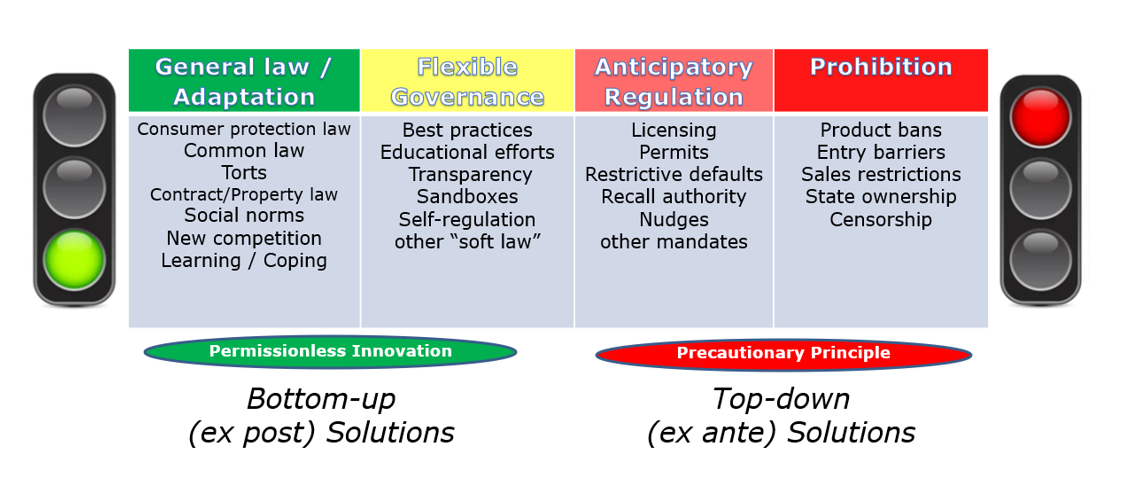
Debates about how to embed ethics and best practices into AI product design is where the question of public policy defaults becomes important. To the extent AI design becomes the subject of legal or regulatory decision-making, a choice must be made between two general approaches: the precautionary principle or the proactionary principle.[1] While there are many hybrid governance approaches in between these two poles, the crucial issue is whether the initial legal default for AI technologies will be set closer to the red light of the precautionary principle (i.e., permissioned innovation) or to the green light of the proactionary principle (i.e., (permissionless innovation). Each governance default will be discussed.

Continue reading →

Last week I attended the Section 230 cage match workshop at the DOJ. It was a packed house, likely because AG Bill Barr gave opening remarks. It was fortuitous timing for me: my article with Jennifer Huddleston, The Erosion of Publisher Liability in American Law, Section 230, and the Future of Online Curation, was published 24 hours before the workshop by the Oklahoma Law Review.

These were my impressions of the event:

I thought it was pretty well balanced event and surprisingly civil for such a contentious topic. There were strong Section 230 defenders and strong Section 230 critics, and several who fell in between. There were a couple cheers after a few pointed statements from panelists, but the audience didn’t seem to fall on one side or the other. I’ll add that my friend and co-blogger Neil Chilson gave an impressive presentation about how Section 230 helped make the “long tail” of beneficial Internet-based communities possible.

AG Bob Barr gave the opening remarks, which are available online. A few things jumped out. He suggested that Section 230 had its place but Internet companies are not an infant industry anymore. In his view, the courts have expanded Section 230 beyond drafters’ intent, and the Reno decision “unbalanced” the protections, which were intended to protect minors. The gist of his statement was that the law needs to be “recalibrated.”

Each of these points were disputed by one or more panelists, but the message to the Internet industry was clear: the USDOJ is scrutinizing industry concentration and its relationship to illegal and antisocial online content.

The workshop signals that there is now a large, bipartisan coalition that would like to see Section 230 “recalibrated.” The problem for this coalition is that they don’t agree on what types of content providers should be liable for and they are often at cross-purposes. The problematic content ranges from sex trafficking, to stalkers, to opiate trafficking, to revenge porn, to unfair political ads. For conservatives, social media companies take down too much content, intentionally helping progressives. For progressives, social media companies leave up too much content, unwittingly helping conservatives.

I’ve yet to hear a convincing way to modify Section 230 that (a) satisfies this shaky coalition, (b) would be practical to comply with, and (c) would be constitutional.

Now, Section 230 critics are right: the law blurs the line between publisher and conduit. But this is not unique to Internet companies. The fact is, courts (and federal agencies) blurred the publisher-conduit dichotomy for fifty years for mass media distributors and common carriers as technology and social norms changed. Some cases that illustrate the phenomenon:

In Auvil v. CBS 60 Minutes, a 1991 federal district court decision, some Washington apple growers sued some local CBS affiliates for airing allegedly defamatory programming. The federal district court dismissed the case on the grounds that the affiliates are conduits of CBS programming. Critically, the court recognized that the CBS affiliates “had the power to” exercise editorial control over the broadcast and “in fact occasionally [did] censor programming . . . for one reason or another.” Still, case dismissed. The principle has been cited by other courts. Publishers can be conduits.

Conduits can also be publishers. In 1989, Congress passed a law requiring phone providers to restrict “dial-a-porn” services to minors. Dial-a-porn companies sued. In Information Providers Coalition v. FCC, the 9th Circuit Court of Appeals held that regulated common carriers are “free under the Constitution to terminate service” to providers of indecent content. The Court relied on its decision a few years earlier in Carlin Communications noting that when a common carrier phone company is connecting thousands of subscribers simultaneously to the same content, the “phone company resembles less a common carrier than it does a small radio station.”

Many Section 230 reformers believe Section 230 mangled the common law would like to see the restoration of the publisher-conduit dichotomy. As our research shows, that dichotomy had already been blurred for decades. Until advocates and lawmakers acknowledge these legal trends and plan accordingly, the reformers risk throwing out the baby with the bathwater.

Relevant research:
Brent Skorup & Jennifer Huddleston, The Erosion of Publisher Liability in American Law, Section 230, and the Future of Online Curation (Oklahoma Law Review).

Brent Skorup & Joe Kane, The FCC and Quasi–Common Carriage: A Case Study of Agency Survival (Minnesota Journal of Law, Science & Technology).
“First electricity, now telephones. Sometimes I feel as if I were living in an H.G. Wells novel.” –Dowager Countess, Downton Abbey

Every technology we take for granted was once new, different, disruptive, and often ridiculed and resisted as a result. Electricity, telephones, trains, and television all caused widespread fears once in the way robots, artificial intelligence, and the internet of things do today. Typically it is realized by most that these fears are misplaced and overly pessimistic, the technology gets diffused and we can barely remember our life without it. But in the recent technopanics, there has been a concern that the legal system is not properly equipped to handle the possible harms or concerns from these new technologies. As a result, there are often calls to regulate or rein in their use.

In the late 1980s, video cassette recorders (VCRs) caused a legal technopanic. The concerns were less that VCRs would lead to some bizarre human mutation as in many technopanics, but rather that the existing system of copyright infringement and vicarious liability could not adequately address the potential harm to the motion picture industry. The then president of the Motion Picture Association of America Jack Valenti famously told Congress, “I say to you that the VCR is to the American film producer and the American public as the Boston Strangler is to the woman home alone.”

Continue reading →

If there are two general principles that unify my recent work on technology policy and innovation issues, they would be as follows. To the maximum extent possible:

  1. We should avoid preemptive and precautionary-based regulatory regimes for new innovation. Instead, our policy default should be innovation allowed (or “permissionless innovation”) and innovators should be considered “innocent until proven guilty” (unless, that is, a thorough benefit-cost analysis has been conducted that documents the clear need for immediate preemptive restraints).
  2. We should avoid rigid, “top-down” technology-specific or sector-specific regulatory regimes and/or regulatory agencies and instead opt for a broader array of more flexible, “bottom-up” solutions (education, empowerment, social norms, self-regulation, public pressure, etc.) as well as reliance on existing legal systems and standards (torts, product liability, contracts, property rights, etc.).

I was very interested, therefore, to come across two new essays that make opposing arguments and proposals. The first is this recent Slate oped by John Frank Weaver, “We Need to Pass Legislation on Artificial Intelligence Early and Often.” The second is Ryan Calo’s new Brookings Institution white paper, “The Case for a Federal Robotics Commission.”

Weaver argues that new robot technology “is going to develop fast, almost certainly faster than we can legislate it. That’s why we need to get ahead of it now.” In order to preemptively address concerns about new technologies such as driverless cars or commercial drones, “we need to legislate early and often,” Weaver says. Stated differently, Weaver is proposing “precautionary principle”-based regulation of these technologies. The precautionary principle generally refers to the belief that new innovations should be curtailed or disallowed until their developers can prove that they will not cause any harms to individuals, groups, specific entities, cultural norms, or various existing laws, norms, or traditions.

Calo argues that we need “the establishment of a new federal agency to deal with the novel experiences and harms robotics enables” since there exists “distinct but related challenges that would benefit from being examined and treated together.” These issues, he says, “require special expertise to understand and may require investment and coordination to thrive.

I’ll address both Weaver and Calo’s proposals in turn. Continue reading →

book cover (small)I am pleased to announce the release of my latest book, “Permissionless Innovation: The Continuing Case for Comprehensive Technological Freedom.” It’s a short manifesto (just under 100 pages) that condenses — and attempts to make more accessible — arguments that I have developed in various law review articles, working papers, and blog posts over the past few years. I have two goals with this book.

First, I attempt to show how the central fault line in almost all modern technology policy debates revolves around “the permission question,” which asks: Must the creators of new technologies seek the blessing of public officials before they develop and deploy their innovations? How that question is answered depends on the disposition one adopts toward new inventions. Two conflicting attitudes are evident.

One disposition is known as the “precautionary principle.” Generally speaking, it refers to the belief that new innovations should be curtailed or disallowed until their developers can prove that they will not cause any harms to individuals, groups, specific entities, cultural norms, or various existing laws, norms, or traditions.

The other vision can be labeled “permissionless innovation.” It refers to the notion that experimentation with new technologies and business models should generally be permitted by default. Unless a compelling case can be made that a new invention will bring serious harm to society, innovation should be allowed to continue unabated and problems, if they develop at all, can be addressed later.

I argue that we are witnessing a grand clash of visions between these two mindsets today in almost all major technology policy discussions today. Continue reading →

One of the criticisms leveled at Bitcoin by those people determined to hate it is that Bitcoin transactions are irreversible. If I buy goods from an anonymous counterparty online, what’s to stop them from taking my bitcoins and simply not sending me the goods? When I buy goods online using Visa or American Express, if the goods never arrive, or if they aren’t what was advertised, I can complain to the credit card company. The company will do a cursory investigation, and if they find that I was indeed likely ripped off, they will refund me my money. Credit card transactions are reversible, Bitcoin transactions are not. For this service (among others), credit card companies charge merchants a few percentage points on the transaction.

The problem with this account is that it’s not true: Baked into the Bitcoin protocol, there is support for what are known as “m-of-n” or “multisignature” transactions, transactions that require some number  m out of some higher number n parties to sign off. Continue reading →

Adam and I have been pretty hard on the FTC’s current leadership for pushing to dramatically expand regulation of online data use with little thought to the impact on ad-supported media, while in the next breath opening the door to dramatic expansion of direct government support of media, and all the while seeking sweeping new regulatory powers from Congress.

After all that complaining (and bashing their Soviet Realist-style statue, “Man Controlling Trade”), you might think we had it in for the agency. But as I’ve said repeatedly, we’re actually big fans of the FTC’s core consumer protection mission: holding companies to their promises. (Indeed, we want to make sure they stay focused on that mission, and have the staff, resources and technological tools to pursue it effectively—which might mean, as I’ve pointed out, increased funding rather than increased powers.) We’ve also repeatedly praised the FTC’s efforts to educate kids, parents, and Internet users in general about things like online privacy, advertising, spyware, user empowerment tools, online scams, etc.

But I don’t want to be accused of being only a fair-weather friend of the agency. So I wanted to point out a particularly good concrete example of the FTC doing what we talk about in the abstract: holding companies to their promises.  Grant Gross notes that the FTC sent a stern letter earlier this month to the company that is seeking to buy the subscriber info and photos and other assets of the now-defunct XY Magazine, which served primarily gay U.S. teens, warning them that the FTC would hold them to the terms of the privacy policy under which XY collected information from its subscribers.

This is a great example of how the FTC can effectively use its existing authority to protect consumers against clear harms involved in the disclosure of truly sensitive data, sometimes even prophylactically—in this case, outing around 100,000 gay youths and young adults—collected by companies that make unambiguous promises to protect users’ data. This incident also illustrates how privacy law can evolve in an organic fashion from a growing body of such well-justified preemptive warnings, enforcement actions brought against truly bad actors, and ultimately court decisions that decide whether the FTC has properly weighed the interests at stake. In other words, just because we don’t have a privacy code enforced by a Data Protection Authority as in Europe doesn’t mean our legal system doesn’t protect privacy!

Continue reading →

Recall a couple of years ago when I lauded Google – and also picked on them – for making customer data “more anonymous”?

“‘Anonymous’ is correctly regarded as an absolute condition,” I wrote. “Like pregnancy, anonymity is either there or it’s not. Modifying the word with a relative adjective like ‘more’ is a curious use of language.”

The challenge of these concepts – “anonymized” or “de-identified” data – is still around, and it’s still a difficult one.

Here’s a sophisticated take on the question:

Information is increasingly difficult to classify as “identified” or “de-identified,” particularly as it is copied, exchanged, or recombined with other information. With rapidly evolving technologies and databases, it is more appropriate to describe a spectrum of “identifiability,” rather than a binary classification of information as identifiable or not. The question could then become not whether deidentified information might be made re-identifiable, but rather which entities would be able to re-identify the information, how much effort they would have to expend, and what limits are placed on their doing so.

And here’s an advocacy group apparently lacking that sophistication. They treat information as flatly “de-identified” in a legal filing about a New Hampshire law that bans the sale of prescription drug data for marketing purposes:

[T]he Prescription Information Law does not implicate patient privacy. While it purports to protect privacy interests, the statute regulates patient de-identified information.

Here’s the thing: Both quotes were issued by the Center for Democracy and Technology. Continue reading →