What explains the rebirth of analog era media? Many people (including me!) predicted that vinyl records, turntables, broadcast TV antennas and even printed books seemed destined for the dustbin of technological history. We were so wrong, as I note in this new oped that has gone out through the Tribune Wire Service.
“Many of us threw away our record collections and antennas and began migrating from physical books to digital ones,” I note. “Now, these older technologies are enjoying a revival. What explains their resurgence, and what’s the lesson?”
I offer some data about the rebirth of analog era media as well as some possible explanations for their resurgence. “With vinyl records and printed books, people enjoy making a physical connection with the art they love. They want to hold it in their hands, display it on their wall and show it off to their friends. Digital music or books don’t satisfy that desire, no matter how much more convenient and affordable they might be. The mediums still matter.”
Read more here. Meanwhile, my own personal vinyl collection continues to grow without constraint! …
The Obama Administration has just released a draft “Consumer Privacy Bill of Rights Act of 2015.” Generally speaking, the bill aims to translate fair information practice principles (FIPPs) — which have traditionally been flexible and voluntary guidelines — into a formal set of industry best practices that would be federally enforced on private sector digital innovators. This includes federally-mandated Privacy Review Boards, approved by the Federal Trade Commission, the agency that will be primarily responsible for enforcing the new regulatory regime.
Many of the principles found in the Administration’s draft proposal are quite sensible as best practices, but the danger here is that they could soon be converted into a heavy-handed, bureaucratized regulatory regime for America’s highly innovative, data-driven economy.
No matter how well-intentioned this proposal may be, it is vital to recognize that restrictions on data collection could negatively impact innovation, consumer choice, and the competitiveness of America’s digital economy.
Online privacy and security is vitally important, but we should look to use alternative and less costly approaches to protecting privacy and security that rely on education, empowerment, and targeted enforcement of existing laws. Serious and lasting long-term privacy protection requires a layered, multifaceted approach incorporating many solutions.
That is why flexible data collection and use policies and evolving best practices will ultimately serve consumers better than one-size-fits all, top-down regulatory edicts. Continue reading →
Ladar Levison, founder of encrypted email service Lavabit, discusses recent government action that led him to shut down his firm. When it was suspected that NSA whistleblower Edward Snowden used Lavabit’s email service, the FBI issued a National Security Letter ordering Levison to hand over SSL keys, jeopardizing the privacy of Lavabit’s 410,000 users. Levison discusses his inspiration for founding Lavabit and why he chose to suspend the service; how Lavabit was different from email services like Gmail; developments in his case and how the Fourth Amendment has come into play; and his involvement with the recently-formed Dark Mail Technical Alliance.
Jack Schinasi discusses his recent working paper, Practicing Privacy Online: Examining Data Protection Regulations Through Google’s Global Expansion published in the Columbia Journal of Transnational Law. Schinasi takes an in-depth look at how online privacy laws differ across the world’s biggest Internet markets — specifically the United States, the European Union and China. Schinasi discusses how we exchange data for services and whether users are aware they’re making this exchange. And, if not, should intermediaries like Google be mandated to make its data tracking more apparent? Or should we better educate Internet users about data sharing and privacy? Schinasi also covers whether privacy laws currently in place in the US and EU are effective, what types of privacy concerns necessitate regulation in these markets, and whether we’ll see China take online privacy more seriously in the future.
First, no matter how well-intentioned, restrictions on data collection could negatively impact the competitiveness of America’s digital economy, as well as consumer choice.
Second, it is unwise to place too much faith in any single, silver-bullet solution to privacy,including “Do Not Track,” because such schemes are easily evaded or defeated and often fail to live up to their billing.
Finally, with those two points in mind, we should look to alternative and less costly approaches to protecting privacy that rely on education, empowerment, and targeted enforcement of existing laws. Serious and lasting long-term privacy protection requires a layered, multifaceted approach incorporating many solutions.
The testimony also contains 4 appendices elaborating on some of these themes.
Down below, I’ve embedded my testimony, a list of 10 recent essays I’ve penned on these topics, and a video in which I explain “How I Think about Privacy” (which was taped last summer at an event up at the University of Maine’s Center for Law and Innovation). Finally, the best summary of my work on these issues can be found in this recent Harvard Journal of Law & Public Policy article, “The Pursuit of Privacy in a World Where Information Control is Failing.” (This is the first of two complimentary law review articles I will be releasing this year dealing with privacy policy. The second, which will be published early this summer by the George Mason University Law Review, is entitled, “A Framework for Benefit-Cost Analysis in Digital Privacy Debates.”) Continue reading →
Odds are you will be monitored today — many times over. Surveillance cameras at airports, subways, banks and other public venues are not the only devices tracking you. Inexpensive, ever-watchful digital sensors are now ubiquitous.
They are in laptop webcams, video-game motion sensors, smartphone cameras, utility meters, passports and employee ID cards. Step out your front door and you could be captured in a high-resolution photograph taken from the air or street by Google or Microsoft, as they update their respective mapping services. Drive down a city thoroughfare, cross a toll bridge, or park at certain shopping malls and your license plate will be recorded and time-stamped.
Several developments have converged to push the monitoring of human activity far beyond what George Orwell imagined. Low-cost digital cameras, motion sensors and biometric readers are proliferating just as the cost of storing digital data is decreasing. The result: the explosion of sensor data collection and storage.
Oh my God! Dust off you copies of the
Unabomber Manifestoand run for your shack in the hills!
No, wait, don’t. Let’s instead step back, take a deep breath and think about this. As the article goes on to note, there will certainly be many benefits to our increasing “sensor society.” Advertising and retail activity will become more personalized and offer consumers more customized good and services. I wrote about that here at greater length in my essay on “Smart-Sign Technology: Retail Marketing Gets Sophisticated, But Will Regulation Kill It First?” More importantly, ubiquitous digital sensors and data collection/storage will also increase our knowledge of the world around us exponentially and do wonders for scientific, environmental, and medical research.
But that won’t soothe the fears of those who fear the loss of their privacy and the rise of a surveillance society in which our every move is watched or tracked. So, let’s talk about what those of you who feel that way want to do about it.
[Here’s an oped of mine that recently ran on Reuters. Readers will recognize many of these themes and arguments since I have developed them here on the TLF many times before.]
by Adam Thierer, Mercatus Center at George Mason University
Would you like to pay $20 a month for Facebook, or a dime every time you did a search on Google or Bing? That’s potentially what is at stake if the Obama administration and advocates of stepped-up regulation of online advertising get their way.
The Internet feels like the ultimate free lunch. Once we pay for basic access, a cornucopia of seemingly free services and content is at our fingertips. But those services don’t just fall to Earth like manna from heaven. What powers the “free” Internet are data collection and advertising. In essence, the relationship between consumers and online content and service providers isn’t governed by any formal contract, but rather by an unwritten
quid pro quo: tolerate some ads or we’ll be forced to charge you for service. Most consumers gladly take that deal—even if many of them gripe about annoying or intrusive ads, at times. Continue reading →
Yesterday, the Federal Trade Commission (FTC) hosted an all-day workshop on “Protecting Kids’ Privacy Online,” which looked into the Children’s Online Privacy Protection Act of 1998 (COPPA) and challenges posed to its enforcement by new technological developments. The FTC staff did a nice job bringing together and moderating 5 panels worth of participants, all of whom had plenty of interesting things to say about the future of COPPA. But I was more struck by what was not said yesterday. Namely, there was:
ZERO explanation of the supposed harms of advertising, marketing, and data collection. Advertising-bashing is an old sport here in Washington, so I guess I should not have been surprised to hear several panelists yesterday engaging in teeth-gnashing and hand-wringing about advertising, marketing, and the data collection methods that make it possible. But this grousing just went on and on without any explanation by the critics of the supposed harms that would result from it.
ZERO appreciation of the benefits of advertising, marketing, and data collection. Not once yesterday — NOT ONCE — did anyone pause to ask what it is that makes all these wonderful online sites, services and content free (or dirt cheap) to consumers. Everyone at this show was guilty of the “manna fallacy” (that all this stuff just falls magically to Earth from the Net Gods above). Well, back here in the real world, something has to pay for all those goodies, and that something is advertising and marketing, which are facilitated by data collection! Or would you like to pay $19.95 a month for each of those currently free sites and services? Yeah, I didn’t think so.
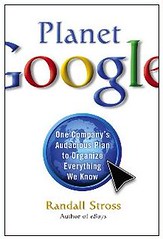
I finally got around to readingPlanet Google: One Company’s Audacious Plan to Organize Everything We Know, by Randall Stross. It’s very well done. Stross is a frequently contributor to the New York Times and the author of several other interesting books on the technology industry. He knows how to weave a story together, and it helps that Google’s story is a pretty amazing one.
Each chapter discusses a different part of Google’s growing family of services — GMail, Google Maps, Google Earth, Book Search, and YouTube. Of course, it all started with search and Stross does a good job explaining how the ingenious Google search algorithm has grown from dorm room project to the greatest aggregator of human knowledge that the world has ever known. This, in turn, has powered Google’s hugely successful online advertising system. The real secret of their success with online advertising, Stross argues, is that “Google’s impersonal, mathematical approach search also provides you with the ability to serve advertisements that are tailored to a search, rather than to the person submitting the search request, whose identity would have to be known.”
Despite the benefits of such generally anonymous searching, as Google has grown and added new services and capabilities, concerns about the sheer volume of data that the company collects have led to heightened privacy concerns. Indeed, privacy is a core theme that Stross uses in the book to tie many of the chapters and issues together. Google is constantly struggling to strike the right balance between providing more access to the world’s information while also being careful not to raise privacy concerns. But it’s unclear exactly how much more information collection that users (or public officials) will tolerate before advocating stricter limits on Google’s reach. As Stross points out:
Guided by its founding mission, to organize all the world’s information, Google has created storage capacity that allows it to gain control of what its users are you doing in a comprehensive way that no other company has done, and to preserve those records indefinitely, without the need to clear out old records to make way for new ones. Moreover, Google differentiates its service by refining its own proprietary software formula to mine and massage the data, technology that it zealously protects from the sight of rivals. This sets up a conflict between Google’s wish to operate a “black box” (completely opaque to the outside) and its users’ wish for transparency.
The Technology Liberation Front is the tech policy blog dedicated to keeping politicians' hands off the 'net and everything else related to technology. Learn more about TLF →


 The Technology Liberation Front is the tech policy blog dedicated to keeping politicians' hands off the 'net and everything else related to technology.