Posts tagged as:

We are entering a new era for technology policy in which many pundits and policymakers will use “algorithmic fairness” as a universal Get Out of Jail Free card when they push for new regulations on digital speech and innovation. Proposals to regulate things like “online safety,” “hate speech,” “disinformation,” and “bias” among other things often raise thorny definitional questions because of their highly subjective nature. In the United States, efforts by government to control these things will often trigger judicial scrutiny, too, because restraints on speech violate the First Amendment. Proponents of prior restraint or even ex post punishments understand this reality and want to get around it. Thus, in an effort to avoid constitutional scrutiny and lengthy court battles, they are engaged in a rebranding effort and seeking to push their regulatory agendas through a techno-panicky prism of “algorithmic fairness” or “algorithmic justice.”

Hey, who could possibly be against FAIRNESS and JUSTICE? Of course, the devil is always in the details as Neil Chilson and I discuss in our new paper for the The Federalist Society and Regulatory Transparency Project on, “The Coming Onslaught of ‘Algorithmic Fairness’ Regulations.” We document how federal and state policymakers from both parties are currently considering a variety of new mandates for artificial intelligence (AI), machine learning, and automated systems that, if imposed, “would thunder through our economy with one of the most significant expansions of economic and social regulation – and the power of the administrative state – in recent history.” Continue reading →

[Cross-posted from Medium.]

[last updated 4/3/2025 – Check my Medium page for latest posts]

This a running list of all the essays and reports I’ve already rolled out on the governance of artificial intelligence (AI), machine learning (ML), and robotics. Why have I decided to spend so much time on this issue? Because this will become the most important technological revolution of our lifetimes. Every segment of the economy will be touched in some fashion by AI, ML, robotics, and the power of computational science. It should be equally clear that public policy will be radically transformed along the way.

Eventually, all policy will involve AI policy and computational considerations. As AI “eats the world,” it eats the world of public policy along with it. The stakes here are profound for individuals, economies, and nations. As a result, AI policy will be the most important technology policy fight of the next decade, and perhaps next quarter century. Those who are passionate about the freedom to innovate need to prepare to meet the challenge as proposals to regulate AI proliferate.

There are many socio-technical concerns surrounding algorithmic systems that deserve serious consideration and appropriate governance steps to ensure that these systems are beneficial to society. However, there is an equally compelling public interest in ensuring that AI innovations are developed and made widely available to help improve human well-being across many dimensions. And that’s the case that I’ll be dedicating my life to making in coming years.

Here’s the list of what I’ve done so far. I will continue to update this as new material is released: Continue reading →

[This essay originally appeared on the AIER blog on May 23, 2019 under the title, “Spring Cleaning for the Regulatory State.”]


Spring is in full blossom, and many of us are in the midst of our annual house-cleaning ritual. A regular deep clean makes good sense because it makes our living spaces more orderly and gets rid of the gunk and grime that has amassed over the past year.

Unfortunately, governments almost never engage in their own spring-cleaning exercise. Statutes and regulations continue to accumulate, layer by layer, until they suffocate not only economic opportunity, but also the effective administration of government itself. Luckily, some states have realized this and have taken steps to help address this problem.

Mountains of Regulations

First, here are some hard facts about regulatory accumulation:

  • Red tape grows: Since the first edition of his annual publication Ten Thousand Commandments in 1993, Wayne Crews has documented how federal agencies have issued 101,380 rules. Other reports find agency staffing levels jumped from 57,109 to 277,163 employees from 1960 to 2017, while agency budgets swelled in real terms from $3 billion in 1960 to $58 billion in 2017 (2009$).
  • Nothing ever gets cleaned up: A Deloitte survey of U.S. Code reveals that 68 percent of federal regulations have never been updated and that 17 percent have only been updated once. If a company never updated its business model, it would fail eventually. But governments get away with doing the same thing without any fear of failure. “If it were a country, U.S. regulation would be the world’s eighth-largest economy, ranking behind India and ahead of Italy,” Crews notes.
  • The burden of regulatory accumulation is getting worse: “The estimate for regulatory compliance and economic effects of federal intervention is $1.9 trillion annually,” Crews finds, which is equal to 10 percent of the U.S. gross domestic product for 2017. When federal spending is added to regulatory costs are added to federal spending, Crews finds, the burden equals $4.173 trillion, or 30 percent of the entire economy. Mercatus Center research has found that “economic growth in the United States has, on average, been slowed by 0.8 percent per year since 1980 owing to the cumulative effects of regulation.” This means that “the US economy would have been about 25 percent larger than it actually was as of 2012” if regulation had been held to roughly the same aggregate level it stood at in 1980.

In sum, the evidence shows that the red tape is growing without constraint, hindering entrepreneurship and innovation, deterring new investment, raising costs to consumers, limiting worker opportunities/wages, and undermining economic growth.

Regulations accumulate in this fashion because the administrative state is on autopilot. Legislatures pass broad statutes delegating ambiguous authority to agencies. Bureaucrats are then free to roll the regulatory snowball down the hill until it has become so big that its momentum cannot be stopped.

The Death of Common Sense

Policy makers enact new rules with the best of intentions, of course, but we should not assume that the untrammeled growth of the regulatory state produces positive results. There is no free lunch, after all. Every regulation is a restriction on opportunities for experimentation with new and potentially better ways of doing things. Sometimes such restrictions make sense because regulations can pass a reasonable cost-benefit test. It would be foolish to assume that all regulations on the books do.

Spring cleaning for the regulatory state, therefore, should be viewed as an exercise in “good governance.” The goal is not to get rid of all regulations. The goal is to make sure that rules are reasonable and cost-effective so that the public can actually understand the law and get the highest value out of their government institutions.

Philip K. Howard, founder and chair of the nonprofit coalition Common Good and the author of The Death of Common Sense, has written extensively about how regulatory accumulation has become a chronic problem. “Too much law,” he argues, “can have similar effects as too little law.” “People slow down, they become defensive, they don’t initiate projects because they are surrounded by legal risks and bureaucratic hurdles,” Howard notes. “They tiptoe through the day looking over their shoulders rather than driving forward on the power of their instincts. Instead of trial and error, they focus on avoiding error.”

In such an environment, risk-taking and entrepreneurialism are more challenging and economic dynamism suffers. But regulatory accumulation also hurts the quality of government institutions and policies, which become fundamentally incomprehensible or illogical. “Society can’t function when stuck in a heap of accumulated mandates of past generations,” Howard concludes. This is why an occasional regulatory house cleaning is essential to unleash economic opportunity and improve the functioning of our democratic institutions.

Regulatory House Cleaning Begins

Reforms to address this problem are finally happening. In a series of new essays, my colleague James Broughel has documented how several states — including IdahoOhioVirginia, and New Jersey — are undertaking serious efforts to get regulatory accumulation under control. They are utilizing a variety of mechanisms, including “regulatory reduction pilot programs” and “red tape review commissions.” Recently, Idaho actually initiated a sunset of its entire regulatory code and will now try to figure out how to clean up its 8,200 pages of regulations containing 736 chapters of state rules.

Meanwhile, other states are undertaking serious reform in one of the worst forms of regulatory accumulation: occupational licenses. The Federal Trade Commission notes that roughly 30 percent of American jobs require a license today, up from less than 5 percent in the 1950s. Research by economist Morris Kleiner and others finds that “restrictions from occupational licensing can result in up to 2.85 million fewer jobs nationwide, with an annual cost to consumers of $203 billion.” And many of the rules do not even serve their intended purpose. A major 2015 Obama administration report on the costs of occupational licensing concluded that “most research does not find that licensing improves quality or public health and safety.”

ArizonaWest Virginia, and Nebraska are among the leaders in reforming occupational-licensing regimes using a variety of approaches. In some cases, the reforms sunset licensing rules for specific professions altogether. Other proposals grant workers reciprocity to use a license they obtained in another state. Finally, some states have proposed letting most professions operate without any license at all but then requiringall, but then require them to make it clear to consumers that they are unlicensed.

The Need for a Fresh Look

Sunsets are not silver-bullet solutions, and the recent experience with sunsetting and “de-licensing” requirements at the state level has been mixed because many legislatures ignore or circumvent requirements. Nonetheless, sunsets can still help prompt much-needed discussions about which rules make sense and which ones no longer do.

Sunsets can be forward-looking, too. I have proposed that when policy makers craft new laws, especially for fast-paced tech sectors, they should incorporate a clause that what we might think of as “the Sunsetting Imperative.” It would demand that any existing or newly imposed technology regulation should include a provision sunsetting the law or regulation within two years. Reforms like these are also sometimes referred to as “temporary legislation” or “fresh look” requirements. Policy makers can always reenact rules that are still relevant and needed.

By forcing a periodic spring cleaning, sunsets and fresh-look requirements can help stem the tide of regulatory accumulation and ensure that only those policies that serve a pressing need remain on the books. There is no good reason for governments not to clean up their messes on occasion, just like the rest of us have to.

Is code speech? That is one of the timeless questions that comes up again and again in the field of Internet law and policy. Many books and countless papers and essays have touched on this topic. Personally, I’ve always thought it was a bit silly that this is even a serious question. After all, if code isn’t speech, what the heck is it?

We humans express ourselves in many creative ways. We speak and write. We sing and dance. We paint and sculpt. And now we code. All these things are forms of human expression. Under American First Amendment jurisprudence, expression is basically synonymous with speech. We very tightly limit restrictions on speech and expression because it is a matter of personal autonomy and also because we believe that there is a profound danger of the proverbial slippery slope kicking in once we allow government officials to start censoring what they regard as offensive speech or dangerous expression.

Thus, we when creative people come up with creative thoughts and use computers and software to express them in code, that is speech. It is fundamentally no different than using a pencil and pad of paper to write a manifesto, or using a guitar and microphone to sing a protest song. The authorities might not like the resulting manifesto or protest song–in fact, they might feel quite threatened by it–but that fact also makes it clear why, in both cases, that expression is speech and that speech is worth defending. Moreover, the methods or mediums of speech production and dissemination–pencils, paper, guitars, microphones, etc.–are what Ithiel de Sola Pool referred to as “Technologies of Freedom.” They help people extend their voices and to communicate with the world, while also learning more about it.

Which brings us to the 3D printers and the code behind the open source blueprints that many people share to fabricate things with 3D printers.  Continue reading →

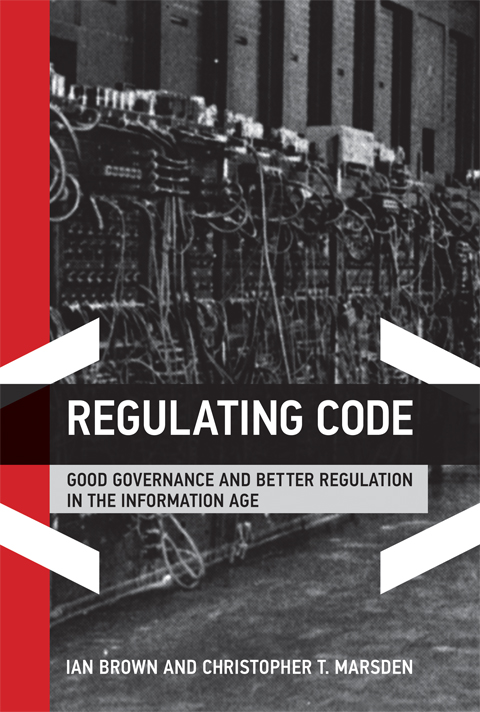
Regulating Code book coverIan Brown and Christopher T. Marsden’s new book, Regulating Code: Good Governance and Better Regulation in the Information Age, will go down as one of the most important Internet policy books of 2013 for two reasons. First, their book offers an excellent overview of how Internet regulation has unfolded on five different fronts: privacy and data protection; copyright; content censorship; social networks and user-generated content issues; and net neutrality regulation. They craft detailed case studies that incorporate important insights about how countries across the globe are dealing with these issues. Second, the authors endorse a specific normative approach to Net governance that they argue is taking hold across these policy arenas. They call their preferred policy paradigm “prosumer law” and it envisions an active role for governments, which they think should pursue “smarter regulation” of code.

In terms of organization, Brown and Marsden’s book follows the same format found in Milton Mueller’s important 2010 book Networks and States: The Global Politics of Internet Governance; both books feature meaty case studies in the middle bookended by chapters that endorse a specific approach to Internet policymaking. (Incidentally, both books were published by MIT Press.) And, also like Mueller’s book, Brown and Marsden’s Regulating Code does a somewhat better job using case studies to explore the forces shaping Internet policy across the globe than it does making the normative case for their preferred approach to these issues. Continue reading →

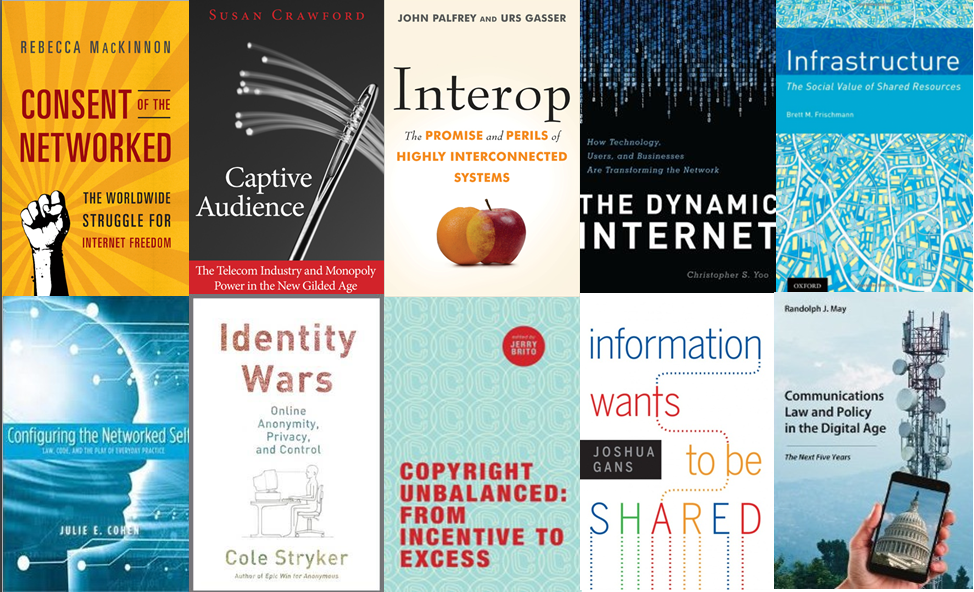
The number of major cyberlaw and information tech policy books being published annually continues to grow at an astonishing pace, so much so that I have lost the ability to read and review all of them. In past years, I put together end-of-year lists of important info-tech policy books (here are the lists for 2008, 2009, 2010, and 2011) and I was fairly confident I had read just about everything of importance that was out there (at least that was available in the U.S.). But last year that became a real struggle for me and this year it became an impossibility. A decade ago, there was merely a trickle of Internet policy books coming out each year. Then the trickle turned into a steady stream. Now it has turned into a flood. Thus, I’ve had to become far more selective about what is on my reading list. (This is also because the volume of journal articles about info-tech policy matters has increased exponentially at the same time.)

So, here’s what I’m going to do. I’m going to discuss what I regard to be the five most important titles of 2012, briefly summarize a half dozen others that I’ve read, and then I’m just going to list the rest of the books out there. I’ve read most of them but I have placed an asterisk next to the ones I haven’t.  Please let me know what titles I have missed so that I can add them to the list. (Incidentally, here’s my compendium of all the major tech policy books from the 2000s and here’s the running list of all my book reviews.)

Continue reading →

In a New York Times op-ed this weekend entitled “You Can’t Say That on the Internet,” Evgeny Morozov, author of The Net Delusion, worries that Silicon Valley is imposing a “deeply conservative” “new prudishness” on modern society. The cause, he says, are “dour, one-dimensional algorithms, the mathematical constructs that automatically determine the limits of what is culturally acceptable.” He proposes that some form of external algorithmic auditing be undertaken to counter this supposed problem. Here’s how he puts it in the conclusion of his essay:

Quaint prudishness, excessive enforcement of copyright, unneeded damage to our reputations: algorithmic gatekeeping is exacting a high toll on our public life. Instead of treating algorithms as a natural, objective reflection of reality, we must take them apart and closely examine each line of code. Can we do it without hurting Silicon Valley’s business model? The world of finance, facing a similar problem, offers a clue. After several disasters caused by algorithmic trading earlier this year, authorities in Hong Kong and Australia drafted proposals to establish regular independent audits of the design, development and modifications of computer systems used in such trades. Why couldn’t auditors do the same to Google? Silicon Valley wouldn’t have to disclose its proprietary algorithms, only share them with the auditors. A drastic measure? Perhaps. But it’s one that is proportional to the growing clout technology companies have in reshaping not only our economy but also our culture.

It should be noted that in a Slate essay this past January, Morozov had also proposed that steps be taken to root out lies, deceptions, and conspiracy theories on the Internet.  Morozov was particularly worried about “denialists of global warming or benefits of vaccination,” but he also wondered how we might deal with 9/11 conspiracy theorists, the anti-Darwinian intelligent design movement, and those that refuse to accept the link between HIV and AIDS.

To deal with that supposed problem, he recommended that Google “come up with a database of disputed claims” or “exercise a heavier curatorial control in presenting search results,” to weed out such things. He suggested that the other option “is to nudge search engines to take more responsibility for their index and exercise a heavier curatorial control in presenting search results for issues” that someone (he never says who) determines to be conspiratorial or anti-scientific in nature.

Taken together, these essays can be viewed as a preliminary sketch of what could become a comprehensive information control apparatus instituted at the code layer of the Internet. Continue reading →

I’ve been hearing more rumblings about “API neutrality” lately. This idea, which originated with Jonathan Zittrain’s book, The Future of the Internet–And How to Stop It, proposes to apply Net neutrality to the code/application layer of the Internet. A blog called “The API Rating Agency,” which appears to be written by Mehdi Medjaoui, posted an essay last week endorsing Zittrain’s proposal and adding some meat to the bones of it. (My thanks to CNet’s Declan McCullagh for bringing it to my attention).

Medjaoui is particularly worried about some of Twitter’s recent moves to crack down on 3rd party API uses. Twitter is trying to figure out how to monetize its platform and, in a digital environment where advertising seems to be the only business model that works, the company has decided to establish more restrictive guidelines for API use. In essence, Twitter believes it can no longer be a perfectly open platform if it hopes to find a way to make money. The company apparently believes that some restrictions will need to be placed on 3rd party uses of its API if the firm hopes to be able to attract and monetize enough eyeballs.

While no one is sure whether that strategy will work, Medjaoui doesn’t even want the experiment to go forward. Building on Zittrain, he proposes the following approach to API neutrality:

  • Absolute data to 3rd party non-discrimination : all content, data, and views equally distributed on the third party ecosystem. Even a competitor could use an API in the same conditions than all others, with not restricted re-use of the data.
  • Limited discrimination without tiering : If you don’t pay specific fees for quality of service, you cannot have a better quality of service, as rate limit, quotas, SLA than someone else in the API ecosystem.If you pay for a high level Quality of service, so you’ll benefit of this high level quality of service, but in the same condition than an other customer paying the same fee.
  • First come first served : No enqueuing API calls from paying third party applications, as the free 3rd-party are in the rate limits.

Before I critique this, let’s go back and recall why Zittrain suggested we might need API neutrality for certain online services or digital platforms. Continue reading →

I’m pretty rough on all the Internet and info-tech policy books that I review. There are two reasons for that. First, the vast majority of tech policy books being written today should never have been books in the first place. Most of them would have worked just fine as long-form (magazine-length) essays. Too many authors stretch a promising thesis into a long-winded, highly repetitive narrative just to say they’ve written an entire book about a subject. Second, many info-tech policy books are poorly written or poorly argued. I’m not going to name names, but I am frequently unimpressed by the quality of many books being published today about digital technology and online policy issues.

The books of Harvard University cyberlaw scholars John Palfrey and Urs Gasser offer a welcome break from this mold. Their recent books, Born Digital: Understanding the First Generation of Digital Natives, and Interop: The Promise and Perils of Highly Interconnected Systems, are engaging and extremely well-written books that deserve to be books. There’s no wasted space or mindless filler. It’s all substantive and it’s all interesting. I encourage aspiring tech policy authors to examine their works for a model of how a book should be done.

In a 2008 review, I heaped praise on Born Digital and declared that this “fine early history of this generation serves as a starting point for any conversation about how to mentor the children of the Web.” I still recommend highly to others today. I’m going to be a bit more critical of their new book, Interop, but I assure you that it is a text you absolutely must have on your shelf if you follow digital policy debates. It’s a supremely balanced treatment of a complicated and sometimes quite contentious set of information policy issues.

In the end, however, I am concerned about the open-ended nature of the standard that Palfrey and Gasser develop to determine when government should intervene to manage or mandate interoperability between or among information systems. I’ll push back against their amorphous theory of “optimal interoperability” and offer an alternative framework that suggests patience, humility, and openness to ongoing marketplace experimentation as the primary public policy virtues that lawmakers should instead embrace. Continue reading →