 Of the many tech policy-related books I’ve read in recent years, I can’t recall ever being quite so torn over one of them as much as I have been about Jaron Lanier‘s You Are Not a Gadget: A Manifesto. There were moments while I was reading through it when I was thinking, “Yes, quite right!,” and other times when I was muttering to myself, “Oh God, no!”
The book is bound to evoke such strong emotions since Lanier doesn’t mix words about what he believes is the increasingly negative impact of the Internet and digital technologies on our lives, culture, and economy. In this sense, Lanier fits squarely in the pessimist camp on the Internet optimists vs. pessimists spectrum. (I outlined the intellectual battle lines between these two camps my essay, “Are You An Internet Optimist or Pessimist? The Great Debate over Technology’s Impact on Society.”) But Lanier is no techno-troglodyte. Generally speaking, his pessimism isn’t as hysterical in tone or Luddite-ish in its prescriptions as the tracts of some other pessimists. And as a respected Internet visionary, a gifted computer scientist, an expert on virtual reality, and a master wordsmith, the concerns Lanier articulates here deserve to be taken seriously— even if one ultimately does not share his lugubrious worldview.
On the very first page of the book, Lanier hits on three interrelated concerns that other Net pessimists have articulated in the past:
- Loss of individuality & concerns about “mob” behavior (Lanier: “these words will mostly be read by nonpersons–automatons or numb mobs composed of people who are no longer acting as individuals.”)
- Dangers of anonymity (Lanier: “Reactions will repeatedly degenerate into mindless chains of anonymous insults and inarticulate controversies.”)
- “Sharecropper” concern that a small handful of capitalists are getting rich off the backs of free labor (Lanier: “Ultimately these words will contribute to the fortunes of those few who have been able to position themselves as lords of the computing clouds.”)
Again, others have tread this ground before, and it’s strange that Lanier doesn’t bother mentioning any of them. Neil Postman, Mark Helprin, Andrew Keen, and Lee Siegel have all railed against the online “mob mentality” and argued it can be at least partially traced to anonymous online communications and interactions. And it was Nick Carr, author of The Big Switch, who has been the most eloquent in articulating the “sharecropper” concern, which Lanier now extends with his “lords of the computing clouds” notion. [More on that towards the end.] Continue reading →
By Berin Szoka & Adam Thierer
 We learned from The Wall Street Journal yesterday that “Federal Communications Commission Chairman Julius Genachowski gets a little peeved when people suggests that he wants to regulate the Internet.” He told a group of Journal reporters and editors today that: “I don’t see any circumstances where we’d take steps to regulate the Internet itself,” and “I’ve been clear repeatedly that we’re not going to regulate the Internet.”
We’re thankful to hear Chairman Julius Genachowski to make that promise. We’ll certainly hold him to it. But you will pardon us if we remain skeptical (and, in advance, if you hear a constant stream of “I told you so” from us in the months and years to come). If the Chairman is “peeved” at the suggestion that the FCC might be angling to extend its reach to include the Internet and new media platforms and content, perhaps he should start taking a closer look at what his own agency is doing—and think about the precedents he’s setting for future Chairmen who might not share his professed commitment not to regulate the ‘net. Allow us to cite just a few examples:
Net Neutrality Notice of Proposed Rulemaking
We’re certainly aware of the argument that the FCC’s proposed net neutrality regime is not tantamount to Internet regulation—but we just don’t buy it. Not for one minute.
First, Chairman Genachowski seems to believe that “the Internet” is entirely distinct from the physical infrastructure that brings “cyberspace” to our homes, offices and mobile devices. The WSJ notes, “when pressed, [Genachowski] admitted he was referring to regulating Internet content rather than regulating Internet lines.” OK, so let’s just make sure we have this straight: The FCC is going to enshrine in law the principle that “gatekeepers” that control the “bottleneck” of broadband service can only be checked by having the government enforce “neutrality” principles in the same basic model of “common carrier” regulation that once applied to canals, railroads, the telegraph and telephone. But when it comes to accusations of “gatekeeper” power at the content/services/applications “layers” of the Internet, the FCC is just going to step back and let markets sort things out? Sorry, we’re just not buying it. Continue reading →
I’ve written before about my dislike of “the cloud.”
The term implies that there aren’t specific actors doing specific things with data, which will tend to weaken people’s impression that they have rights and obligations when using or providing cloud services. We’re talking privacy problems.
When “cloud” services fail, the results can be widespread and significant. Think of cloud computing as a sibling of security monoculture.
TechDirt’s indefatigable Mike Masnick reminds us of this with a tweet today about hiccups in Google Calendar that may have prevented him getting on a conference call. He’s written once or twice about the cloud in terms of legal/discovery issues, privacy issues, and business/regulatory hurdles.
Remote computing is not going away, but it’s a fad that should fade over time. I think I hit the right notes in an earlier post where I said:
There will always be a place for remote storage and services—indeed, they will remain an important part of the mix—but I think that everyone should ultimately have their own storage and servers. (Hey, we did it with PCs! Why not?) Our thoroughly distributed computing, storage, and processing infrastructure should be backed up to—well, not the cloud—to specific, identifiable, legally liable and responsible service providers.
 Hmmm… What am I missing? I cannot lay my finger on a single line in the Communications Act of 1934, the Telecommunications Act of 1996, or any statute in between that gives the Federal Communications Commission (FCC) the authority to regulate cloud computing. And yet, like any good stickler for jurisdictional authority, my PFF colleague Barbara Esbin keeps bringing to my attention little FCC chirps here and there which suggest that the agency is slowly positioning itself to become the Federal Cloud Commission. For example, back in September, Barbara brought to my attention this passage in the Commission’s recent Wireless Innovation and Investment Notice of Inquiry, (paragraph 60, pg. 21):
As other approaches, such as cloud computing, evolve, will established standards or de facto standards become more important to the applications development process? For example, can a dominant cloud computing position raise the same competitive issues that are now being discussed in the context of network neutrality? Will it be necessary to modify the existing balance between regulatory and market forces to promote further innovation in the development and deployment of new applications and services?
In my earlier essay about this, I noted that these questions should serve as a wake-up call for Google and other cloud-based providers who think that “neutrality” mandates will end at the infrastructure layer of the Net. As Berin Szoka and I argued in our paper on “high-tech mutually assured destruction,” regulatory regimes grow but almost never contract. And I’m even less optimistic about the FCC limiting its regulatory aspirations after the latest thing Barbara Esbin brought to my attention.
Today, as part of the Commission’s ongoing effort to develop a National Broadband Plan, the FCC released a request for information “on data portability and its relationship to broadband.” (NBP Public Notice #21) “The Commission seeks tailored comment on broadband and portability of data and their relation to cloud computing, transparency, identity, and privacy,” the notice says. Here was the second item on the list of things the Commission said it was investigating: Continue reading →
by Berin Szoka & Adam Thierer, Progress Snapshot 5.11 (PDF)
Ten years ago, Nobel Prize-winning economist Milton Friedman lamented the “Business Community’s Suicidal Impulse:” the persistent propensity to persecute one’s competitors through regulation or the threat thereof. Friedman asked: “Is it really in the self-interest of Silicon Valley to set the government on Microsoft?” After yesterday’s FCC vote’s to open a formal “Net Neutrality” rule-making, we must ask whether the high-tech industry—or consumers—will benefit from inviting government regulation of the Internet under the mantra of “neutrality.”
The hatred directed at Microsoft in the 1990s has more recently been focused on the industry that has brought broadband to Americans’ homes (Internet Service Providers) and the company that has done more than any other to make the web useful (Google). Both have been attacked for exercising supposed “gatekeeper” control over the Internet in one fashion or another. They are now turning their guns on each other—the first strikes in what threatens to become an all-out, thermonuclear war in the tech industry over increasingly broad neutrality mandates. Unless we find a way to achieve “Digital Détente,” the consequences of this increasing regulatory brinkmanship will be “mutually assured destruction” (MAD) for industry and consumers.
New Fronts in the Neutrality Wars
The FCC’s proposed rules would apply to all broadband providers, including wireless, but not to Google or many other players operating in other layers of the Net who favor such broadband-specific rules. With this rulemaking looming, AT&T came after Google with letters to the FCC in late September and then another last week accusing the company of violating neutrality principles in their business practices and arguing that any neutrality rules that apply to ISPs should apply equally to Google’s panoply of popular services. In particular, AT&T accused Google of “search engine bias,” suggesting that only government-enforced neutrality mandates could protect consumers from Google’s supposed “monopolist” control.
The promise made yesterday by the FCC—to only apply neutrality principles to the infrastructure layer of the Net—is hollow and will ultimately prove unenforceable. Continue reading →
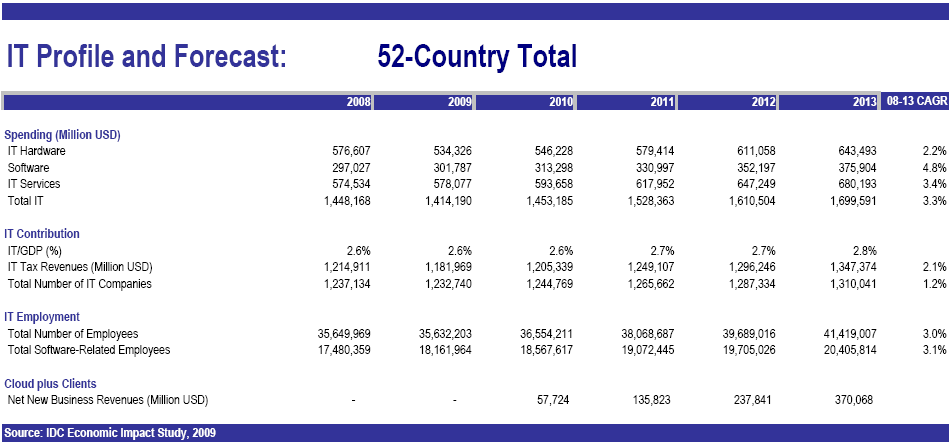
This Microsoft-funded study projects that, by 2013, cloud computing will have added $800 billion in net new business revenues for the 52 countries surveyed (over 2009 levels). The growing economic importance of the cloud is likely to increase pressure for government involvement. As President Reagan said: “Government’s view of the economy could be summed up in a few short phrases: If it moves, tax it. If it keeps moving, regulate it. And if it stops moving, subsidize it.”
 In episode #44 of “Tech Policy Weekly,” Berin Szoka and Adam Thierer engage in a debate with Internet security expert Chris Soghoian, who is a student fellow at the Berkman Center for Internet & Society at Harvard University. He is also a Ph.D. candidate at Indiana University’s School of Informatics.
Chris is an up-and-coming star in the field of cyberlaw and technology policy as he has quickly made a name for himself in debates over privacy policy, data security, and government surveillance. He straddles the line between academic and activist, and the role he often plays in many tech policy debates is somewhat akin to what Ralph Nader has done in many other fields through the years. Except, in this case, instead of “Unsafe at Any Speed” it’s more like “Unsafe at Any Setting,” since Chris is often raising a stink about what he regards as unjust or unreasonable privacy or security settings that various online websites or service providers use.
On the show, Chris talks about two of his recent crusades to get certain online providers to change their default settings to improve user security or privacy: (1) His effort this week to get major email providers—and Google in particular—to change their default security settings on their email offerings; and (2) his earlier crusade to create permanent opt-out cookies to stop behavioral advertising by advertising networks.
There are several ways to listen to today’s TLF Podcast. You can press play on the player below to listen right now, or download the MP3 file. You can also subscribe to the podcast by clicking on the button for your preferred service. (And do us a favor, Digg this podcast!)
[display_podcast]
Continue reading →
 I just finished reading through The Economist’s new 14-page special report on cloud computing, “Let It Rise” in which Ludwig Siegele provides an outstanding overview of cloud computing and why it is so important:
The rise of the cloud is more than just another platform shift that gets geeks excited. It will undoubtedly transform the information technology (IT) industry, but it will also profoundly change the way people work and companies operate. It will allow digital technology to penetrate every nook and cranny of the economy and of society, creating some tricky political problems along the way.
Even if you are very familiar with cloud computing, I recommend you take a look at the article. Anyway, while I was reading it, I was unsurprised to come across some comments from Nicholas Carr, whose new book
The Big Switch: Rewiring the World, from Edison to Google, is essentially an early history of cloud computing and an investigation into its effects on our economy, culture, and society. And that also reminded me that, even though I have mentioned Carr’s book here several times since it was released earlier this year, I have failed to give it a dedicated review. And it certain deserves one because “The Big Switch” is easily one of the most important technology policy books of 2008.
Continue reading →

 The Technology Liberation Front is the tech policy blog dedicated to keeping politicians' hands off the 'net and everything else related to technology.