I’ve written before about my dislike of “the cloud.”
The term implies that there aren’t specific actors doing specific things with data, which will tend to weaken people’s impression that they have rights and obligations when using or providing cloud services. We’re talking privacy problems.
When “cloud” services fail, the results can be widespread and significant. Think of cloud computing as a sibling of security monoculture.
TechDirt’s indefatigable Mike Masnick reminds us of this with a tweet today about hiccups in Google Calendar that may have prevented him getting on a conference call. He’s written once or twice about the cloud in terms of legal/discovery issues, privacy issues, and business/regulatory hurdles.
Remote computing is not going away, but it’s a fad that should fade over time. I think I hit the right notes in an earlier post where I said:
There will always be a place for remote storage and services—indeed, they will remain an important part of the mix—but I think that everyone should ultimately have their own storage and servers. (Hey, we did it with PCs! Why not?) Our thoroughly distributed computing, storage, and processing infrastructure should be backed up to—well, not the cloud—to specific, identifiable, legally liable and responsible service providers.
The cloud won’t grow quite the way Berin notes, at least not if I can help it.
As the ongoing T-Mobile Sidekick failure shows, if you release your data to “the cloud,” you give up control. In this case, giving up control means giving up your data. (Speculation about what happened is here.)
When you combine that with the privacy consequences of delivering your data to god-knows-where, and to service providers that have heaven-knows-what data-sharing agreements with governments and corporations, the cloud looks a lot more gray.
There will always be a place for remote storage and services—indeed, they will remain an important part of the mix—but I think that everyone should ultimately have their own storage and servers. (Hey, we did it with PCs! Why not?) Our thoroughly distributed computing, storage, and processing infrastructure should be backed up to—well, not the cloud—to specific, identifiable, legally liable and responsible service providers.
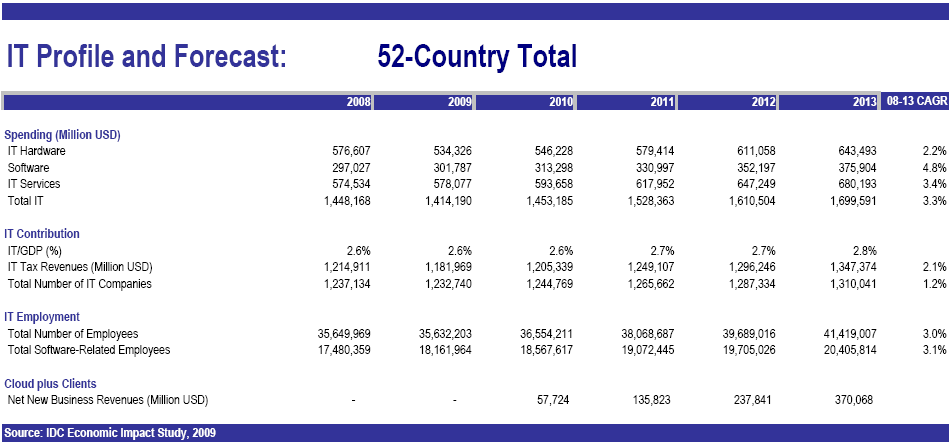
This Microsoft-funded study projects that, by 2013, cloud computing will have added $800 billion in net new business revenues for the 52 countries surveyed (over 2009 levels). The growing economic importance of the cloud is likely to increase pressure for government involvement. As President Reagan said: “Government’s view of the economy could be summed up in a few short phrases: If it moves, tax it. If it keeps moving, regulate it. And if it stops moving, subsidize it.”
 Come one, come all. ACT will be hosting a lunch event next Tuesday (June 23) at noon on privacy, free software, and government procurement.
We’ll discuss “free” software (ie. no license fees, free as in beer). It’s a nuanced take on some of what Chris Anderson will surely be talking about in his upcoming book on Free—where does the $ come from in software that we all use for free on the web, or that we download to our computer?
To answer this question, we’ll attempt to update traditional Total Cost of Ownership analysis for ad-based software and services. There’s a lot of discussion about privacy, security and sustainability considerations of cloud based solutions. In addition, the event will deal with skeptics who think that “free” means no business model at all. We’ll describe how free software and services are usually just one aspect of a larger enterprise geared toward expanding market penetration and increasing revenues. Mike Masnick described this in a recent Techdirt post.
I’m going to moderate, and our speakers will be Rob Atkinson at ITIF, Tom Schatz at CAGW, and Peter Corbett of iStrategyLabs.
We’ll be releasing a paper on all this, so come join us for lunch and a lively discussion–and best of all, it’s FREE!!
Further details are here.
Earlier this month, Google made news when it announced that its cloud computing productivity suite Google Docs had suffered a technical glitch that temporarily compromised a subset of users’ shared documents. After becoming aware of this glitch, Google notified its users via email and posted an entry to the Official Google Docs Blog that offered a more detailed explanation of what happened.
It turns out that a bug in Google’s permissions code was causing certain documents that had been shared by their author with other users but subsequently unshared to remain visible to those users. By the time Google notified its users, the bug had already been resolved, and Google estimates that only around 0.05% of all documents were vulnerable due to the glitch. As to how many documents were actually viewed by unauthorized parties, it’s unclear at this point.
All in all, the Google Docs glitch, while troubling, seems relatively minor as far as bugs go. Nevertheless, the Electronic Privacy Information Center’s Mark Rotenberg jumped on the chance to attack Google, as he often does when Google makes news for anything privacy-related. Yesterday, EPIC filed a complaint with the Federal Trade Commission that called on the FTC to investigate Google’s privacy safeguards, order Google to shut down all cloud computing services—including Gmail, which has 26 million users—pending a thorough privacy evaluation, and force Google to pay $5 million to a fund that would be setup for “privacy research.”
Watchdog activist groups like EPIC can play a useful role in the public discourse on privacy, helping to publicize unsavory behavior by companies and educating consumers about keeping data secure. Unfortunately, however, these groups’ admirable focus on protecting privacy sometimes edges on the myopic, causing them to overreact to data breaches and sometimes even call for regulatory interventions that are decidedly
anti-consumer. EPIC’s latest complaint about Google is a classic example of this.
Continue reading →
I hate the term “cloud computing” because it denies the duties and responsibilities of network operators and software and database managers.
It’s like a George Carlin bit: “I didn’t breach the data. The cloud did it! It was out in the cloud! How did the government get my private data? It got it from the cloud. The cloud gave the government the data . . . .”
 I just finished reading through The Economist’s new 14-page special report on cloud computing, “Let It Rise” in which Ludwig Siegele provides an outstanding overview of cloud computing and why it is so important:
The rise of the cloud is more than just another platform shift that gets geeks excited. It will undoubtedly transform the information technology (IT) industry, but it will also profoundly change the way people work and companies operate. It will allow digital technology to penetrate every nook and cranny of the economy and of society, creating some tricky political problems along the way.
Even if you are very familiar with cloud computing, I recommend you take a look at the article. Anyway, while I was reading it, I was unsurprised to come across some comments from Nicholas Carr, whose new book
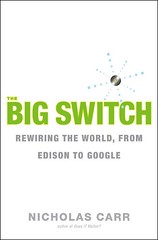
The Big Switch: Rewiring the World, from Edison to Google, is essentially an early history of cloud computing and an investigation into its effects on our economy, culture, and society. And that also reminded me that, even though I have mentioned Carr’s book here several times since it was released earlier this year, I have failed to give it a dedicated review. And it certain deserves one because “The Big Switch” is easily one of the most important technology policy books of 2008.
Continue reading →
Coincident with the news of a few days ago that Microsoft is embracing the Web even for its longtime PC-centric OS and apps, The Economist has a big special report on “cloud computing,” including articles on:
 Earlier this year, I mentioned an outstanding book that John Palfrey of the Berkman Center for Internet & Society at Harvard Law School co-edited entitled Access Denied: The Practice and Policy of Global Internet Filtering. It’s an excellent resource for anyone studying the methods governments are (unfortunately) using to stifle online expression across the globe. It’s one of the most important technology policy books of the year.
Well, it looks like John Palfrey will have a second title on this year’s “Best Tech Books” list. I’ve just finished his new book with his Berkman Center colleague Urs Gasser, Born Digital: Understanding the First Generation of Digital Natives, and it is definitely worthy of your attention. In my book review posted today on the City Journal’s website, I argue that “Palfrey and Gasser’s fine early history of this generation serves as a starting point for any conversation about how to mentor the children of the Web.” It’s a comprehensive and very even-handed discussion about a variety of concerns or Internet pathologies, including: online safety, personal privacy, copyright piracy, offensive content, classroom learning, and much more.
My
City Journal review is down below, but in coming weeks I will be posting some additional thoughts about some specific things in the book worthy of more attention (including a few things I disagreed with). Overall, I’d say Born Digital is a close runner-up in the race for “Tech Book of the Year,” closely trailing Jonathan Zittrain’s Future of the Internet and How to Stop It (which I have reviewed multiple times) and Nick Carr’s The Big Switch. But I found far more to agree with in Born Digital than I did in those two books. Highly recommended.
Continue reading →
The introduction below was originally written by Berin Szoka, but now that I (Adam Marcus) am a full-fledged TLF member, I have taken authorship.
Adam Marcus, our exceptionally tech-savvy new research assistant at PFF, has published his first piece
at the PFF blog, which I reprint here for your edification.
Today Google’s DC office hosted an interesting panel on cloud computing. What was missing was a good definition of what “cloud computing” actually is.
While Wikipedia has its own broad definition of cloud computing, many think of cloud computing more narrowly as strictly web-based for which clients need nothing but a web browser. But that definition doesn’t cover things like Skype and SETI@home. And just because PFF has implemented Outlook Web Access so we can access the Exchange server via the Web, doesn’t necessarily mean we’ve implemented what most people might think of as “cloud computing.” Yet these are all variations on a common theme, which leads me to propose my own basic definition: any client/server system that operates over the Internet.
To understand the potential policy and legal issues raised by cloud computing so-defined, one must break down the discussion into a 4-part grid. One axis is divided into private data (
e.g., email) and public data (e.g., photo sharing). The other axis is divided into data hosted on a single server or centralized server farm and data hosted on multiple computers in a dynamic peer-to-peer network (e.g., BitTorrent file sharing).
Continue reading →

 The Technology Liberation Front is the tech policy blog dedicated to keeping politicians' hands off the 'net and everything else related to technology.