Interoperability is a topic that has long been of interest to me. How networks, platforms, and devices work with each other–or sometimes fail to–is an important engineering, business, and policy issue. Back in 2012, I spilled out over 5,000 words on the topic when reviewing John Palfrey and Urs Gasser’s excellent book, Interop: The Promise and Perils of Highly Interconnected Systems.
I’ve always struggled with the interoperability issues, however, and often avoided them became of the sheer complexity of it all. Some interesting recent essays by sci-fi author and digital activist Cory Doctorow remind me that I need to get back on top of the issue. His latest essay is a call-to-arms in favor of what he calls “adversarial interoperability.” “[T]hat’s when you create a new product or service that plugs into the existing ones without the permission of the companies that make them,” he says. “Think of third-party printer ink, alternative app stores, or independent repair shops that use compatible parts from rival manufacturers to fix your car or your phone or your tractor.”
Doctorow is a vociferous defender of expanded digital access rights of many flavors and his latest essays on interoperability expand upon his previous advocacy for open access and a general freedom to tinker. He does much of this work with the Electronic Frontier Foundation (EFF), which shares his commitment to expanded digital access and interoperability rights in various contexts.
I’m in league with Doctorow and EFF on some of these things, but also find myself thinking they go much too far in other ways. At root, their work and advocacy raise a profound question: should there be any general right to exclude on digital platforms? Although he doesn’t always come right out and say it, Doctorow’s work often seems like an outright rejection of any sort of property rights in networks or platforms. Generally speaking, he does not want the law to recognize any right for tech platforms to exclude using digital fences of any sort. Continue reading →
 Hanno F. Kaiser, a U.S. and EU antitrust lawyer and partner with Latham & Watkins LLP, has just released an important essay on a topic I have devoted much time to here over the years: the debate over the relative advantages of “open” vs. “closed” technological systems and the Lessig-Zittrain-Wu school of thinking about these issues.
Kaiser’s essay is entitled, ”
Are Closed Systems an Antitrust Problem?” and it appears in the latest edition of Competition Policy International. This essay is not to be missed. Kaiser’s terrific paper helps us better understand and debunk many of the myths and misperceptions that continue to riddle this debate. Here’s Kaiser’s key insight:
At bottom, the bad reputation of closed systems or walled gardens in the “open versus closed” debate is quite undeserved. Walled gardens generally benefit their environments—both in the real world and the digital realm. The primary purpose of a garden wall, after all, is to shelter plants from wind and frost, not to keep intruders out. In the protected space of the garden, flowers can grow that would not otherwise survive in the wild. Walled gardens thus deliberately create a microcosm that is different from the surrounding ecosystem. Therefore, as long as the garden does not take over the entire ecosystem, walled gardens increase, not reduce, overall diversity. From a competition policy perspective, enjoying the fruits of a walled garden is generally not a guilty pleasure.
Therefore, “as a policy matter, ‘open’ is not necessarily better than ‘closed’,” Kaiser argues, and elaborates as follows: Continue reading →
I’ve spent a great deal of time here defending “techno-optimism” or “Internet optimism” against various attacks through the years, so I was interested to see Cory Doctorow, a novelist and Net activist, take on the issue in a new essay at Locus Online. I summarized my own views on this issue in two recent book chapters. Both chapters appear in The Next Digital Decade and are labeled “The Case for Internet Optimism.” Part 1 is sub-titled “Saving the Net From Its Detractors” and Part 2 is called “Saving the Net From Its Supporters.” More on my own thoughts in a moment. But let’s begin with Doctorow’s conception of the term.
Doctorow defines “techno-optimism” as follows:
In order to be an activist, you have to be… pessimistic enough to believe that things will get worse if left unchecked, optimistic enough to believe that if you take action, the worst can be prevented. […]
Techno-optimism is an ideology that embodies the pessimism and the optimism above: the concern that technology could be used to make the world worse, the hope that it can be steered to make the world better.
What this definition suggests is that Doctorow has a very clear vision of what constitutes “good” vs. “bad” technology or technological developments. He turns to that dichotomy next as he seeks to essentially marry “techno-optimism” to a devotion to the free/open software movement and a rejection of “proprietary technology”: Continue reading →
I’m going to close out my series of essays about Tim Wu’s new book, The Master Switch: The Rise and Fall of Information Empires, by discussing his proposed solutions. In the first five essays in the series, [1, 2, 3, 4, 5] I’ve critiqued Wu’s look at information history as well as his use of terms like “market failure,” “laissez-faire” and “open” vs. “closed.” I argued there’s a great deal of over-simplification, even outright distortion, in his use of those terms throughout the book.
Anyway, let’s run through the basics of the book once more before getting to Wu’s proposed solutions. By my reading of
The Master Switch, Wu’s argument essentially goes something like this:
- Information industries go through cycles. After a period of “openness” and competition, they tend to drift toward “closed,” corporate-controlled, anti-consumer models and outcomes.
- The resulting “monopolists” then block much innovation, competition, and free speech.
- Consequently, “the purely economic laissez-faire approach… is no longer feasible.”
- Moreover, information industries are more important than all others (“information industries… can never be properly understood as ‘normal’ industries”) and even traditional forms of regulation, including antitrust, “are clearly inadequate for the regulation of information industries.” (p. 303).
- Thus, special rules should apply to information-related sectors of our economy.
Again, I’ve challenged some of these assertions in my previous essays, specifically, Wu’s incomplete history of cycles and the fact that he greatly underplays the role of governments in “locking-in” sub-optimal market structures or, worse yet, creating those structures through misguided public policies or regulatory capture. Wu discusses some of those factors in his book, but he tends to regard them as secondary to the inquiry, whereas I believe they are crucial to understanding how most “closed” or anti-competitive scenarios develop or endure. Instead, Wu simplistically suggests that “the purely economic laissez-faire approach… is no longer feasible,” even though no such state of affairs has ever existed within communications or media industries. They have been subjected to varying levels of indirect influence or direct control almost since their inception.
Regardless, what does Tim Wu want done about the problems he has (mis-)diagnosed? Continue reading →
Tim Wu was kind enough to comment on my general overview and critique of his new book, The Master Switch:
The Rise and Fall of Information Empires. That essay will be the first of many I plan to pen about Wu’s important book. I appreciate Prof. Wu being willing to engage me in a debate over some of these issues since I’m sure he has better things to do with his time. Some of the points he raised in his comment will be addressed in subsequent posts.
In this post, I want to respond briefly to his assertion that I was “missing the point of the book” which is “to describe the world we live in.” He says that his book, “suggests that we tend to go through open and closed cycles in the Information Industries, and that, roughly, both have their strengths and weaknesses, and both become popular at different times for various reasons.” But he fears there are “greater risks in the closed periods.”
Contrary to what he suggests, I certainly understand that’s the point of his book, it’s just that I don’t fully agree with his analysis or conclusions. Let me be clear about a crucial point, however: I accept that almost every industry goes through “cycles” of some sort and that, typically, after a “Wild West” period of greater “openness” and more atomistic competition, some degree of “consolidation” or more “closed” (or proprietary) models often sets in. (A somewhat different and far more descriptive interpretation of such cycles can be found in Deborah Spar’s 2001 book, Ruling the Waves: Cycles of Discovery, Chaos, and Wealth from Compass to the Internet. She outlines a more refined 4-part cycle of: Innovation, Commercialization, Creative Anarchy, and Rules.)
My primary beef with Prof. Wu is that, contrary to his assertion yesterday in commenting on my post, his book seems to regard the progression of “the Cycle” as mostly linear and one-directional: straight down toward a perfectly closed, corporate-controlled, anti-consumer Hell. By my reading of his book – much like Lessig and Zittrain’s work – Wu is painting an overly pessimistic portrait of technologies being subjected to the “perfect control” of largely unfettered markets.
I believe history – especially recent history — teaches us something very different. Continue reading →
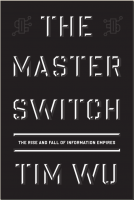 Tim Wu’s new book, The Master Switch: The Rise and Fall of Information Empires, will be released next week and it promises to make quite a splash in cyberlaw circles. It will almost certainly go down as one of the most important info-tech policy books of 2010 and will probably win the top slot in my next end-of-year list.
Of course, that doesn’t mean I agree with everything in it. In fact, I disagree vehemently with Wu’s general worldview and recommendations, and even much of his retelling of the history of information sectors and policy. Nonetheless, for reasons I will discuss in this first of many critiques, the book’s impact will be significant because Wu is a rock star in this academic arena as well as a committed activist in his role as chair of the radical regulatory activist group, Free Press. Through his work at Free Press as well as the New America Foundation, Professor Wu is attempting to craft a plan of action to reshape the Internet and cyberspace.
I stand in opposition to almost everything that Wu and those groups stand for, thus, I will be spending quite a bit of time addressing his perspectives and proposals here in coming months, just as I did when Jonathan Zittrain’s hugely important The Future of the Internet & How to Stop It was released two years ago (my first review is here and my latest critique is here). In today’s essay, I’ll provide a general overview and foreshadow my critiques to come. (Note: Tim was kind enough to have his publisher send me an advance uncorrected proof of the book a few months ago, so I’ll be using that version to construct these critiques. Please consult the final version for cited material and page numbers.) Continue reading →
So, do I need to remind everyone of my ongoing rants about Jonathan Zittrain’s misguided theory about the death of digital generativity because of the supposed rise of “sterile, tethered” devices? I hope not, because even I am getting sick of hearing myself talk about it. But here again anyway is the obligatory listing of all my tirades: 1, 2, 3, 4, 5, 6, 7, 8 + video and my 2-part debate with Lessig and him last year.
You will recall that the central villain in Zittrain’s drama
The Future of the Internet and How to Stop It is big bad Steve Jobs and his wicked little iPhone. And then, more recently, Jonathan has fretted over those supposed fiends at Facebook. Zittrain’s worries that “we can get locked into these platforms” and that “markets [will] coalesce [around] these tamer gated communities,” making it easier for both corporations and governments to control us. More generally, Zittrain just doesn’t seem to like that some people don’t always opt for the same wide open general purpose PC experience that he exalts as the ideal. As I noted in my original review of his book, Jonathan doesn’t seem to appreciate that it may be perfectly rational for some people to seek stability and security in digital devices and their networking experiences—even if they find those solutions in the form of “tethered appliances” or “sterile” networks, to use his parlance.
Every once and awhile I find a sharp piece by someone out there who is willing to admit that they see nothing wrong with such “closed”
platforms or devices, or they even argue that those approaches can be superior to the more “open” devices and platforms out there. That’s the case with this Harry McCracken rant over at Technologizer today with the entertaining title, “The Verizon Droid is a Loaf of Day-Old Bread.” McCracken goes really hard on the Droid — which hurts because I own one! — and I’m not sure I entirely agree with his complaint about it, but what’s striking is how it represents the antithesis of Zittrainianism: Continue reading →
Harvard Berkman Center professor Jonathan Zittrain has published another pessimistic, Steve-Jobs-is-Taking-Us-Straight-To-Cyber-Hell editorial building on the gloomy thesis he set forth in his 2008 book, The Future of the Internet and How to Stop It. His latest piece appears in the Financial Times and it’s entitled, “A Fight over Freedom at Apple’s Core. Concerning the recent Apple iPad announcement, Zittrain warns: “Mr Jobs ushered in the personal computer era and now he is trying to usher it out.”
I’m not going to go into yet another lengthy dissertation about what it so misguided about his thesis that cyberspace is becoming more “regulable” and that digital “generativity” is dying because of the rise of devices like the iPhone & iPad, or sites like Facebook. Instead, I will just point you to the many things I’ve written before explaining just how far off the mark Prof. Zittrain is on this point. [See the complete list down below + video of our debate.]
But let me just say this… Ignoring that fact that he is an iPhone user himself — which makes no sense considering that he thinks of Apple as the font of all cyber-evil — he can’t muster any substantive empirical evidence proving that the Net and digital devices are being more “closed, sterile, and tethered,” as he repeatedly claims in his book and editorials. And that’s not surprising because the reality is that the digital world is more open and generative than ever, and even if there are some “closed” devices and systems out there, they are actually quite innovative and not perfectly closed as Zittrain suggests. The spectrum of “open vs. closed” systems and devices is incredible diverse and nothing is
perfectly “open” or “closed.” We can have the best of both worlds: many open systems with some partial “walled gardens” here and there (or hybrid systems combining both). Regardless, we are witnessing greater digital “generativity” and innovation with each passing year. Until Zittrain can prove the opposite, his thesis must be considered a failure.
Finally, I want to associate myself with this excellent critique of the Zittrain thesis by Prof. Ed Felten, who points out that Zittrain’s argument doesn’t even work for the iPad, which I would agree is a fairly “closed appliance” in the Zittrainian scheme of the things:
Continue reading →
 Despite my frequent disagreements with his policy conclusions, Farhad Manjooo of Slate is one of the most gifted tech policy pundits around today and everything he writes is worth reading (and I whole-heartedly agreed with his recent article on the high-tech and antitrust). Alas, I find myself again disagreeing with him again today.
In his latest column, “The Great iPhone Lockdown: Should the FCC force Apple to sell Google’s apps?” Manjoo responds to a recent essay by TLF contributor Ryan Radia (“Newsflash to FCC: The iPhone is a Closed Platform, and Consumers Love It“). In that essay, Ryan generally argued that: (a) a lot of people own and love the iPhone despite some silly restrictions on certain apps; and (b) if they don’t like that, there are plenty of other options from which they can choose. Consequently, regulation seems unwarranted and likely highly misguided in light of the potential unitended consequences in might yield. It’s an argument I very much agree with, of course. Anyway, Manjoo responds:
Radia’s argument isn’t crazy. Just the other day, I argued that the government shouldn’t go after Google for antitrust violations because the tech industry is fluid; companies that are on top today can fall tomorrow. So what if Apple rejects apps capriciously? If its actions are so terrible, consumers will eventually abandon it.
But then Manjoo counters that argument and goes completely off-the-rails with several assertions that I find quite perplexing: Continue reading →
Over at the Verizon Policy Blog, Link Hoewing has a sharp piece up entitled, “Of Business Models and Innovation.” He makes a point that I have often stressed in my debates with Zittrain and Lessig, namely, that the whole “open vs. closed” debate is typically greatly overstated or misunderstood. Hoewing correctly argues that:
The point is not that open or managed models are always better or worse. The point is that there is no one “right” model for promoting innovation. There are examples of managed and open business models that have been both good for innovation and bad for it. There are also examples of managed and open models that have both succeeded and failed. The point is in a competitive market to let companies develop business models they believe will serve consumers best and see how things play out.
Exactly right. Moreover, the really important point here is that there exists a diverse spectrum of innovative digital alternatives from which to choose. Along the “open vs. closed” spectrum, the range of digital technologies and business models continues to grow and grow
in both directions. Do you want wide-open, tinker-friendly devices, sites, or software? You got it. Do you want a more closed, simple, and safe online experience? You can have that, too. And there are plenty of choices in between.
This is called progress!


 The Technology Liberation Front is the tech policy blog dedicated to keeping politicians' hands off the 'net and everything else related to technology.