I came across an article last week in the AV Club that caught my eye. The title is: “The Telecommunications Act of 1996 gave us shitty cell service, expensive cable.” The Telecom Act is the largest update to the regulatory framework set up in the 1934 Communications Act. The basic thrust of the Act was to update the telephone laws because the AT&T long-distance monopoly had been broken up for a decade. The AV Club is not a policy publication but it does feature serious reporting on media. This analysis of the Telecom Act and its effects, however, omits or obfuscates important information about dynamics in media since the 1990s.
The AV Club article offers an illustrative collection of left-of-center critiques of the Telecom Act. Similar to Glass-Steagall repeal or
Citizens United, many on the left are apparently citing the Telecom Act as a kind of shorthand for deregulatory ideology run amuck. And like Glass-Steagall repeal and Citizens United, most of the critics fundamentally misstate the effects and purposes of the law. Inexplicably, the AV Club article relies heavily on a Common Cause white paper from 2005. Now, Common Cause typically does careful work but the paper is hopelessly outdated today. Eleven years ago Netflix was a small DVD-by-mail service. There was no 4G LTE (2010). No iPhone or Google Android (2007). And no Pandora, IPTV, and a dozen other technologies and services that have revolutionized communications and media. None of the competitive churn since 2005, outlined below, is even hinted at in the AV Club piece. The actual data undermine the dire diagnoses about the state of communications and media from the various critics cited in the piece. Continue reading →
This is just a listing of the installments of my ongoing “Media Deconsolidation Series.” I needed to create a single repository of all the essays so I could point back to them in future articles and papers. For those not familiar with it, this series represents an effort to set the record straight regarding the many myths surrounding the media marketplace. These myths are usually propagated by a group of radical anti-media regulatory activists who I call the “media reformistas.” Sadly, however, many policymakers, journalists, and members of the public are buying into some of these myths, too.
In particular, I have spent much time here debunking the notion that rampant consolidation is taking place and that media operators are only growing larger and devouring more and more companies. In fact, nothing could be further from the truth. Over the past several years, traditional media operators and sectors have been coming apart at the seams in the face of unprecedented innovation and competition. The volume of divestiture activity has been quite intense, and most traditional media operators have been getting smaller, not bigger. As a result, America’s media marketplace is growing more fragmented and atomistic with each passing day.
Anyway, here’s the series so far…
Continue reading →
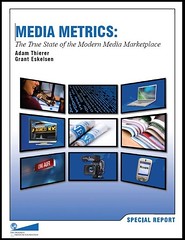 Faithful readers will recall that, several months ago, I penned a 7-part “Media Metrics” series that took a hard look at the health of the media marketplace. Today, the Progress & Freedom Foundation is releasing a greatly expanded version of these essays that I have put together with my PFF colleague Grant Eskelsen. In this 100-page special report, “Media Metrics: The True State of the Modern Media Marketplace,” we begin by noting that heated debates about the state of the media marketplace continue to rage in Washington, and opinions seem to range from grim to outright apocalyptic. As we note on pg. 1:
Many people—including a large number of legislators and regulators—argue that America’s media marketplace is in a miserable state. Some claim that citizens lack choice in media outlets and that options are just as scarce as ever. Others believe that media “localism” is dead or that many groups or niches go underserved because of a lack of true “diversity” in media. Others argue that the market is hopelessly over-concentrated in the hands of a few evil media barons who are hell-bent on force-feeding us corporate propaganda. And still others say that the quality of news and entertainment in our society has deteriorated because of a combination of all of the above. It all sounds quite troubling, but is any of it true?
After taking an objective look at the true state of America’s media marketplace, we conclude that such pessimism is unwarranted. Indeed, a careful review of the facts reveals that—contrary to what those media critics suggest—we have more media choice, more media competition, and more media diversity than ever before. Indeed, to the extent there was ever a “golden age” of media in America, we are living in it today. The media sky has never been brighter and it is getting brighter with each passing year.
Continue reading →

 The Technology Liberation Front is the tech policy blog dedicated to keeping politicians' hands off the 'net and everything else related to technology.