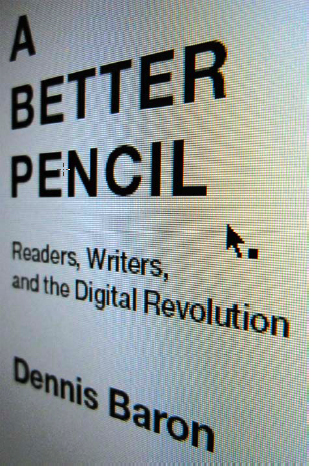
 I very much enjoyed Dennis Baron’s new book, A Better Pencil: Readers, Writers, and the Digital Revolution, and highly recommend you pick it up. Baron does a wonderful job exploring the history of techno-pessimism and the endless battles about the impact of new technologies on life and learning, something I have written about here before in my essays on “Internet optimists vs. pessimists” (See: 1, 2, 3).
I have a complete review of Baron’s
A Better Pencil now up on the City Journal‘s website here. I’ve also pasted it down below.
Plato Wrote it Down
by Adam Thierer
a review of A Better Pencil: Readers, Writers, and the Digital Revolution, by Dennis Baron (Oxford University Press, 280 pp., $24.95)
In the beginning, Dennis Baron reminds us in his new book,
A Better Pencil, there was the word—the spoken word, that is. Oral tradition, the passing of knowledge through stories and lectures, was the primary method of instruction and learning throughout early human civilization. But then a few innovative souls decided to start writing everything down on stones and clay. Almost as soon as they did, a great debate began on the impact of new communications technology on culture and education. And it rages on today, with a new generation of optimists and skeptics battling over the impact that computing, the Internet, and digital technologies have on our lives and on how we learn about the world.
Continue reading →
 Two great articles today about the dangers of government getting too involved in the newspaper business as the industry experiences serious marketplace difficulties. Slate’s Jack Shafer (“Saving Newspapers From Their Saviors“) and Mark Hopkins of Silicon Angle (“Obama Administration ‘Open’ to State Run Newspapers“) both raise concerns about President Obama’s recent comments hinting that he is open to legislation that might grant struggling news organizations tax breaks if they were to restructure as nonprofit businesses.
In a piece for the
City Journal back in March entitled “Socializing Media in Order to Save It,” I discussed the specific proposal in question, Senator Benjamin L. Cardin’s (D-MD) bill, S. 673, the “Newspaper Revitalization Act,” which would allow newspapers to become nonprofit organizations in an effort to help them stay afloat. Importantly, however, the measure would also disallow political endorsements on their editorial pages as part of the deal. In my essay, I pointed out how “If the FCC received grant-making authority to dole out subsidies to media operators… it’s hard to imagine how journalists won’t be expected to surrender something in exchange.” And that something would be their journalistic independence.
Shafer and Hopkins raise similar concerns in their essays. Continue reading →
I cannot in strong enough terms recommend that everyone read Gordon Crovitz’s latest Wall Street Journal column, “Free Speech, Now that Speech is Free.” It perfectly encapsulates everything we stand for here and makes the case that I have made again and again: Speech regulation — of all flavors — makes less and less sense in a world of information abundance and user empowerment, and it is a complete affront to our First Amendment rights. As Crovitz argues:
The Constitution was drafted at a time when there were few media outlets, and few people could be heard. Since then, technology has made it possible for everyone to express their views. The cost of expressing opinions continues to fall. Now that speech is no longer expensive, it’s time to return to the Founders’ intention that speech be free and that Congress not abridge anyone’s right to speak.
Amen brother! In his essay today, Crovitz specifically takes on America’s increasingly insane campaign finance laws, which make a mockery of the First Amendment. In the wake of last week’s Supreme Court arguments in the Citizens United case, Crovitz points out the insulting stupidity and sheer futility of these analog era, scarcity-oriented laws:
Continue reading →
I’ve got a new essay up over at the
City Journal about John Nichols and Robert McChesney’s proposal to have the government heavily subsidize failing media enterprises to “save journalism.” It follows below:
“Socializing Media in Order to Save It“
by Adam D. Thierer
City Journal March 27, 2009
With proposals to nationalize or heavily subsidize various segments of our economy more in vogue than ever, it was probably only a matter of time before someone suggested that America’s media marketplace should be brought into the government fold. John Nichols of The Nation and the prolific neo-Marxist media theorist Robert W. McChesney have now provided the road map for media’s march to serfdom. The cost to the American taxpayer would be at least $60 billion, but the cost for the First Amendment and our democracy would be incalculable.
Nichols and McChesney have coauthored several books and essays about media policy that view the world through the prism of class struggle, “manufactured consent” (á la Noam Chomsky), and the rest of the typical Marxoid tripe about history and economics. In their view, private, for-profit media cannot be trusted. As they stated in their 2003 call to arms,
Our Media, Not Theirs: The Democratic Struggle Against Corporate Media, media-reform efforts must begin with “the need to promote an understanding of the urgency to assert public control over the media.” “Our claim,” they continue, “is simply that the media system produces vastly less of quality than it would if corporate and commercial pressures were lessened.”
In a new
Nation essay, “The Death and Life of Great American Newspapers,” the authors bring their earlier work to its logical conclusion. Saving journalism, they argue, essentially requires that media become an appendage of the state. Journalism, they claim, is a “public good,” which—like education and defense—requires constant government oversight and support: “A moment has arrived at which we must recognize the need to invest tax dollars to create and maintain news gathering, reporting and writing with the purpose of informing all our citizens.” They propose that government devote $60 billion to “subscription subsidies, postal reforms, youth media and investment in public broadcasting.” Think of it as a “free press ‘infrastructure project,’” they say. “It would keep the press system alive. And it has the added benefit of providing an economic stimulus.” (Isn’t it amazing how everything stimulates the economy these days?)
Continue reading →
In a City Journal article earlier this year, I wondered “how long some local papers have left when they are barred from restructuring their businesses or partnering with other local media operators to stem the bleeding and reinvent their business models.” I was responding to the Senate’s smack-down of a half-hearted reform effort that FCC chairman Kevin Martin pushed through in November 2007, which proposed relaxing the FCC’s newspaper/broadcast cross-ownership rule. That rule, unrevised since going into effect in 1975, prohibits a newspaper operator from also owning a radio or television station in the same media market. However, waivers were granted to grandfather in some combined newspaper and broadcast operations that had existed long before the ban took effect. Martin’s proposal was to simply tweak the rule to permit similar combinations in just the nation’s 20 largest media markets.
Martin’s limited liberalization proposal, however, led to howls of disapproval from FCC democrats like Michael Copps and many folks on both side of the aisle in Congress. Supposedly, this was nothing more than a “giveaway” to the newspaper industry, which critics said was doing just fine. It really makes you wonder if any of those critics even both reading the news about newspapers today.
As I have documented here on many occasions, as well as in my big Media Metrics report, the newspaper industry is in huge trouble with every financial variable of importance rapidly heading south. Alan Mutter does a good job here of summarizing “the secular forces dragging down newspapers: Declining readership, shrinking advertising, high fixed costs and growing online competition that makes it increasingly difficult to charge the premium ad rates that were possible prior to the Internet.” As a result of these forces, everyday brings another headline like this one today in the New York Times: “The Star-Ledger of Newark Plans 40% Cut,” or this one in the Wall Street Journal: “Some Newspapers Shed Unprofitable Readers.” The numbers are just miserable, and they just get worse and worse.
Continue reading →
 Earlier this year, I mentioned an outstanding book that John Palfrey of the Berkman Center for Internet & Society at Harvard Law School co-edited entitled Access Denied: The Practice and Policy of Global Internet Filtering. It’s an excellent resource for anyone studying the methods governments are (unfortunately) using to stifle online expression across the globe. It’s one of the most important technology policy books of the year.
Well, it looks like John Palfrey will have a second title on this year’s “Best Tech Books” list. I’ve just finished his new book with his Berkman Center colleague Urs Gasser, Born Digital: Understanding the First Generation of Digital Natives, and it is definitely worthy of your attention. In my book review posted today on the City Journal’s website, I argue that “Palfrey and Gasser’s fine early history of this generation serves as a starting point for any conversation about how to mentor the children of the Web.” It’s a comprehensive and very even-handed discussion about a variety of concerns or Internet pathologies, including: online safety, personal privacy, copyright piracy, offensive content, classroom learning, and much more.
My
City Journal review is down below, but in coming weeks I will be posting some additional thoughts about some specific things in the book worthy of more attention (including a few things I disagreed with). Overall, I’d say Born Digital is a close runner-up in the race for “Tech Book of the Year,” closely trailing Jonathan Zittrain’s Future of the Internet and How to Stop It (which I have reviewed multiple times) and Nick Carr’s The Big Switch. But I found far more to agree with in Born Digital than I did in those two books. Highly recommended.
Continue reading →
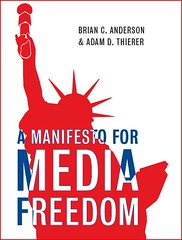 I’m pleased to announce the publication of A Manifesto for Media Freedom, which I co-authored with Brian C. Anderson of the Manhattan Institute. Brian serves as editor of Manhattan Institute’s excellent City Journal and he is the author of best-selling books like South Park Conservatives and Democratic Capitalism and Its Discontents.
In this little manifesto, we highlight one of the central ironies of the Information Age. Namely, that despite “the breathtaking abundance of new and old media outlets for obtaining news, information, and entertainment…”
many people hate this profusion, and never more than when it involves political speech. The current media market, they charge, doesn’t represent true diversity, or isn’t fair, or is subject to manipulation by a small and shrinking group of media barons. They want the government to regulate it into better shape, which just happens to be a shape that benefits them. Doing so… would be a disaster, a kind of soft or not-so-soft tyranny that would wipe out whole sectors of media, curtailing free speech and impoverishing our democracy.
In other words, instead of celebrating the unprecedented cornucopia of media choices at our collective disposal, many policymakers and media critics are calling for just as much media regulation as ever. We itemize these threats in our chapters and they include: efforts to revive the “Fairness Doctrine”, media ownership regulations, “localism” requirements, Net neutrality mandates, a la carte regulations, cable and satellite censorship, video game censorship, regulation of social networking sites, campaign finance-related speech restrictions, and so on.
In each case, we advance a pro-freedom paradigm to counter the advocates of media control. What do we mean by the “media freedom” that we advocate as the alternative to these new regulatory crusades? Here’s how we put it in the book:
Continue reading →
The Parents Television Council has a new report out this week about the supposed decline of the TV “Family Hour.” The City Journal has just posted my response to that PTC report here. It begins as follows…
Who Killed TV’s “Family Hour”?
It’s not who you think.
by Adam D. Thierer
7 September 2007
The nonprofit Parents Television Council (PTC) released a report this week lamenting the supposed death of broadcast television’s “family hour.” Though neither the Federal Communications Commission nor Congress ever mandated it, 8 to 9 PM Monday through Saturday (Eastern time), and 7 to 9 PM on Sunday, have traditionally been devoted to family-friendly programming. But the PTC’s new report claims that these blocks of time are now “no place for children,” because “corporate interests have hijacked the family hour” and “have pushed more and more adult-oriented programming to the early hours of the evening.”
One might respond to this claim by questioning the PTC’s methodology, particularly its definitions of foul language. Simon Vozick-Levinson of Entertainment Weekly’s “PopWatch Blog” takes this approach, accusing the PTC of “cooking the numbers” to suit its cultural agenda. But I don’t want to engage in methodological nit-picking, since it quickly devolves into a subjective squabble about acceptable language and appropriate programming. Instead, I want to point out the fundamental flaw in the report’s premise. The family hour may well be dead—but parents, not broadcasters, were the ones who killed it.
… read the rest at the City Journal’s website.

 The Technology Liberation Front is the tech policy blog dedicated to keeping politicians' hands off the 'net and everything else related to technology.