Posts tagged as:

[first published at The Bridge on August 9, 2018]

What happens when technological innovation outpaces the ability of laws and regulations to keep up?

This phenomenon is known as “the pacing problem,” and it has profound ramifications for the governance of emerging technologies. Indeed, the pacing problem is becoming the great equalizer in debates over technological governance because it forces governments to rethink their approach to the regulation of many sectors and technologies.

The Innovation Cornucopia

Had Rip Van Winkle woken up his famous nap today, he’d be shocked by all the changes around him. At-home genetics tests, personal drones, driverless cars, lab-grown meats, and 3D-printed prosthetic limbs are just some of the amazing innovations that would boggle his mind. New devices and services are flying at us so rapidly that we sometimes forget that most did not even exist a short time ago. Continue reading →

Advocates of regulation will credit regulators for the fact that major browser providers Microsoft and Mozilla are going after online “tracking.” In forthcoming versions of their browsers, they will provide controls that protect against unwanted monitoring even better than the controls that now exist.

When consumer advocates cluster in Washington, D.C., asking federal agencies to solve consumer issues, of course, any progress on the issues will be credited to the threat of coercion. But experiments like these have no controls.

Decisions about the qualities of goods and services are made out at the leading edge of consumer demand, where producers work to anticipate developing public interests. Meeting demand after it has been realized is a recipe for business failure because competitors getting there before the others win market share and profits. Laggards are losers.

You can tell when regulators push for something that does not match up with consumer demand as perceived in the business sector. The regulators get nowhere. That would be the FTC’s call a decade ago for a suite of regulations requiring “notice, choice, access, and security.” The current push for “tracking” controls does appear to meet up with consumer demand, and, again, the browser providers are working on it years ahead of what any regulation would have required.

I’ve put “tracking” in scare quotes because the open question is just what anyone means by the word. The report linked above notes a comment from Google, provider of the Chrome browser:

“The idea of ‘Do Not Track’ is interesting, but there doesn’t seem to be consensus on what ‘tracking’ really means, nor how new proposals could be implemented in a way that respects people’s current privacy controls,” said the company…

Maybe Google will be the laggard and loser for not moving on “tracking” as fast as its competitors. That’s one approach, while Microsoft and Mozilla will each take a different tack to the problem. The result will be an experiment that does have controls. The browser provider that meets up with consumer interests, in the consumer-friendliest way, wins. Such would not be the case if a federal regulation—yes, one-size-fits-all—determined what “tracking” was and how browsers or others would provide protection against it.

Marketplace competition will do better than any other known method for determining what “tracking” means to consumers and what to do about it. There is no privacy advocate, there is no technologist, no advocacy group, nor academic who knows what to do here.

The one thing I recommend is that do-not-track efforts should control the content of the header and the domains the browser communicates with. Simply putting a “do-not-track” signal in the header would punt the problem back to regulators and the cadre that surrounds them. This group would come up with something that satisfies itself, the regulatory community, but that does not digest and reconcile actual consumers’ competing interests in privacy, convenience, access to content, and so on.

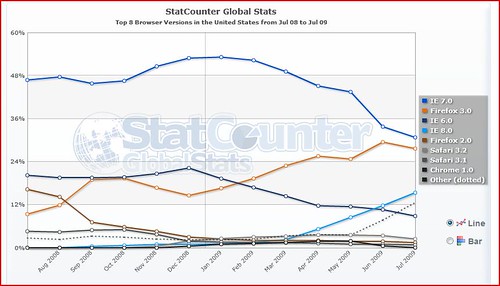
Really, what would we do without European antitrust regulators protecting us from the evils of browser innovation? If Microsoft was allowed to actually bundle its Internet Explorer browser alongside its operating system we might actually do something really crazy… like perhaps try it! After all, the latest browser stats make it pretty clear most of us have a choice and that fewer and fewer of us rely on IE. As Erick Schonfeld noted on Tech Crunch today:

The new browser wars on on. More than a decade after Microsoft killed off Netscape with Internet Explorer, competition in the browser market has never been stronger. Just last week, Mozilla released Firefox 3.5, which has now been downloaded nearly 14 million times. Earlier in June, Apple released Safari 4. In March, Microsoft introduced Internet Explorer 8, and Google came out with a speedier beta of its Chrome browser. Some early data is coming in showing relative market share and how fast people are upgrading. If you look at the chart above from Statcounter, it indicates that since March Internet Explorer has lost 11.4 percent market share to other browsers. [..] Where did that go? It went to Firefox, Safari, and Chrome. Nearly 5 percent of that, or about half, went to Firefox 3.0, which currently has 27.6 percent market share. That doesn’t count last week’s upgrade.

08-09 browser stats

Alas, as I pointed out in my essay a few weeks ago (“European Regulators Think Consumers Too Stupid to Know How to Download a Different Browser“), some Euro-crats still seem to believe that changing browsers requires great detective skills to unearth alternatives.  It’s just pure poppycock and yet another sad example of how antitrust law is usually hopelessly behind the times and has absolutely nothing to do with protecting consumers or fostering innovation.

Now, please excuse me while I get back to surfing the Net via Firefox and Chrome (and Opera on my mobile phone). My God, how did I ever find these browser alternatives!

According to Ina Fried of CNet News, Microsoft plans to remove its Internet Explorer web browser from the new versions of Windows 7 when it ships it in Europe later this year. [Additional coverage at ZDNet.]  MS is apparently doing so to assuage the concerns of EU antitrust officials, who have been obsessed with the company for the past decade. [Update: Here is MS official announcement.]

Apparently, European officials think their citizens are too stupid to find an alternative browser.  I mean, seriously, how hard is it?  Does the competition lack name recognition such that consumers can’t find them?  Hmmm… Google and Apple seem to be pretty well known brands, and their browsers (Chrome & Safari) are pretty easy to find.  And then there’s Mozilla’s Firefox browser (my PC favorite) and Opera (my mobile phone favorite), which are outstanding browsers. [Incidentally, Firefox already has 31% share of the European market.]

OK, OK, the regulators might say, but these competitors are just too expensive!  Uh, no, wait… every one of them is free. So, strike that theory.

Well, the regulators need another theory then. How about illegal tying of products and services! You know, there’s only certain sites or services you can use with IE, right?   Nope, that theory doesn’t work either.  And does anyone believe that MS could really tie OS functionality to the use of IE? How long would the world tolerate Outlook e-mails or Word documents that only allowed linking to URLs via IE??  Come on.

OK, any other theories left? Not that I can think of. Which brings us back to the only theory the Euro-crats have left: people are sheep. They’ll take whatever MS bundles into the OS free, you see, and they will use it more than they use competing products.  Thus, we regulators have to save them from their own stupidity! The masses just don’t know what’s good for them!  These free, integrated services are harming them! And, therefore, the only remaining solution is to kill innovation by crippling functionality and removing the free offering. That’s pro-consumer! … or so say the European antitrust bureaucrats.

Meanwhile, back in the real world, a whole lotta innovation continues to take place. But shhhh.. don’t tell the Euro-crats. They need a company to pick on. Welcome to the Theater of the Techno-Absurd.

Firefox logoAs noted in the first installment of our “Privacy Solution Series,” we are outlining various user-empowerment or user “self-help” tools that allow Internet users to better protect their privacy online-and especially to defeat tracking for online behavioral advertising purposes. These tools and methods form an important part of a layered approach that we believe offers an effective alternative to government-mandated regulation of online privacy.

In the last installment, we covered the privacy features embedded in Microsoft’s Internet Explorer (IE) 8. This installment explores the privacy features in the Mozilla Foundation’s Firefox 3, both the current 3.0.7 version and the second beta for the next release, 3.5 (NOTE – The name for the next version of Firefox was just changed from 3.1 to 3.5 to reflect the large number of changes, but the beta is still named 3.1 Beta 2). We’ll make it clear which features are new to 3.1/3.5 and those which are shared with 3.0.7. Future installments will cover Google’s Chrome 1.0, Apple’s Safari 4, and some of the more useful privacy plug-ins for browsers . The availability and popularity of privacy plug-ins for Firefox such as AdBlock (which we discussed here), NoScript and Tor significantly augments the privacy management capabilities of Firefox beyond the capability currently baked into the browser.  In evaluating the Web browsers, we examine:

(1) cookie management; (2) private browsing; and (3) other privacy features

Continue reading →

By Adam Thierer, Berin Szoka, & Adam Marcus

IE logoAs noted in the first installment of our “Privacy Solution Series,” we are outlining various user-empowerment or user “self-help” tools that allow Internet users to better protect their privacy online-and especially to defeat tracking for online behavioral advertising purposes.  These tools and methods form an important part of a layered approach that we believe offers an effective alternative to government-mandated regulation of online privacy.

In some of the upcoming installments we will be exploring the privacy controls embedded in the major web browsers consumers use today: Microsoft’s Internet Explorer (IE) 8, the Mozilla Foundation’s Firefox 3, Google’s Chrome 1.0, and Apple’s Safari 4. In evaluating these browsers, we will examine three types of privacy features:

(1) cookie management controls; (2) private browsing; and (3) other privacy features

We will first be focusing on the default features and functions embedded in the browsers. We plan to do subsequent installments on the various downloadable “add-ons” available for browsers, as we already did for AdBlock Plus in the second installment of this series. Continue reading →

Microsoft’s share of the browser market across all versions of Internet Explorer has dropped, by one estimate, dropped from 78.58%  in December 2007 to 68.15% in December 2008 (or by just under 8% in another estimate).

[IE’s] share dropped from 69.77% in November to 68.15% in December. [During the same period,] Firefox gained more than half a point and ended up at 21.34%, Safari approaches the [10%] hurdle with 7.93% and Chrome came in at 1.04%, the first time Google was able to cross the 1% mark.

This is particularly interesting: 

Since IE6 is used primarily within corporations, its market share is much higher during the week than it is on weekends. As a result, all other browsers gain on weekends and especially during a holiday. Because of that circumstance, Net Applications noted that the December numbers should be taken with a grain of salt. However, it is worth the note that IE6 achieved … market share numbers of about 28% during the week and about 21% on weekends in early 2008. In December, these numbers were down to about 20% during the week and 15% on weekends.    

So, Microsoft still has an established base among corporate users, where IT administrators  generally prevent employees from installing new applications (including browsers) and the sysadmins often don’t roll out alternative browsers across a corporate network for any one of several possible reasons, including:

  • They just don’t want to bother having to install, regularly upgrade and support another piece of software;
  • They may overestimate the security vulnerability of such alternative browsers compared to Internet Explorer;
  • The crustier sysadmins may not realize that today’s browsers are not only free for individual users, but also for corporate users–unlike the old Netscape Navigator; and
  • Corporate intranets may be designed for IE, in which case rolling out an alternative browser might cause confusion among less tech-savvy employees.

Microsoft may still have an advantage that could be considered “unfair,” but so what?   Continue reading →

By Berin Szoka & Adam Thierer

As we noted in our intro to this ongoing series, Google’s tenth anniversary has passed with Googlephobia reaching new heights of hysteria.

But is Google really too big and dangerous, or are people just too lazy to find other alternatives to each of the wonderful services that Google offers?  If one is truly paranoid about the firm’s supposed dominance, it doesn’t take much effort to live a Google-free life. To prove it, we set out to find alternatives to each of the services that Google provides.  After awhile, we got a little tired of compiling alternatives in each category and just provided links for the additional choices at your disposal.  It’s tough to see what the fuss is about with the cornucopia of choices at our disposal.  If you don’t like Google, then just don’t use it or any of its services.  The choice is yours.

In each case, we’ve listed Google first, even though Google may not be the market leader ( e.g., Google’s relatively unknown social network Orkut).

Search Engines

Continue reading →

Googlephobia: The Series

by on September 11, 2008 · 9 comments

By Berin Szoka & Adam Thierer as part of an ongoing series

With Google celebrating its 10th anniversary this week, many panicky pundits are using the occasion to claim that Google has become the Great “Satan” of the Internet.  Nick Carr wonders what the future holds for “The OmniGoogle.” The normally level-headed Mike Malone worries that Google is “turning into Big Brother.”  And Washington Post’s Rob Dubbin says that he can’t escape Google’s “tentacles,” even for just 24 hours.  Meanwhile, speculation abounds that the Justice Department is preparing a major antitrust lawsuit against Google concerning its advertising partnership with Yahoo! or perhaps even a broader suit concerning Google’s “dominance” of online advertising generally.

Carr quotes Google co-founder Sergey Brin’s now-famous 2003 interview:

I think people tend to exaggerate Google’s significance in both directions.  Some say Google is God.  Others say Google is Satan.  But if they think Google is too powerful, remember that with search engines, unlike other companies, all it takes is a single click to go to another search engine. People come to Google because they choose to.  We don’t trick them.

In the last five years, Google has become far more than just a search engine.  As Google’s suite of suite of complementary products continues to grow, so too does the specter of Google as an all-knowing and therefore all-powerful economic colossus.  Yet Google isn’t even close to being the sort of nefarious monopolist out to destroy user privacy at every turn, as some seem to imply—if not exclaim.  Indeed, in our view, the Net is overall a far better place because of the existence of Google and the many free services it provides consumers.

Our point is not that Google should be immune from criticism.  Indeed, healthy criticism of corporate actions plays a vital role in the free market by disciplining corporate policies and behavior—often thus providing an effective alternative to government regulation.  This is particularly important in the area of consumer privacy protection, as demonstrated by Google’s quick response to public concern about its Chrome EULA. Continue reading →